
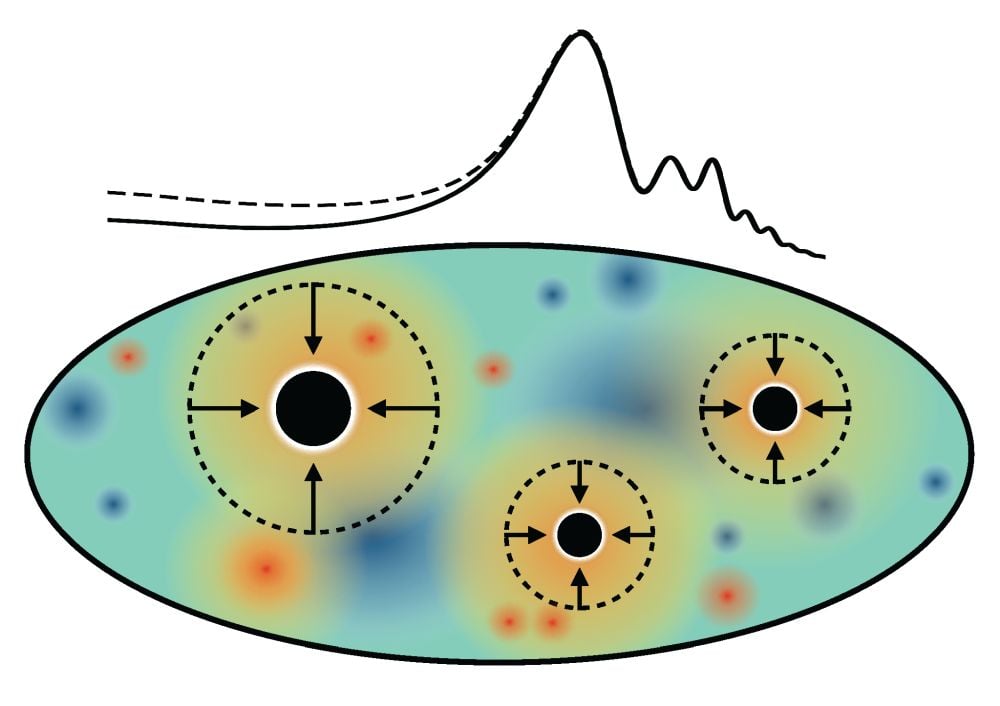
If cosmologists ever identify what dark matter actually is, it may be because of a process of elimination. There are many potential candidates for dark matter, including WIMPs and axions, which are both hypothetical particles. But one of the most intriguing candidates are primordial black holes (PBHs) that formed in the early Universe. They're hypothetical too, but are massive objects, so their presence should be detectable in a way that particles aren't. All dark matter candidates have their supporters and their dectractors, and PBHs are no different. But PBHs have fairly well-defined search strategies that should detect them if they exist. If they exist, then cosmologists should find evidence of them in the cosmic microwave background (CMB). The CMB is relic radiation from the Big Bang itself, the oldest detectable light that exists. It was released when the Universe was only about 380,000 years old. For the most part, the CMB appears smooth and uniform, or isotropic. But increasingly powerful detectors let cosmologists examine the CMB for minor fluctuations. Those could show the presence of PBHs, or at least a subset of them called stupendously large black holes, or SLABs. SLABs, if they exist, are truly stupendously massive, with masses up to 10 billion billion solar masses. Yes, that's two billions one after another. This is a temperature map of the CMB created with data from the ESA's Planck spacecraft. The CMB can only be measured from space, and Planck's job was to measure anisotropies in the CMB. The different colours show temperature differences, and those differences correspond to where the first galaxies formed. Image Credit: NOIRLab, CC BY 4.0, https://commons.wikimedia.org/w/index.php?curid=130789180 New research published in Physical Review Letters says that SLABs can't be dark matter. It's titled "Closing the Mass Window for Stupendously Large Black Holes," and the lead author is Christopher Gerlach. Gerlach is a theoretical physicist at Johannes Gutenberg University in Mainz, Germany, and its PRISMA++ Cluster of Excellence. “A possible solution to the puzzle of dark matter was that it might have collected shortly after the Big Bang in giant black holes with masses ranging from 100 million to 10 billion billion times that of the sun," said lead author Gerlatz. This work is largely based on the ESA's Planck satellite. The Planck satellite ended its mission in 2013, but researchers are still generating new insights from its data. Part of that is because of more raw computing power. But it's also because they can cross-correlate it with new data from sources that didn't exist back in 2013. Physicists also have better ways to filter out interference, like that from the Milky Way. “That we are still generating new insights into the universe’s evolution and structure 13 years after it was shut down only emphasizes how important the Planck satellite was and is to physicists," explained Gerlach. “The early universe still has many puzzles waiting to be solved.” - Nicholas Leister, Johannes Gutenberg University. SLABs, if they're real, formed from overdensities of matter after the Big Bang. They didn't need to form massive stars, burn their fuel, and explode as supernovae. They skipped that step, and are too massive for that, anyway. Since they're theorized to have formed so early, before massive objects like galaxy clusters, they should be the only things that left such an imprint on the CMB. “If these SLABs had existed in large numbers and contained significant amounts of dark matter, they would have left a characteristic imprint on the CMB through their unique perturbations, or, in a word, making it grainy," said study co-author Nicholas Leister, also a JGU physicist. This image is an artist's interpretation of what primordial black holes could look like. SLABs, Stupendously Large Black holes, a hypothetical sub-type of primordial black holes, would be far more massive than these. Image Credit: NASA Previous work has all but eliminated the possibility that regular primordial black holes could account for all dark matter. But what about SLABs? Have they survived the process of dark matter elimination, unlike their less massive cousins? To find out, the researchers first modelled SLABs and how they would affect the CMB. Then they compared the modelled effects to the actual CMB. The result was clear: the CMB doesn't have the characteristic graininess that SLABs should have imprinted on it. "In this work, we have shown that the production of stupendously large PBHs would generate large DM isocurvature perturbations, tightly constrained by CMB and BAO data," the authors explain. "We show that primordial black holes (PBHs) in the Stupendously Large Black Hole mass range (M≳1011M⊙) produce isocurvature perturbations exceeding current Planck Cosmic Microwave Background (CMB) limits, thereby excluding them as a significant dark matter component," the authors conclude. This artist's impression depicts a rapidly spinning supermassive black hole surrounded by an accretion disc. SMBH are massive and they're real. But they're still dwarfed by the hypothetical SLABs. Credit: ESO, ESA/Hubble, M. Kornmesser The results also counter some other thinking regarding PBHs and dark matter. When the JWST discovered its notorious early massive galaxies, galaxies so massive that they challenged models of galaxy formation, it set the astrophysical community in motion searching for explanations. Astrophysicists cast their net wide, and one explanation they caught concerned PBHs. One 2022 study, titled "Accelerating Early Massive Galaxy Formation with Primordial Black Holes," suggested that PBHs make up a fraction of dark matter and were behind the JWST's early, massive galaxies. But that's unlikely to be true, according to these results. "They also challenge scenarios attributing the early massive galaxy candidates observed by James Webb Space Telescope to PBH-induced fluctuations," the researchers write. SLABs were also potential explanations for another unexplained phenomenon. A gravitational wave background hum pervades the Universe, sensed by Pulsar Timing Arrays, and some researchers asked if SLABs could be responsible. "These questions are also unlikely to be answered by SLABs, since our findings show that they didn’t exist in large numbers," said Nicholas Leister. “The early universe still has many puzzles waiting to be solved.” So the search for dark matter candidates continues. It's possible that no one type of object or particle makes up dark matter. Dark matter may be a collective effect generated by different particles, objects, or phenomena. But it looks like SLABs are no longer in contention.
Astrophysicists Cross Another Dark Matter Candidate Off Their List: Stupendously Large Black Holes
Full Article
Original Source
Read the full article at Universetoday →KhanList aggregates and links to publicly available news content. We do not host full articles from third-party sources. Always verify important information with original sources.