
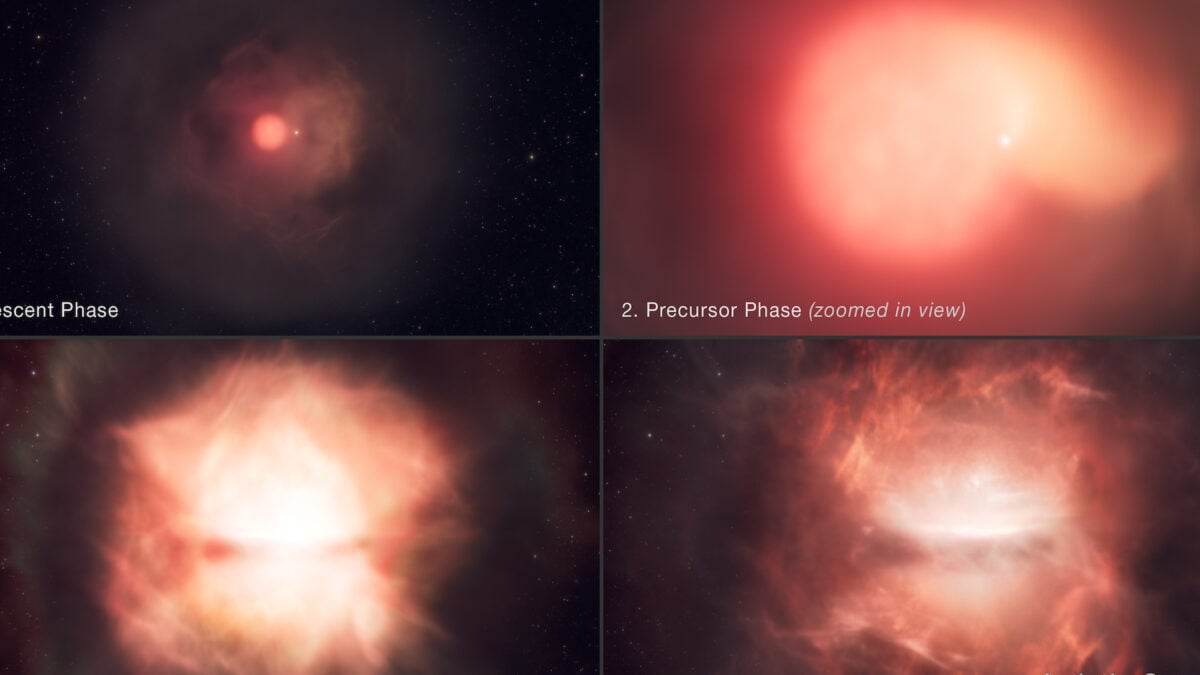
A bright flash in the nearby Andromeda galaxy turned out to be the spectacular death spiral of one star consuming another. The culprit was an enormous red giant, dubbed Big Bao, which had expanded until it swallowed a smaller companion, Small Bao. In fewer than 10 orbits, the smaller star spiraled into the giant’s core, triggering the brilliant cosmic display. In a recent study published in Nature, a team of astronomers detailed the stellar merger from start to finish, providing an unprecedented glimpse at the conditions that led to this type of cosmic event. “The excitement was real. We couldn’t quite believe our luck,” Viraj Karambelkar, a NASA Hubble Fellow at Columbia University and lead author of the study, said in a statement. “No one expected to see an explosion in their lifetime, as these stars remain relatively stable for thousands of years.” Stellar feast The stellar merger took place about 2.5 million light years away from Earth on the outskirts of the Andromeda galaxy. In 2023, the astronomers behind the study first noticed a red giant star, or a dying star with expanding outer layers, that was gradually brightening. Karambelkar and his colleagues launched an observing campaign, bringing together telescopes at Caltech’s Palomar Observatory and other facilities, to watch as the star continued to brighten over the course of two years. The star is seven times more massive and 18,000 times brighter than our solar system’s sun. It was orbited by a smaller star, whose diameter was about 70% that of our sun. As the red giant star, or Big Bao, continued to expand, its companion, Small Bao, began to spiral inward toward the core of the larger star. By October 2025, the red giant star feasted on Small Bao, triggering a massive eruption a million times brighter than our sun. “Combining our data with data from other global facilities helped us build a uniquely detailed picture of the AT2025abao system and confirm that a small star had crashed into the core of its larger companion,” Mansi Kasliwal, director of the Palomar Observatory and co-author of the study, said in a statement. Following the explosion, the team continued to observe Big Bao to see how its brightness would evolve. The follow-up data revealed that about 10% of the red giant star’s envelope, or the gas and dust surrounding it, was ejected in the eruption. “It was kind of symbolic how the year was coming to an end as we managed to bring together the puzzle pieces from the story of Big and Small Bao,” Karambelkar said. “But in my mind, this felt like a closure of just one chapter in a story that is just starting.”
Astronomers Watch a Giant Dying Star Devour Its Smaller Companion
Full Article
Original Source
Read the full article at Gizmodo →KhanList aggregates and links to publicly available news content. We do not host full articles from third-party sources. Always verify important information with original sources.