
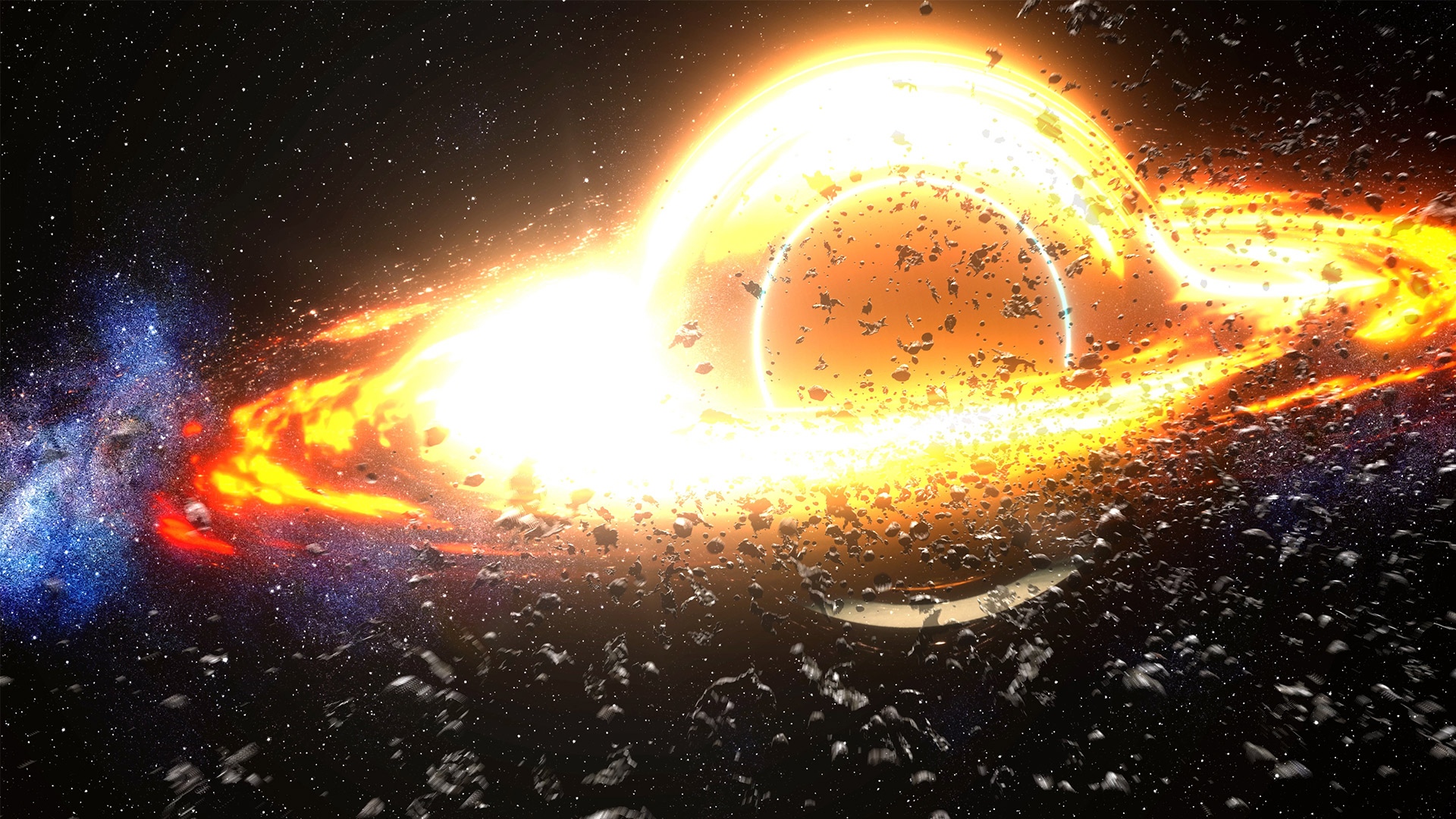
Can a dying star reveal the location of a black hole that has otherwise gone unnoticed? Turns out, it can. Astronomers have now traced a stellar destruction event to a massive black hole about 3,500 light-years from the center of its host galaxy. This discovery offers a rare look at a so-called wandering black hole and raises a further question: how did it end up so far from home? Most massive black holes are found at the centers of galaxies, where they can sometimes reveal themselves by pulling in surrounding matter. However, black holes away from galactic centers can remain nearly invisible when they are not actively feeding. The newly studied event, called TDE 2023mfm, shows how a star’s destruction can expose one of these otherwise elusive objects. “We present the discovery and analysis of the optically selected tidal disruption event (TDE) 2023mfm, which originates from a wandering massive black hole (MBH) in a massive galaxy,” the study authors note. Catching a wandering black hole The event began when a star ventured too close to a massive black hole and was pulled apart by its intense gravity. This phenomenon, known as a tidal disruption event (TDE), sends stellar debris around the black hole and can produce a bright flare that astronomers detect across different wavelengths. The Zwicky Transient Facility first spotted TDE 2023mfm on June 28, 2023. The researchers subsequently examined observations from several observatories, including the Hubble Space Telescope, Swift, Keck, Lick, Chandra, XMM-Newton, and the Very Large Array (VLA). Each instrument offered a different clue. Optical and ultraviolet observations tracked the flare’s brightness and temperature, while optical spectroscopy helped identify the type of event. The researchers found a broad hydrogen emission line, a signature consistent with a category known as TDE-H. The flare also remained blue and hot, reaching a temperature of around 22,000 Kelvin for more than a month after its peak. The light curve (the record of how an object’s brightness changes over time) showed that the event rose to its peak and then gradually faded. It remained above half its peak brightness for nearly 48 days, closely matching the duration and peak brightness of another off-center event, TDE 2024tvd. Crucially, high-resolution optical, ultraviolet, and radio observations placed the flare about 1.08 kiloparsecs, or roughly 3,500 light-years, from the galaxy’s center. The team estimated that the black hole responsible has a mass of roughly one million to 10 million times that of the Sun, although the precise value depends on the method used. The researchers found no X-ray emission clearly attributable to the disruption. Although a faint X-ray source was present, it most likely came from the galaxy’s nucleus. That absence did not rule out a TDE: some such events remain X-ray faint even years after a star is destroyed, as seen in other unusual black hole feeding events. A delayed radio signal deepens the mystery The black hole’s location is clear, but its history is not. One possibility is that it arrived with a smaller galaxy that merged with its host. The researchers identified a faint stellar population at the same location, with an estimated mass of around 10 million to 100 million Suns. If this population is the remnant of a smaller galaxy, much of that galaxy’s original stellar material may have been stripped away. Other proposed explanations involve black holes being flung away from galactic centers by gravitational interactions or gravitational-wave recoil following a merger. However, the host galaxy still contains a black hole at its own center, identified through a faint active galactic nucleus. This makes a minor merger a plausible explanation, but the observations do not establish how the wandering black hole arrived there. “The radio emission, on the other hand, tells a different story,” the researchers said. Unlike some comparable TDEs, this event produced no detected radio emission early on. A faint signal emerged only about 991 days after the optical discovery, roughly 2.7 years later, and evolved slowly. This late signal may come from an outflow of material launched by the disruption, but the observations cannot yet establish its origin. Differences in the surrounding gas or the angle from which the event is viewed could also explain the unusual behavior. The findings show how combining observations across the electromagnetic spectrum can uncover black holes that ordinary searches might miss. The team says further high-resolution radio observations, particularly with very long baseline interferometry, could help determine the source’s size and clarify the nature of the outflow. Moreover, finding additional off-center black holes could help astronomers understand how galaxies merge and how their central black holes evolve. The study is published on the arXiv. Get the latest in engineering, tech, space & science - delivered daily to your inbox.Rupendra Brahambhatt is an experienced writer, researcher, journalist, and filmmaker. With a B.Sc (Hons.) in Science and PGJMC in Mass Communications, he has been actively working with some of the most innovative brands, news agencies, digital magazines, documentary filmmakers, and nonprofits from different parts of the globe. As an author, he works with a vision to bring forward the right information and encourage a constructive mindset among the masses.
Astronomers spot a black hole tearing apart a star 3,500 light-years off-center
Full Article
Original Source
Read the full article at Interestingengineering →KhanList aggregates and links to publicly available news content. We do not host full articles from third-party sources. Always verify important information with original sources.