
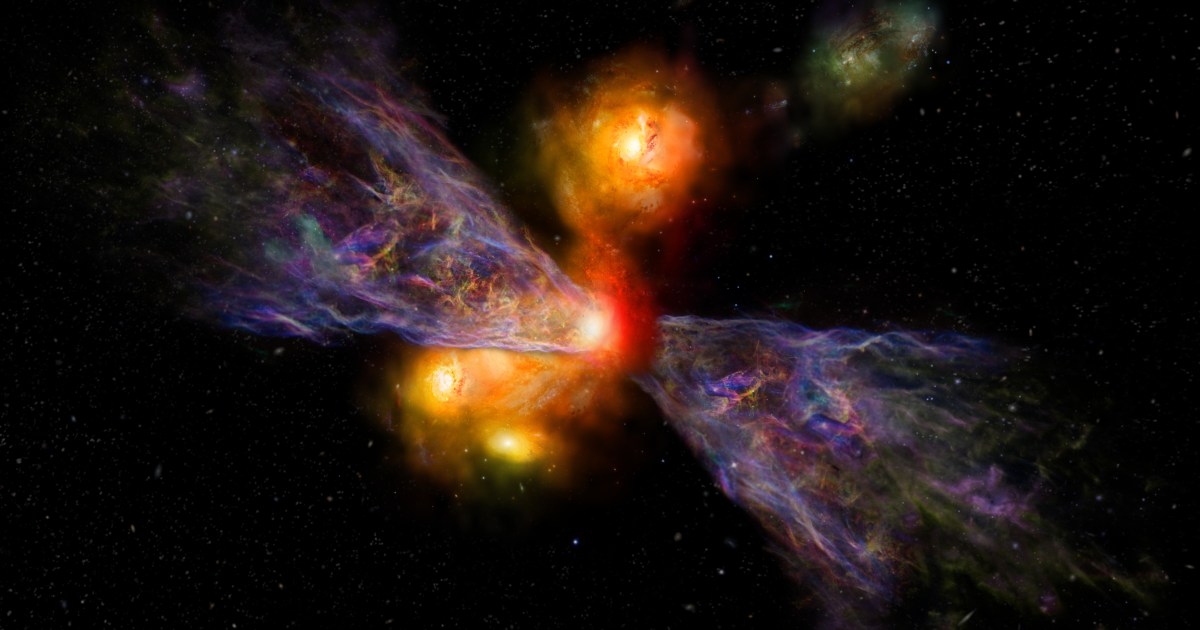
The young galaxy CRISTAL-2 glows brightly with intense star formation at center in this artist’s impression. Currently undergoing a merger, CRISTAL-2 is also ejecting an intense plume of cold gas, almost as large as the galaxy itself, likely driven out by winds from exploding supernovae. Credit: Joshua Worth/CC BY 4.0 In the local universe, it is common to find galaxies that have stopped forming new stars. These so-called quiescent galaxies have lived for billions of years and over that time, gradually exhausted their star-forming gas. By contrast, galaxies that lie at much greater distances — and thus appear to us when they were young, in the early universe — should have plenty of gas and be readily forming stars. But ever since it first began surveying the cosmos, the James Webb Space Telescope (JWST) has discovered more quiescent galaxies within the cosmos’ first 2 billion years than current models of galaxy formation and evolution predict. Astronomers don’t know why they have stopped forming stars so soon, but they have many theories. Some of them require dark energy to have had a stronger influence in the early universe than previously thought, and thus have profound impacts on our understanding of the universe and its evolution. Now, a team has found evidence that when galaxies collide — as they frequently did in the early universe — it can trigger a burst of star formation so intense that it generates winds capable of snuffing out the opportunity for any further stars to be born. This could explain the high number of young but unexpectedly quiescent galaxies JWST has found without needing drastic changes to our understanding of dark energy and its influence over time. Blowing in the wind In order to form stars, galaxies need reservoirs of gas that are dense and cold, lacking energy and prone to collapsing inward. One way to end a galaxy’s era of star formation — a process that astronomers call quenching — is to trigger strong winds that blast outward from the galaxy. These vast, high-speed flows of charged particles can blow away or heat this cold gas. Such galactic winds can have two possible sources of energy. One is an actively accreting central supermassive black hole (called an active galactic nucleus, or AGN). The other is the energetic blasts generated by massive stars that form and then quickly die, ending their lives by exploding as supernovae. But astronomers have never caught such a wind in the act of draining its host of gas in the early universe, as it is difficult to get a detailed look inside a galaxy so far away. To better discern the inner workings of star-forming galaxies in the early universe, researchers carried out a joint survey combining observations taken with the Atacama Large Millimeter/submillimeter Array (ALMA) — a powerful radio observatory in Chile — and infrared data from JWST. They also turned to archival data from the Hubble Space Telescope. A team led by astrophysicist Rebecca Davies of Swinburne University of Technology in Australia spotted one particular galaxy, called CRISTAL-02, that shows what appears to be the first direct evidence of a wind powerful enough to halt star formation in a massive galaxy just 1.1 billion years after the Big Bang. The discovery was published June 10 in Monthly Notices of the Royal Astronomical Society. CRISTAL-02 is part of a larger sample of around two dozen star-forming galaxies at a similar distance (and therefore of a similar age). Observations showed a huge plume of cold gas extending outside the galaxy, almost as large as the galaxy it comes from. The plume is moving toward Earth at some 60 miles (100 kilometers) per second. Finding fast-moving gas so far from the galaxy is a sign the gas is being actively pushed out in a wind-driven process. But to truly determine the nature of the plume, the team first had to rule out another possibility behind its formation: Because CRISTAL-02 also appears to be in the throes of merging with several other galaxies, the plume could be a tidal tail — gas stripped away by gravitational forces during the interaction, rather than a genuine wind. This was tricky to determine, Davies says, as no single measurement could settle the question of the gas’ origin; instead the team had to combine several different measurements to characterize the plume and confirm its cause. First, Davies’ team measured how many new stars the galaxy produces each year. Massive stars live much shorter lives than less massive ones, so looking at how many young, massive stars are in a galaxy indicates how quickly it is forming new stars to replace the ones that are dying. So, the team searched for signs of these young, massive stars in the galaxy’s spectrum and measured how bright those features appear. The researchers also needed to determine how much gas the galaxy is losing. They did so by first using ALMA data to calculate the mass in the plume and then combining it with the gas’ velocity and distance from the galaxy’s center. The verdict: CRISTAL-02 is forming stars at roughly three times the rate of a typical galaxy its size at this distance, but is losing twice as much gas as the galaxy’s star-formation rate. “If this rapid blowout continues, the galaxy could be dead in less than 50 million years, explaining the origin of the mysterious massive dead galaxies in the early universe,” Davies said in a press release. In the stars Finally, the team turned to identifying the cause of the plume. Was the gas being pushed out by energy coming from the galaxy’s central black hole, or was the galaxy’s burst of intense star formation — and the resulting supernova blasts — the culprit? Models predict that the most powerful outflows from massive galaxies like these should be the result of accretion onto supermassive black holes, Davies says. But CRISTAL-02 shows no sign of AGN activity in its center. On the other hand, based on the amount of massive young stars in the galaxy, Davies’ team calculated that the energy transferred to the surrounding gas as these stars die and explode as supernovae would be powerful enough to produce the observed plume. The speed of the gas backs this idea up. Supernova-driven outflows rarely exceed speeds of about 1,550 miles (2,500 km) per second, says Christy Tremonti, an astronomer at the University of Wisconsin–Madison who was not involved in the study. Velocities higher than this usually point to an AGN as the energy source. CRISTAL-02’s outflow is moving around 400 miles (640 km) per second, comfortably within the range expected for a wind produced by a powerful starburst. Davies says that “the result is surprising,” going against the conventional wisdom that AGN are the cause of star-formation-ending winds. Tremonti notes that “theoretical models love to use AGN feedback to shut off star formation in massive galaxies — almost every simulation does.” Yet CRISTAL-02’s star formation alone appears capable of triggering a wind that could exhaust its gas supply within tens of millions of years. The bigger picture CRISTAL-02’s story may not be an isolated case, Davies says. Studies suggest that around 40% of massive star-forming galaxies in the early universe are merging, meaning many of them may be caught in similar growth spurts. If this commonly results in subsequent supernova-driven winds, it could help explain why so many early galaxies burned brightly and died young. “It may be the case that AGN are really important for keeping star formation off, but maybe they’re not the thing that shuts it down initially,” Tremonti says. The case isn’t entirely closed. Davies says her team cannot completely rule out the presence of an active supermassive black hole — either one too faint to detect, or one that may have flared briefly in the past and pushed gas away from the galaxy before subsequently fading from view. Tremonti agrees this is one of the hardest scenarios to eliminate. Future observations in the mid-infrared, which can peer through dust that might otherwise hide a buried black hole, could help close this gap. As for CRISTAL-02, its fate is somewhat ironic: The explosive burst of star formation it is undergoing is also the underlying cause of its imminent death. Shreejaya Karantha is a science writer based in India. Her work has appeared in Sky & Telescope, Phys.org, Live Science US, and The Hindu.
Astronomers catch ‘galaxy-killing’ wind in the act
Full Article
Original Source
Read the full article at Astronomy →KhanList aggregates and links to publicly available news content. We do not host full articles from third-party sources. Always verify important information with original sources.