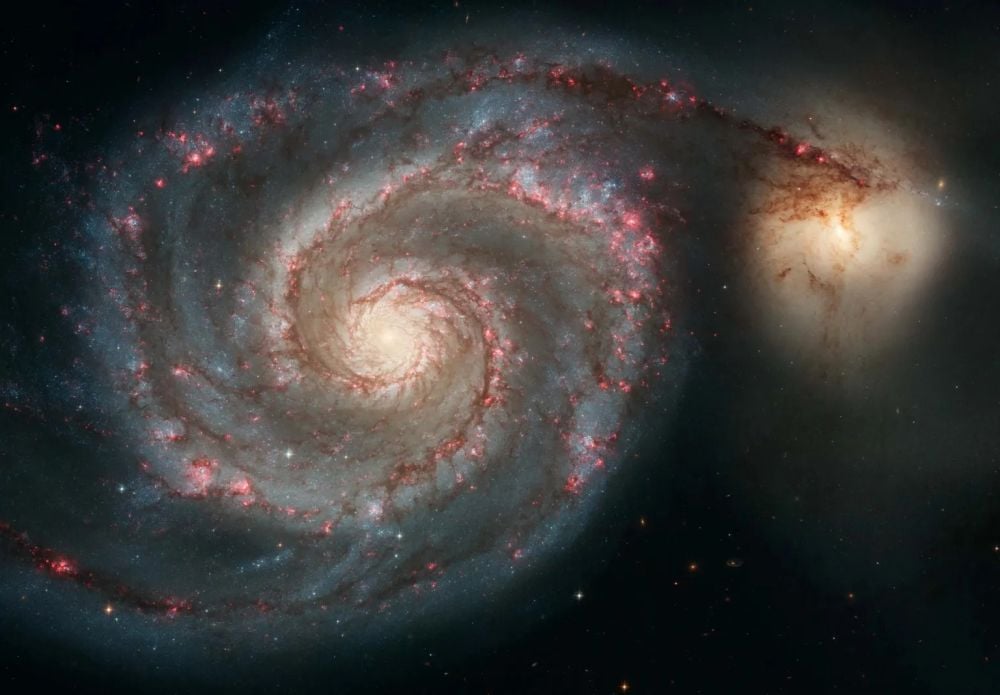
The Whirlpool Galaxy (M51) is a classic grand spiral galaxy. It was the first object identified as a spiral, way back in 1845. At the time, it and other galaxies were considered to be spiral nebulae, since astronomers didn't know other galaxies existed. Edwin Hubble finally proved that there were other galaxies in the early 1920s. Now we know of several hundred thousand spiral galaxies, though there's no exact number. Spiral galaxies are one of those immediately recognizable natural objects. They look simple, as if they should be easy to explain. But they're not. They look like the stars and gas in the spiral arms are rotating around the galactic center, but that explanation doesn't work. The inner regions of a galaxy's disk rotate faster than the outer spiral arms, so in a few rotations over a few hundred million years, the spiral arms should wind up tighter and tighter until the spiral is gone. Since that doesn't happen, there must be another explanation. That led to the density wave theory. In this thinking, the spiral arms are a wave pattern like a traffic jam. The jam persists, but the cars that comprise it keep changing. Density wave theory explains some of what's observed in spiral galaxies, but not everything. It can't explain why the arms last so long. They should be damped down by physical forces. So astronomers have been trying to understand spiral galaxies and their arms. Along with how they form and maintain themselves, researchers ask a related question: why do some spiral galaxies have two arms and some have more? An answer to that question can help answer the larger question. New research in The Astrophysical Journal digs into the question of spiral arms. It's titled "Galaxy Spiral Arm Count versus Concentration and Mass: A First Look with Euclid," and as the title makes clear, it's largely based on new observations with the ESA's Euclid space telescope. The lead author is Beverly Smith, professor in the Department of Physics and Astronomy at East Tennessee State University. “Spiral galaxies are among the most recognizable objects in the universe, yet we've never fully understood why they develop different numbers of spiral arms," lead author Smith said in a press release. “By studying thousands of galaxies, we're beginning to identify patterns that reveal how these systems formed and evolved over billions of years.” The ESA launched the Euclid Space Telescope two years ago to study the expansion of the Universe. It measures the redshift of galaxies out to z=2, which is about 10 billion years ago. The idea is that measuring their redshifts and their shapes will help define the link between dark energy and the expansion rate of the Universe. But those same observations also allowed Euclid to distinguish the spiral arms in galaxies billions of light years away. Astronomers could see how spiral galaxies looked billions of years ago. "Spiral galaxies can be divided into classes based on the number of arms and the structure of the arms," the researchers write. "Grand design spiral galaxies have two long continuous arms, multiarmed galaxies have three or more relatively long arms, and flocculent galaxies have many short arm fragments." *The Universe is a sea of galaxies separated by vast distances, as this zoom-in of the Vera Rubin Observatory's Cosmic Treasure Chest shows. Researchers want to know how spiral galaxies form and maintain their arms, but it's not easy to discern which ones are spirals and how many arms they have. Image Credit: NSF–DOE Vera C. Rubin Observatory* In this work, the researchers examined and compared two-armed and three-armed spirals. "Using catalogued information from Euclid Quick Data Release 1, we compare two-armed and three-armed spiral galaxies as classified by the Euclid Zoobot software," the authors write. The Euclid data also contains data on stellar masses, concentrations, and star formation rates (SFRs). The researchers identified more than 380,000 galaxies in the data, and after filtering out some that have an indistinguishable number of arms, they reached some conclusions. "About 60%−70% of Euclid spirals are two-armed and about 15%–20% are three-armed. One-armed galaxies are rare, with low masses compared to two-armed spirals," the authors write. "Only about 1% of the spirals in our sample are classified as one armed," they add. The rest, about 20%, are excluded because their number of arms isn't clear. They also found that spiral galaxies with large central bulges, including the Milky Way, usually have two dominant spiral arms. "Galaxies with large bulges tend to have declining rotation curves, which in turn produces a large shear rate, which favors two-armed morphologies," the authors explain. But galaxies with less massive centers typically have numerous arms. Interestingly, these results agree with computer simulations. "These results are consistent with theoretical models and simulations, which show that two-armed galaxies are favored when the bulge is prominent," the authors write. The results also show that two-armed spirals have lower average SFRs, driven by their overall lower masses, while three-armed spirals have higher SFRs. *This image shows a small portion of Euclid's Deep Field South. Galaxies of different shapes and colours fill the frame, with many of the shapes being too difficult to clearly discern, and the number of arms difficult to count. Image Credit: ESA/Euclid/Euclid Consortium/NASA, image processing by J.-C. Cuillandre, E. Bertin, G. Anselmi. Licence: CC BY-SA 3.0 IGO or ESA Standard Licence* This research extends our understanding of spiral galaxies and gives some insight into how they form. But there are caveats. "Few galaxies are truly completely two armed or completely three armed (or completely four armed), but instead there is a continuum of morphologies, with branches and spurs being common," the authors write, adding that "... spiral arm structure is more complicated than the three simple categories of grand design, multiarmed, and flocculent." Other researchers developed a more detailed galaxy identification system that includes 12 categories. "The additional information these 12 categories provide may be helpful in exploring questions about the origin and evolution of spiral patterns in galaxies," the researchers explain. But that would be very difficult to implement in a large survey like Euclid's. A galaxy's spiral arms are shaped by how matter is concentrated, and that includes dark matter. Counting spiral arms in galaxies could help estimate how much dark matter is present in their centers, according to the researchers. “The number of spiral arms turns out to be more than just an interesting feature – it reflects what's happening deep within the galaxy itself,” Smith said. “That's exciting because it gives us another tool for understanding parts of the universe we can't observe directly, like dark matter.” This research alone can't answer the question of how spiral arms form and maintain themselves over long time periods. But it contains some hints. Two-armed (grand-design-like) spirals dominate in the mass range and redshift range in this work. That supports the idea that massive and settled disks are more likely to maintain a stable two-armed pattern. The three-armed galaxies, much fewer in number, are more consistent with the idea that spiral arms are transient or recurrent. It's possible that there are two sub-types of two-armed spirals. Maybe some are transient, while others are long-lived, according to the authors. "Employing a more detailed morphological classification scheme for spiral patterns in galaxies may lead to a better understanding of the various processes involved in creating and maintaining spiral patterns in galaxies," the researchers write. "A deeper look at subtle variations in the spiral structures and the physical properties of galaxies selected by different methods may lead to useful insights."
Astronomers Are Still Trying to Understand How a Galaxy's Spiral Arms Form
Full Article
Original Source
Read the full article at Universetoday →KhanList aggregates and links to publicly available news content. We do not host full articles from third-party sources. Always verify important information with original sources.