
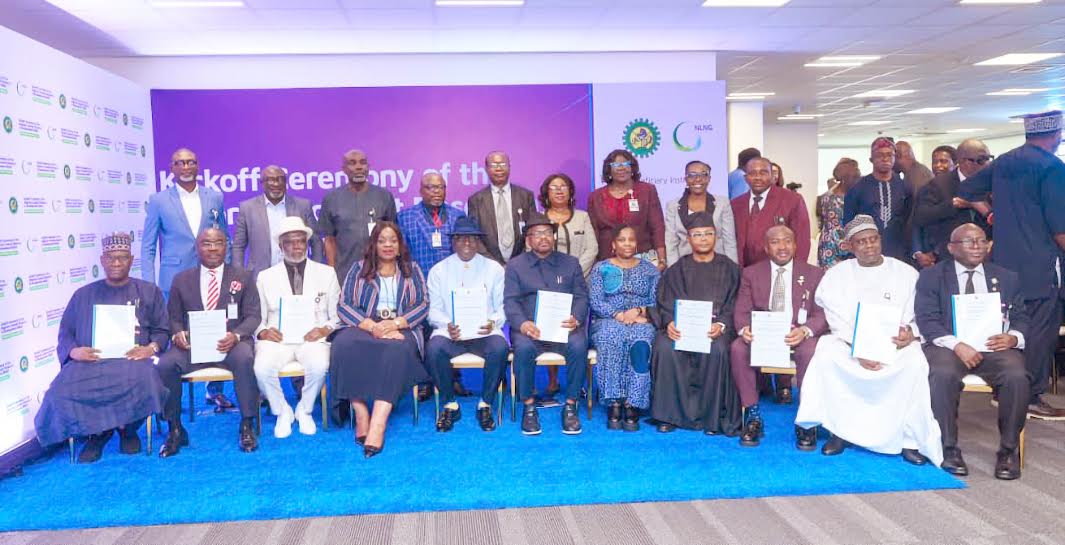
Follow THISDAYLIVE on GoogleAdd us as a preferred source to see more of our stories in Google Follow us on Google In a strategic move to reposition Nigeria’s universities as centres of technological innovation, industrial research and homegrown solutions, the Nigeria Liquefied Natural Gas Limited in partnership with the Nigerian Content Development and Monitoring Board, has committed $9 million to establish and endow research professorial chairs in six universities across the country’s six geopolitical zones, writes Blessing Ibunge Technology is the driving force behind the development of countries across the world. A country that adopts the right technology will definitely witness rapid growth and development. And universities play a major role in the research and development in the technologies to be adopted. That is why the decision of the Nigerian Content Development and Monitoring Board (NCDMB) and Nigeria LNG Limited (NLNG) to commit $9 million to six Nigerian universities to accelerate indigenous research, develop home-grown technologies and bridge the longstanding gap between academic discoveries and industrial applications in the country’s oil and gas sector, has been hailed by stakeholders. The initiative was unveiled last week at the kick-off ceremony of the Nigerian Content Research and Development (NC-R&D) Professorial Chairs Endowment Programme in Port Harcourt, Rivers State. It represents a significant investment in strengthening the country’s research ecosystem, developing indigenous technological capabilities and addressing longstanding challenges in the oil, gas and energy industries. With $1.5 million to six universities, the initiative seeks to bridge the gap between academia and industry, strengthen local research capacity and develop Nigerian solutions to critical energy-sector challenges. Under the programme, each of the six beneficiary universities will receive an endowment of $1.5 million to establish dedicated professorial chairs focusing on specialised, industry-related research, with the ultimate objective of producing commercially viable innovations and practical solutions to national industrial challenges. The ceremony brought together the Vice-Chancellors and representatives of the beneficiary institutions, the Executive Secretary of NCDMB, Felix Ogbe, the Managing Director and Chief Executive Officer of NLNG, Adeleye Falade, the company’s General Manager, External Relations and Sustainable Development, Sophia Horsfall, and other senior government and industry officials. A major highlight was the signing of the programme’s coordination and implementation documents by the leadership of NLNG, NCDMB and the participating institutions, formally setting the framework for the initiative’s implementation and governance. Beyond the financial commitment, the programme seeks to institutionalise a stronger relationship between government, industry and academia, ensuring that research conducted in Nigerian universities responds directly to the technological, operational and environmental needs of the country’s industries. Research as Solutions to Real Industrial Problems According to the MD of NLNG, Falade, the initiative represents an opportunity to establish a functional partnership between industry, academia and government, where research is not merely an academic exercise but a practical instrument for solving problems. He explained that the programme was designed to ensure that research receives structured funding, operates under a prescribed governance framework and produces outcomes that can be deployed commercially. “The end product for us is an opportunity to bring together industry, which is ourselves, academia and also government, represented by NCDMB, where we’re able to provide the funding under a very prescribed framework by which research takes place, gets funded, and we have products from the academia that are industry-ready,” Falade said. He explained that each university would receive $1.5 million with governance and periodic reviews established to ensure that the programme achieves its objectives. He stressed that the initiative was particularly important because sustainable industrial development and technological breakthroughs depend on consistent investment in research and development. “Everything rides on research and development. If you see any institution or organisation today that is making breakthrough achievements, it is because they are investing heavily in research,” he stated. Falade cited the example of a female innovator recently recognised for developing a technology that reportedly reduced a scanning process from 20 minutes to approximately two minutes, illustrating the transformative potential of sustained research investment. He added that NLNG’s broader approach to sustainable development was anchored on interventions that deliver lasting value to Nigeria and its citizens.He expressed optimism that the professorial chairs would produce researchers capable of addressing present and emerging industrial challenges while strengthening the research capacity of Nigerian universities. Providing further insight into the rationale behind the initiative, NLNG’s General Manager, External Relations and Sustainable Development, Sophia Horsfall, described the programme as a major intervention to strengthen Nigeria’s university research system and create opportunities for young researchers to contribute meaningfully to national development. She said the investment was not simply about providing financial resources to universities but about creating an ecosystem that encourages collaboration, knowledge exchange and sustainable funding for research. “We see this as an opportunity to reinforce our commitment to sustainable development by committing these sums of $1.5 million to the respective beneficiary institutions. We are enabling an improvement, really a renaissance of research capacity in the universities in Nigeria, particularly the selected ones,” Horsfall said. She explained that the initiative was designed to encourage partnerships capable of attracting additional research funding beyond the initial endowment. According to her, sustainable development and a thriving economy can only be achieved when research, innovation and the development of indigenous technological talent receive the attention they deserve. “We believe that sustainable development and an economy that thrives can only do so where research is happening, where there’s innovation, and where there’s a commitment to developing Nigerian talent and technological innovations,” she added. Horsfall noted that the initiative followed NCDMB’s triple-helix approach, which promotes collaboration among government, industry and academia to produce industry-ready graduates and research outcomes with practical economic value. She explained that the six universities were deliberately selected to ensure geographical inclusiveness, with each institution contributing its academic strengths and research experience to the programme. She also challenged the beneficiary universities to use the opportunity to expand their research activities, attract additional grants and funding, commercialise intellectual property and develop sustainable partnerships with industry. Nigeria Must Move from Participation to Tech Competence For the NCDMB, the initiative represents an important transition in the country’s local content development journey, particularly as Nigeria seeks to move beyond the participation of indigenous companies and professionals towards building globally competitive technological capabilities.Austin Uzoka, who is the Senior Technical Adviser to the Executive Secretary of NCDMB, Felix Ogbe, said the programme was designed to strengthen the relationship between government, industry and academia while developing homegrown technologies to support the growth of Nigerian industries.He identified three major expected outcomes: developing indigenous technologies, building local expertise to address operational challenges in the oil and gas industry, and positioning Nigeria for future industrial competitiveness. According to him, the programme would reduce dependence on foreign technical expertise by strengthening the capacity of Nigerians to develop solutions to problems encountered in the country’s oil fields. He explained that Nigeria had made considerable progress in the participation aspect of local content development but must now concentrate on building the capabilities required to sustain industrial growth. “The first level of local content has to do with participation of Nigerians. We have achieved that. The next level is about building capability and building capacity. That’s what we need to focus our energy on,” Uzoka said.He maintained that the development of a competitive Nigerian supply chain would remain difficult without deliberate investment in technological competence and indigenous capacity. “The ultimate is to build a competitive supply chain. But if you don’t build number two, which is capacity, it becomes difficult to build number three,” he added.Uzoka stressed that although research and development required substantial investment, delaying such investment would undermine Nigeria’s ability to compete in the future energy and industrial landscape. Universities Outline Research Priorities, Practical Solutions For the beneficiary universities, the endowment presents an opportunity to translate academic knowledge into practical solutions to Nigeria’s energy, environmental and infrastructure challenges.The institutions are expected to concentrate on distinct research areas that align with their academic strengths while addressing identified industrial and national development priorities. At the University of Abuja, now Yakubu Gowon University, Vice-Chancellor, Prof. Hakeem Babatunde Fawahinmi, said the institution would focus on geosciences using satellite-based spatial technology. He explained that the research would help strengthen the protection, monitoring and security of critical national infrastructure, particularly gas pipelines, at a time when Nigeria is increasingly positioning natural gas as a major component of its energy transition. “Our research is going to focus on geosciences using spatial technology through satellites. We believe that this is one way to protect the critical infrastructure of the country, which, of course, includes the pipelines for gas,” he saidFawahinmi explained that satellite-based monitoring could provide a more effective approach to monitoring pipeline safety, security and integrity across the country’s extensive gas infrastructure network. At the University of Ibadan, the research focus will centre on environmental pollution management, ecosystem protection and the development of environmentally sustainable approaches to natural resource exploitation.Representing the Vice-Chancellor, Prof Peter Olamakinde Olapegba, the Deputy Vice-Chancellor (Academic), Prof. Juwon Tunde Arotiba, said the institution would draw on its existing research strengths in petroleum engineering, environmental health and computing science to address industrial pollution. He said the university hoped to develop solutions to gas and air pollution while ensuring that the exploitation of Nigeria’s natural resources benefits host communities and the wider environment. “We hope to be able to solve the industrial problem of gas pollution, air pollution and produce resources in an environmentally friendly way so that it will be beneficial to our community,” Arotiba stated. Similarly, the University of Nigeria, Nsukka, will focus on green energy production and geo-environmental engineering. Representing the Vice-Chancellor, Prof. Simon Ortunaya, Prof. Michael Onyia described the endowment as a major boost to the institution’s research capacity, particularly in the development of clean and renewable energy technologies. “My university has been given the area of green energy production and geo-environmental engineering. This has to do with clean energy. We will be researching on clean energy,” he said. Onyia explained that the research would also address environmental protection and the development of energy solutions that minimise environmental damage. For Modibbo Adama University, Yola, Adamawa State, the research priority will be biofuels and alternative energy sources. The Vice-Chancellor, Prof. Ibrahim Umar, said the institution would explore opportunities presented by the region’s abundant sunshine, wind resources and agricultural waste to develop alternative energy technologies. He explained that the university would investigate how organic waste could be converted into useful energy resources and explore the potential of biofuels in the development of energy storage technologies. “We want to produce alternative energy using solar and wind energy. We also want to use biofuels to see how we can produce cells and lithium-cell batteries because we have a lot of waste all over the place. We want to convert that into energy,” Umar said. Other beneficiaries are Rivers State University and Aliko Dangote University of Science and Technology. Rivers State University is expected to play a coordinating role through the NLNG Research and Innovation Centre for Computer and Electrical Engineering (RICCEE). while Aliko Dangote University of Science and Technology will focus on sustainable energy innovation and climate-resilient food systems. The Challenge of Sustainability and Commercialisation While the $9 million commitment represents a significant intervention in university-based research, stakeholders at the ceremony emphasised that the programme’s ultimate success would be measured not by the amount invested but by the quality, relevance and commercial application of the research outcomes. For NLNG, the initiative is part of its medium-term Nigerian Content Research and Development programme and aligns with the provisions of the Nigerian Oil and Gas Industry Content Development Act 2010. It also builds on the company’s broader interventions in education, human capacity development, innovation and sustainable development, including the Nigerian Prize for Science, Literature, Innovation and Creative Arts. Falade urged the beneficiary universities to maximise the opportunity by strengthening industry partnerships, creating exchange programmes and ensuring that research outputs translate into practical solutions. He particularly highlighted the importance of providing opportunities for younger researchers to deepen their expertise and contribute to the development of indigenous technologies. Horsfall similarly called on the universities to build sustainable research ecosystems capable of attracting additional funding and extending the impact of the initial endowment. The NCDMB, on its part, sees the initiative as an important instrument for advancing the next phase of Nigerian Content development, where indigenous participation is complemented by technological ownership, innovation and global competitiveness. The programme presents an opportunity to redefine the relationship between Nigeria’s universities and its industrial sector. For years, concerns have persisted over the disconnect between academic research and the practical requirements of industry, with many promising discoveries failing to progress beyond university laboratories. The NLNG-NCDMB partnership seeks to address this gap by providing structured funding, institutional support and an industry-focused research framework. However, its long-term impact will depend on the ability of the beneficiary institutions to deliver measurable results, protect intellectual property, attract further investments and translate discoveries into commercially viable technologies. As Nigeria confronts the demands of energy transition, environmental sustainability, industrial competitiveness and technological self-reliance, the importance of homegrown research cannot be overstated. The significant of the event remains that, Nigeria’s industrial future cannot depend indefinitely on imported expertise and technology, it must be built on the knowledge, creativity and innovative capacity of Nigerians. And with the NLNG-NCDMB professorial chairs initiative, the country’s universities have been handed an opportunity to move beyond producing graduates and academic publications to becoming active drivers of industrial transformation.
Assessing the Benefits of NLNG’s, NCDMB’s $9million Research Fund
Full Article
Original Source
Read the full article at Thisdaylive →KhanList aggregates and links to publicly available news content. We do not host full articles from third-party sources. Always verify important information with original sources.