
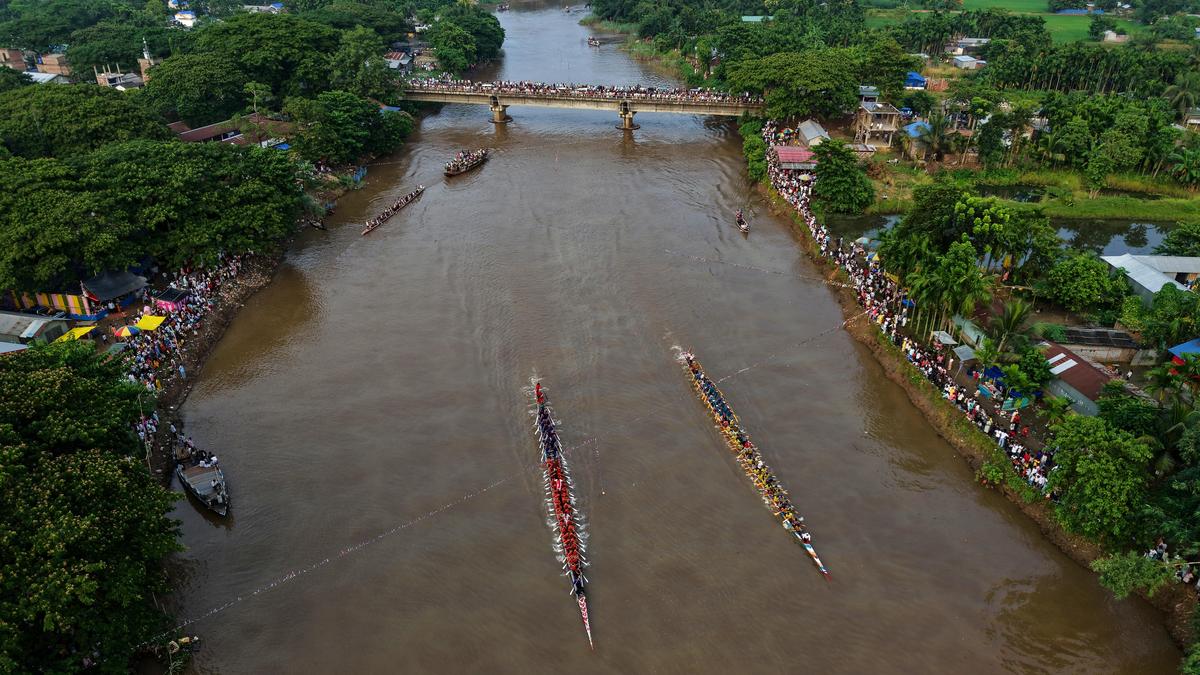
Kulsi river in Champupara village, west of Guwahati. File | Photo Credit: AP After decades of conflict over a disputed boundary, villagers in Assam and Meghalaya living along the Kulsi River have come together to oppose a hydropower project pursued jointly by the two State governments.In June 2025, the governments of Assam and Meghalaya announced their plan to build a 55-megawatt hydropower-cum-irrigation project on the Kulsi, a natural habitat of the endangered Gangetic dolphin. The dam was proposed at the confluence of the Dron, Shree and Dilma Rivers, which form the Kulsi, a tributary of the Brahmaputra.The location of the proposed project is on the Assam-Meghalaya border, about 80 km southwest of Guwahati.On Thursday (October 8, 2026), more than 2,000 people from the indigenous Bodo, Garo, Khasi and Rabha communities gathered at Ukiam to renew their opposition to the Kulsi project. Ukiam is near the proposed dam site and almost equidistant from Borduar and Langpih, two of the six disputed border sectors awaiting settlement since the 1970s.Chiefs take a standThe Assam-Meghalaya Joint Protection Committee (AMJPC), founded in 2025 to coordinate opposition to the proposed project, organised the protest rally. During the rally, three traditional chiefs — Kestor Manik Syiem Iich of Nongkhlaw, Phlowing Syiem Nongbak of Nongmynsaw, and Order Syiem Sad of Rambrai — assured the villagers that they would not grant consent for the hydropower project.“Projects involving land in Meghalaya require no-objection certificates from the traditional chiefs, who are custodians of their respective areas. Such consent will not be granted for this project,” the Nongkhlaw chief said. The other two chiefs maintained a similar stand.Albert Nonglang, president of the AMJPC, said the proposed dam would affect 46 villages across the two States. He argued that monetary compensation would not adequately address the long-term consequences of displacement for the indigenous communities.“The proposed 62-metre-high dam will also have significant ecological and social implications for Kamrup district in Assam and West Khasi Hills district in Meghalaya,” he said.Assam-based AMJPC members stressed the need to consult local communities and traditional institutions before pushing any project.According to the Ministry of Jal Shakti, the project would help irrigate about 26,000 hectares and mitigate floods, apart from generating 55MW of power. In its detailed project report, the Brahmaputra Board estimated that the project would cost ₹1,454.95 crore at June 2017 price levels. Published - October 10, 2026 08:02 pm IST
Assam, Meghalaya villagers join hands to oppose States’ joint hydropower project
Full Article
Original Source
Read the full article at Thehindu →KhanList aggregates and links to publicly available news content. We do not host full articles from third-party sources. Always verify important information with original sources.