
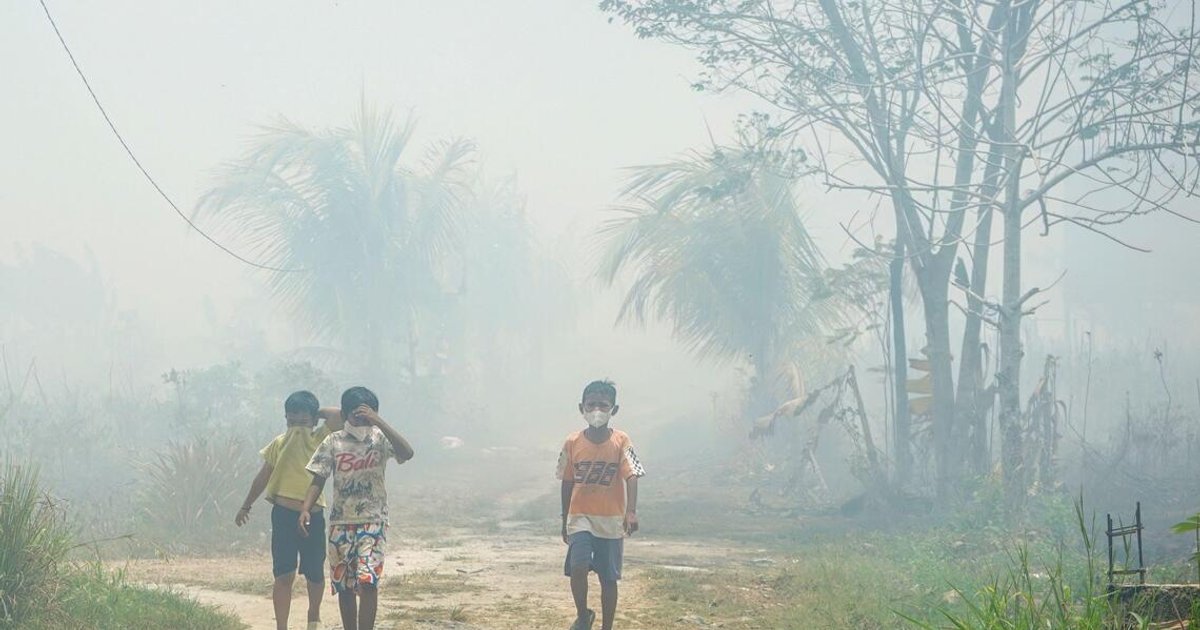
JAKARTA – More than two decades after South-east Asian countries signed an agreement to tackle transboundary haze, smoke from forest and peatland fires in Indonesia continues to affect its neighbours.ASEAN has established monitoring systems, funds and road maps, yet missed its goal of a haze-free region by 2020. As another crisis unfolds, askST examines what the grouping can achieve, whether bilateral cooperation works better and who must act to prevent future fires.1. What has ASEAN done to tackle transboundary haze?The ASEAN Agreement on Transboundary Haze Pollution, signed in 2002 and in force since 2003, commits members to preventing, monitoring and mitigating cross-border pollution. Indonesia was the last original ASEAN member to ratify the legally binding agreement in 2014.Established in 1993, the Singapore-based ASEAN Specialised Meteorological Centre monitors hot spots and provides early warnings. Other initiatives include peatland management strategies and a haze control fund set up in 2007.After missing its target of eliminating transboundary haze by 2020, ASEAN adopted a new road map in 2023, with a target of 2030.A haze coordination centre is planned for Indonesia, although its underlying agreement has yet to enter into force.2. Why does haze persist despite these efforts?The difficulty lies not so much in detecting fires, but in ensuring countries act on the information.Joanne Lin, senior fellow and coordinator of the ASEAN Studies Centre at the ISEAS – Yusof Ishak Institute, said: “Having a legally binding agreement does not necessarily translate into effective implementation, particularly when ASEAN has limited powers to compel compliance or enforce domestic environmental laws.”Being legally binding means member states are obliged under international law to cooperate, share information and take measures to mitigate transboundary haze. But the agreement leaves implementation largely to individual governments, without giving ASEAN the power to impose penalties or compel countries to comply.Disputes are settled through consultation or negotiation, while ASEAN’s consensus-based approach and principle of non-interference constrain pressure on individual governments.Simon Tay, chairman of the Singapore Institute of International Affairs, said ASEAN had made progress in monitoring haze and sharing information, but domestic enforcement remained crucial.“We have become much better at tracking fires than preventing them,” he said.He pointed to persistent land management problems in the plantation and forestry sectors, saying governments must continue investigating and holding offenders accountable.For decades, burning has remained a cheap way to clear land for plantations. Observers have pointed out that what is perceived as weak enforcement and relatively low risks of punishment have often allowed the financial benefits to outweigh the consequences, despite the environmental and health costs borne by communities across the region.3. What powers does ASEAN have to hold companies accountable?The power to go after companies responsible for fires that cause haze remains with national authorities, not ASEAN, said Tay.“ASEAN is not a regional policeman. It cannot investigate, prosecute or punish companies,” he said.But with companies and investors operating across borders, he said ASEAN could do more to facilitate the sharing of concession maps, corporate ownership information and evidence.“The smoke crosses borders. Cooperation in investigating responsibility should do so too,” he added.On Oct 16, the National Environment Agency (NEA) issued preventive measure notices to seven Indonesian companies whose concession lands were linked to fires suspected of contributing to haze in Singapore.The agency subsequently issued notices to three more companies under Singapore’s Transboundary Haze Pollution Act, bringing the total to 10. Enacted in 2014, the Act allows action against entities responsible for haze affecting the Republic even when activities occur overseas.Senior Minister K. Shanmugam said on Oct 19 that Singapore was exploring legal, economic and regulatory measures, including tracing corporate connections.But enforcement has proved difficult. Following the 2015 haze, Singapore issued notices to six Indonesian companies. A court warrant against a company director in 2016 sparked a diplomatic dispute, while Singapore said Jakarta had not provided requested information.Asked about Singapore’s latest preventive measure notices at an Oct 22 briefing, Indonesian Foreign Ministry spokesman Vahd Nabyl Achmad Mulachela said information from neighbouring countries would be examined under Indonesian regulations. Tackling fires involved legal and preventive measures as well as firefighting, he said.“Any information received that can help efforts to tackle forest and land fires will certainly be followed up on seriously,” he said.4. Could bilateral cooperation be more effective than ASEAN-wide action?Working directly with affected neighbours can bring firefighting help more quickly, although Indonesia must still agree to accept it.During the 2015 crisis, Indonesia accepted a Singapore Chinook helicopter carrying a 5,000-litre water bucket, as well as a Malaysian Bombardier CL-415 firefighting aircraft and supporting helicopter.This year, Singapore’s Minister for Sustainability and the Environment Grace Fu said on Oct 16 that the Republic had offered civilian firefighting and cloud-seeding assistance. Malaysia said on Oct 21 that Jakarta had agreed to accept its assistance for fires in Sumatra and Kalimantan, with arrangements still being coordinated.Singapore Management University law academic Eugene Tan, who served as Singapore’s representative or alternate representative to the ASEAN Intergovernmental Commission on Human Rights for eight years until October 2026, said the region was already engaged in damage control.He was referring to how countries were now focused on containing the fires and mitigating the haze, rather than preventing the fires from starting in the first place.“The haze-causing fires this year are a done deal – we are now at the mercy of nature (wind and rain),” he said.“The big issue is how to get Indonesia to implement and enforce its treaty obligations,” he added.At the Oct 22 briefing, Vahd said Indonesia understood its neighbours’ concerns and that existing ASEAN haze mechanisms were functioning. Jakarta was considering assistance offers according to conditions on the ground, he said, without confirming acceptance of specific offers.Malaysia is also considering ways to push for an ASEAN response more quickly. Malaysian Foreign Minister Mohamad Hasan said on Oct 12 that Kuala Lumpur would propose bringing haze under ASEAN’s disaster-response framework at a November meeting, drawing on the ASEAN Coordinating Centre for Humanitarian Assistance on Disaster Management’s experience in coordinating relief.Even if clearer procedures for requesting personnel and equipment could help, this would not remove the need for Indonesia’s consent, Lin said.“Under ASEAN’s disaster-response framework, assistance can only be deployed at the request or with the consent of the affected country, and this is unlikely to change,” she added.Tay said ASEAN-wide cooperation remained important, but countries need not move at the same pace.“Singapore, Malaysia and Indonesia can deepen practical cooperation, especially in the most fire-prone areas,” he said.Such efforts could focus on enforcement, land management, peatland protection and incentives for companies and communities to prevent fires.5. What can countries do to prevent future haze crises?Ultimately, experts say, the fires must be prevented in Indonesia, rather than merely fought after smoke crosses borders.Indonesian environmental groups point to weak corporate accountability. In a Sept 22 statement, Greenpeace Indonesia senior researcher Sapta Ananda Proklamasi said peatland-fire enforcement rarely targeted companies, offering little deterrence when fires recurred on their concessions.He cited a lawsuit brought by South Sumatran residents against three pulpwood companies over haze linked to fires on their concessions. Filed in 2024, it was dismissed by a lower court and appealed to the Supreme Court.Tan called Indonesia the “linchpin” of the regional response, urging stronger coordination between national and provincial authorities, backed by political will to enforce environmental laws.Singapore and Malaysia could also scrutinise companies and financial institutions linked to fire-prone plantation and forestry operations, complementing enforcement in Indonesia, observers noted.NEA said on Oct 23 that it had issued notices to 10 Singapore-registered companies, including Wilmar International and Asia Pulp & Paper, seeking documents and information on their corporate links, land concessions in Indonesia, and measures taken to prevent and fight fires.Lin said Jakarta could demonstrate leadership through earlier information-sharing, accepting assistance sooner and investing in long-term prevention, as well as by hosting ASEAN’s haze coordination centre.Prevention, rather than firefighting after a crisis begins, must be the priority, Tan stressed.“Prevention of the haze must be the watchword. To deal with the haze after the fires are burning uncontrollably is too little, too late,” he said.
askST: Why has ASEAN struggled to tackle haze and what can countries do about it?
Full Article
Original Source
Read the full article at Straitstimes →KhanList aggregates and links to publicly available news content. We do not host full articles from third-party sources. Always verify important information with original sources.