
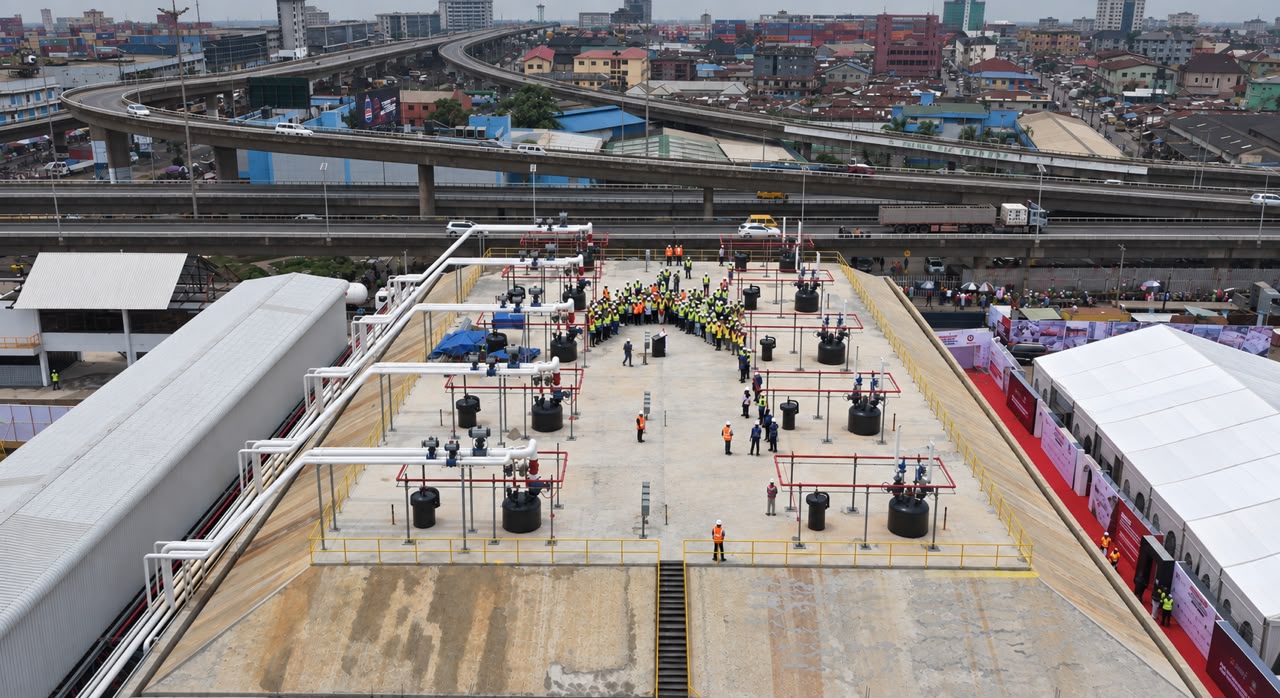
*Targets cooking gas price cut via blending as NMDGIF-funded project anchors national gas expansion Peter Uzoho Asiko Energy Holdings has achieved mechanical completion of its fully mounded 5000 metric tons Liquefied Petroleum Gas (LPG) and Propane terminal in Ijora, Lagos, with first gas cargo expected from the Nigeria LNG Limited and other suppliers in November 2026. The completion ceremony held Tuesday marks the delivery of the first phase of a larger integrated gas infrastructure that will culminate in twelve 250 cubic meters cbm tanks and later a 30,000cbm fully contained LNG terminal to commence next year. The terminal has five 1,000 MT propane-rated tanks, a mounded safety design and a 1.7 kilometres underground pipeline connecting it to three jetty points at Apapa Port. Funded by the Nigerian Midstream and Downstream Gas Infrastructure Fund (NMDGIF) in alignment with the national Decade of Gas agenda, Asiko broke ground for the project in 2022 to create a tri-fuel hub linking coastal supply to inland distribution. Speaking at the event, Chairman of Asiko Energy Holfings Board, Mr. Alex Ogedengbe, said the vision started 20 years ago and moved from conception to reality through determination and partnership. Ogedengbe said the project was more than an Asiko project but part of a broader national effort to move gas from opportunity to impact. He said Nigeria is richly endowed with gas which must play a central role in decarbonization, energy security and economic development. He commended the federal government and the NMDGIF for catalysing private investment, and thanked the Nigerian Midstream and Downstream Petroleum Regulatory Authority (NMDPRA) and other agencies for regulatory guidance. Managing Director, Asiko Energy, Mr. Felix Ekundayo, said the significance of the project was that the terminal will receive gas from NLNG and other Nigerian producers and bring gas previously isolated and exported into the domestic market. Ekundayo said the mechanical completion will be followed by instrumentation and electrical works — testing of wires, valves and emergency systems — within weeks ahead of the first ship in November. “The significance of the project is that it allows us to receive gas from NLNG and other Nigerian producers, to bring that gas that was previously isolated on islands and exported, into the country and distribute it. We already have a distribution chain in hinterland and that distribution chain will now be fed by our own infrastructure which you see here today. “So what we are doing here today is the mechanical completion. There’s a stage called mechanical completion and then the next stage after this is instrument and electrical. Instrument and electrical is where we put in all the wires, all the valves are tested, all the emergency systems are tested. “We’re going to complete those within the next few weeks and we’re looking forward to receiving the first ship cargo in November”, he said. On pricing, Ekundayo said the facility was built to receive cheaper off-spec LPG from global producers and blend it to cooking gas specification to drive down prices. According to him, the terminal has inline blending skids that can blend as the ship discharges and load trucks immediately, plus blending pumps for in-tank blending. Managing Director of NLNG, Mr. Adeleye Falade, described the terminal as a masterpiece for Nigeria’s energy security. Falade said Nigeria has the gas but produces the lowest proportion relative to reserves, while about 100,000 Nigerians die annually from smoke inhalation from unclean cooking. He said NLNG pioneered cooking gas in Nigeria in 2005 with 70,000 tons and 100 percent market share. He said last year, the company supplied 500,000 tons domestically, now about 40 percent of demand, after its board decided in 2022 to dedicate 100 percent of LPG production to the domestic market. He added that NLNG will raise LPG output by 50 percent by end of next year and needs partners like Asiko to bridge the infrastructure deficit. Nigeria holds over 200 trillion cubic feet of gas but remains deficit in midstream infrastructure, forcing reliance on dirty fuels. The Asiko terminal, backed by NMDGIF, provides coastal-to-hinterland linkage that will deepen LPG penetration, displace biomass and kerosene, and cut indoor air pollution. The wider 30,000cbm LNG development is expected to expand gas for power, industry and transport, enable LNG-to-CNG applications and strengthen domestic utilisation. By enabling blending of cheaper LPG grades, the project is projected to make cooking gas more affordable for households while creating hundreds of direct jobs.
Asiko Hits Mechanical Completion of 5000MT LPG Terminal in Ijora, Expects First Gas Nov
Full Article
Original Source
Read the full article at Thisdaylive →KhanList aggregates and links to publicly available news content. We do not host full articles from third-party sources. Always verify important information with original sources.