
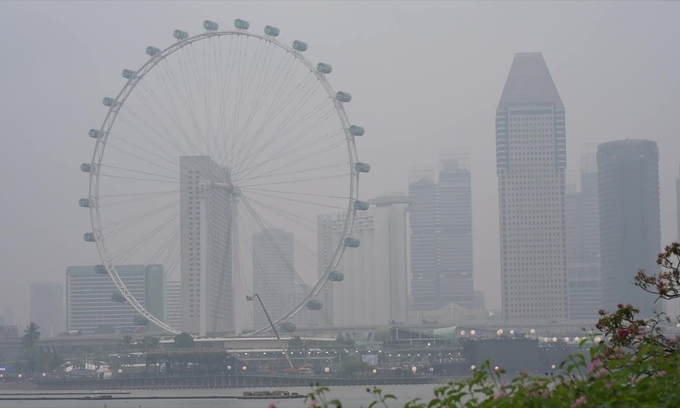
Singapore will activate haze-related medical subsidies on Monday, capping treatment costs at S$10 (US$7.82) for eligible patients as worsening air quality raises health concerns. The subsidies will be available to people seeking treatment for haze-related illnesses under the Public Health Preparedness Clinic (PHPC) Scheme.Children aged 18 and below, seniors aged 65 and above, Community Health Assist Scheme cardholders and Medical Fee Exemption Cardholders will pay no more than S$10 for treatment at polyclinics and participating PHPC clinics, the Ministry of Health said in a statement.Pioneer Generation and Merdeka Generation seniors will have their out-of-pocket expenses capped at S$5, while people receiving Public Assistance will receive fully subsidized treatment under the Haze Subsidy Scheme (HSS).Health Minister Ong Ye Kung announced on Sunday that the government would activate both schemes as transboundary haze worsened, The Straits Times reported.Eligible conditions include allergic rhinitis, asthma, bronchitis, conjunctivitis, chronic obstructive pulmonary disease, upper respiratory tract infections and complications arising from these illnesses. A blanket of grey haze swallows Singapore's skyline on Oct. 10, 2026, with the iconic Marina Bay Sands hotel barely visible through the smog. Video by VioryIntroduced in 2013, the HSS was last activated during the 2015 haze crisis, when the Pollutant Standards Index (PSI) peaked at 341 on the morning of Sept. 25. The scheme operated from Sept. 16 to Nov. 22 that year.The Ministry of Health said the PHPC Scheme coordinates primary healthcare responses and provides subsidized treatment during public health alerts and emergencies, including haze events. It was also used during the Covid-19 pandemic.As of 10 a.m. Sunday, 24-hour PSI readings stood at 117 in the north, 114 in the south, 135 in the east, 150 in the west and 149 in the central region.The readings marked a slight improvement from the previous day, when the PSI peaked at 183 in the central region around midnight before gradually declining.The 24-hour PSI reached a new high for this year's haze season on Friday, with the central region recording 192 at 5 p.m., Channel News Asia reported, citing data from the National Environment Agency (NEA).Singapore classifies PSI readings of 101 to 200 as unhealthy. The index measures air quality using a 24-hour rolling average of six major air pollutants.Singapore, which boasts the highest GDP per capita in Asia, estimated at over US$107,000 in 2026 according to the International Monetary Fund, topped global pollution rankings for major cities after smoke from forest fires in neighboring Indonesia swept across the city-state, affecting visibility during its Formula One Grand Prix weekend.Footage showed a blanket of gray haze obscuring Singapore's skyline on Saturday, with the Marina Bay Sands hotel barely visible through the smog, Viory reported.According to Swiss air quality monitoring firm IQAir, Singapore's Air Quality Index (AQI) rose to 216 on Friday morning, placing it in the "very unhealthy" category.The smoke originated from forest fires across Indonesia. The NEA warned on Thursday that "moderate to dense smoke plumes from southern and central Sumatra and West Kalimantan were observed to drift towards Singapore."The agency warned that haze could persist, saying that "under the prevailing southeasterly or southerly winds, smoke haze may continue to drift towards Singapore," according to Viory.Singapore’s 28-agency Haze Task Force is prepared to introduce additional measures if the 24-hour Pollutant Standards Index (PSI) rises above 200.The measures include distributing N95 masks to eligible residents and opening air-conditioned haze shelters at community clubs and selected residents’ committee and residents’ network centers.Public hospitals, polyclinics, nursing homes and other healthcare facilities have also activated haze preparedness plans. These include operating air purifiers, keeping windows closed in wards and corridors, and using portable air coolers to lower indoor temperatures where appropriate, according to Channel News Asia.The Ministry of Education will consider closing schools if the next day’s air quality forecast reaches the hazardous range, with the 24-hour PSI exceeding 300.
Asia's richest country offers haze treatment subsidies as air quality deteriorates
Full Article
Original Source
Read the full article at E →KhanList aggregates and links to publicly available news content. We do not host full articles from third-party sources. Always verify important information with original sources.