
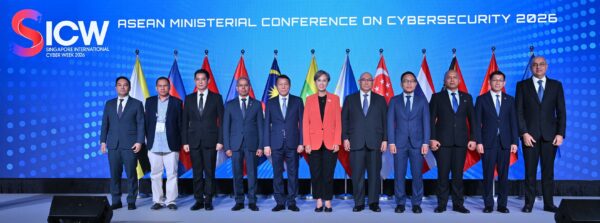
It was immediately apparent to habitués of Singapore International Cyber Week (SICW) that this year’s edition – the 11th, which ran from October 12-15 – was going to be different. Just days before the opening, on October 9, Taira Masaaki, who heads the Liberal Democratic Party’s cybersecurity strategy headquarters, told an emergency party meeting that Japan was in “a state of emergency in cyberspace.” More than 20 major Japanese companies had disclosed attacks in the preceding weeks. A ransomware attack on IDC Frontier, SoftBank’s cloud subsidiary, on October 7 took down systems at 495 companies and local governments. It is unclear whether artificial intelligence (AI) directed any of those attacks. However, what was clear was that AI was the frisson that changed – perhaps for good – the tone and tenor of discussions at the plenaries, the closed sessions, and the corridor conversations at SICW. It has perhaps altered permanently the nature of discourse at all cyber forums of equal scale and standing that aspire to similar convening power. What follows are thoughts and takeaways on where we should go from here. Companies With the Power of States U.S. AI companies such as OpenAI, Google, and Anthropic were in the room this year at SICW. It would have been useful to also have had some of the large Chinese AI firms present in order to get a sense of the alternative approaches. But regardless of their country of origin, some of these firms wield the power of states, and of powerful states for that matter. Their models automate tasks, and as we have seen in 2026, that increasingly includes cyber attacks. As AI agents become increasingly autonomous, the infrastructure underpinning them becomes an increasingly attractive target for cyberattacks. Yet the companies developing these technologies and governments see different elements of the threat. A government can monitor attacks on its own networks and critical infrastructure, whilst frontier AI labs and major cloud providers can detect patterns of malicious activity across their customers and services. Neither has the complete picture. Ransomware is a clear example of where this matters. If these different sources of intelligence can be brought together, it would make it easier to spot emerging threats and understand how attackers are operating in order to disrupt attacks before they spread. This is also changing how governments work with industry. Traditionally, governments set cybersecurity requirements, consulted industry, and expected or legislated that companies comply. However, frontier AI presents a far more complicated problem, which changes the dynamic. The companies who develop advanced AI systems possess technical knowledge, operational experience, and insights into emerging threats that governments cannot easily replicate. The dichotomy here lies in the fact that while governments are considering how AI companies should be regulated, they are increasingly reliant on the technology and the expertise those same companies have. This means that the companies themselves have considerable influence over the decisions governments are trying to make about them. Australia’s 2026 cyber threat assessment, released in October, illustrates what is at stake perfectly. The Australian Signals Directorate (ASD) warned that AI has been enabling malicious actors to identify vulnerabilities and carry out attacks – conduct espionage, steal money, and disrupt systems – at greater speed, scale, and sophistication. ASD Director General Abigail Bradshaw warned that frontier AI models had “redefined” the threat facing Australia, making further disruption to essential services increasingly likely. The report pointed to emerging risks from the unintended behavior of AI agents, a problem that Australia has very publicly been managing over the past few months. Furthermore, it stated that there have been over 4,400 notifications to Australian organizations about possible malicious activity over the past year, which is an increase of almost 80 percent from 2025. Bradshaw went on to state that ASD had been working directly with frontier AI companies, including OpenAI, to establish new early-warning protocols around emerging model capabilities and their potential misuse. These arrangements have also been shared with other AI labs and Five Eyes intelligence partners. This is significant as it demonstrates intelligence agencies need to work with AI frontier labs before new capabilities are widely deployed, rather than responding to the threats that they appear to increasingly unleash. The question is how do governments secure that cooperation while retaining independence and authority to regulate those same companies. This is where Singapore’s approach becomes particularly interesting. It seems likely that Singapore’s approach will (as so often is the case in these matters) be measured and shorn of histrionics – relying on the assumption that the cooperative approach can work, at least in the first instance. Minister for Digital Development and Information Josephine Teo, who is at the helm of the cybersecurity portfolio, while noting the safeguards put in place by frontier AI companies, said that these were insufficient, given the risks posed by increasingly capable systems. She also told Parliament days before SICW opened that Singapore does not currently require frontier AI developers to give the government access to their models, warning that a rigid requirement could be counterproductive if it makes companies limit cooperation or information-sharing. The non-coercive approach was on view when Anthropic, in the course of opening its Singapore office, signed an MOU covering AI safety, security, and model evaluation at Cyber Week. Filling the Quantum Gap Amid all the talk of AI, it was easy to miss some of the deeper signals and concerns emanating from conversations at SICW. Post-quantum cryptography was the quieter theme, perhaps because technically, it does not have a date attached to it. A quantum computer able to break today’s public-key encryption does not yet exist, but there was general agreement that that day – “Q-Day” – can be glimpsed on the horizon. The problem here is that we do not need to reach Q-Day for the risks to eventuate. Policymakers and technical experts across the region should be considering it now, rather than assuming that their successors will carry the can. The risk to secrets is already real, because data stolen now can be stored and decrypted later. Organizations holding information that needs to remain confidential for years to come should already be planning their migration to quantum-resistant cryptography. Even after this is completed, systems will require continual monitoring and updating as the technology and subsequent threat evolves. All this also means the need for discussions and coordination not just within but across regions. Australia has recommended that companies complete the transition by the end of 2030. Singapore has set 2031 as the target for critical infrastructure and 2035 for everyone else. At surface level these timelines appear reasonable, but international networks and supply chains do not operate within national boundaries. If one country, or one part of a network, has migrated while another has not, the security communications and data shared between them remains exposed. Therefore, industry and governments need to think beyond their own migration deadlines and consider how different timelines will impact the networks and services that connect them. The Politics of Getting Everyone in the Room Despite these uncertainties, there were positives that underlined SICW’s convening power. The event brought Washington, Beijing, and Moscow into the same building, alongside ASEAN’s cyber ministers, the United Nations, and, this year, senior officials from Anthropic and OpenAI. No other annual cyber convention meeting assembles all of those layers at once. The interactions should not be sugar-coated. Officials from the EU walked out of the High-Level Panel on Diplomacy, which featured a Russian official (Dmitrii Bukin from the Ministry of Foreign Affairs), just as they had done in 2025. (Some did, however, leave staffers at the end of the room to take notes). And there were occasional sharp moments from the United States, for example when Sean Cairncross, the United States national cyber director, used the plenary to attack digital authoritarianism. Chinese officials chose not to respond directly, and it does not appear that others (including ASEAN states) shared these sentiments. SICW is not – at least not yet – a showpiece for great power cyber grandstanding. Singapore officials may well want to keep the tone even-handed. At the same time, they may value balance, with middle and even smaller powers having a seat at the table. After all, Singapore officials repeatedly averred in and about SICW that the decisions in this realm cannot be left to the major powers and the frontier AI companies, and that cyber diplomacy has to involve all. The program reflected that, with delegations from Timor-Leste to Tuvalu. Australia is on the same page and is playing a role in this respect. When it helped set up the Pacific Cyber Security Operational Network in 2018, the point was to give every Pacific incident responder a counterpart to call, and most of those calls now go island to island rather than through Canberra. Tuvalu shows how far the layers have joined. The Falepili Union of 2023 gave Australia a security role in a country of 11,000 people, and ground has since been broken on the Tuvalu Vaka cable, a US$56 million link delivered with Google and backed by Australia, Japan, New Zealand, Taiwan, and the United States. What to Do Before 2027 Cyber diplomacy has enough rules. It needs more follow-through. The common thread is that the technology now moves faster than the policy written to govern it. It would be tempting therefore to suggest that new norms are needed. But our conclusion from the week is that the region does not need a new set of rules. The norms already agreed at the United Nations and endorsed within ASEAN (in the case of the GGE, the Group of Governmental Experts, with the permanent mechanism established by the OEWG also being welcomed by the body) are adequate to the task. What is missing is implementation, and that is work small and middle powers are well placed to lead. What is actually required is picking a small number of things the countries in the room can do together, and doing them before the next SICW. Three concrete steps follow from this year’s discussions. First, align post-quantum migration deadlines across shared infrastructure, or at least agree which systems must migrate on the earlier timeline whoever owns them. Second, build information-sharing arrangements with the large technology firms that give governments the view of telemetry they cannot collect themselves, on terms that survive a change of chief executive. Third, agree on a common ASEAN vocabulary for AI risk that carries weight and meaning beyond the region, so that a regulator in Jakarta and a regulator in Canberra mean the same thing when they describe risk. Singapore chairs ASEAN in 2027, which makes the next SIWC especially significant. For Australia and Singapore it is the first real test of whether small and middle powers can set a cyber agenda rather than hold a seat while others set it. The rules are written. The next 12 months will show who is prepared to carry them out.
Asian Cybersecurity in the Age of AI and Quantum Computing
Full Article
Original Source
Read the full article at Thediplomat →KhanList aggregates and links to publicly available news content. We do not host full articles from third-party sources. Always verify important information with original sources.