
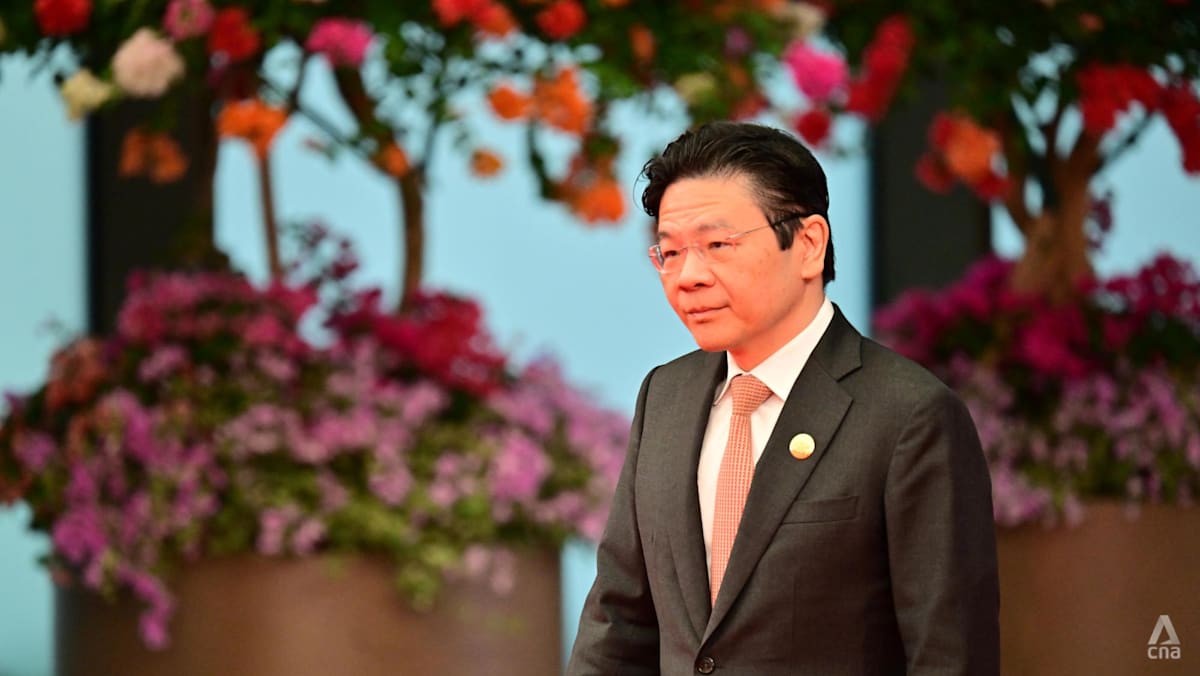
SHENZHEN: Asia-Pacific economies should not allow the region to split into competing economic blocs as the world moves into a more fragmented era of globalisation, Singapore Prime Minister Lawrence Wong said on Thursday (Nov 19).The region should remain open and connected, find new ways to cooperate and ensure that economic cooperation delivers real benefits for businesses and people, he said during a session at the Asia-Pacific Economic Cooperation (APEC) Economic Leaders' Meeting in Shenzhen.Amid heightened public scrutiny on global semiconductor trade this month – with the US announcing tighter chip export controls for four Southeast Asian countries, including Singapore, as well as Brazil – Mr Wong urged member economies to cooperate on artificial intelligence (AI) issues."So much of the public discussions around AI has been about the competition for leadership position, competition for the best chips and the best models, and some of that is inevitable," he said. "But in fact, there is much scope for us to work closely together on important issues like AI safety and the responsible use of AI."Mr Wong, who will be visiting Beijing later in the week, said that while the Asia-Pacific region prospered by opening up and connecting with the world, the conditions that made this success possible can no longer be taken for granted."Geopolitical tensions are rising, economic ties are increasingly viewed through the lens of national security," he said."We must adapt to these new realities. In particular, we should not allow our region to become divided into competing economic blocs, and that is where APEC has an important role to play."By working together, the region can continue to be an engine of growth and prosperity for the world, said Mr Wong, who is also Singapore’s finance minister.To that end, the region must preserve openness even as economies adjust to new economic and security realities.He said the region should not stop at agreements like the Comprehensive and Progressive Agreement for Trans-Pacific Partnership (CPTPP) and the Regional Comprehensive Economic Partnership, but take concrete steps towards APEC's goal of a free trade area of the Asia-Pacific."Our approach should be open and inclusive, to reinforce rather than to divide the wider trading system," he said, adding that economies should continue to support reforms to strengthen the World Trade Organization (WTO) and uphold a rules-based multilateral trading system.NEW WAYS TO COOPERATE, SEEKING REAL BENEFITSMr Wong also called on leaders to find new ways to cooperate, even though reaching consensus may be very difficult."That should not become an excuse for inaction," he said.Plurilateral initiatives at the WTO show how willing parties can make progress, while new initiatives like the Green Economy Partnership Agreement and the Future of Investment and Trade Partnership can also develop innovative approaches to emerging opportunities."We should pursue a more flexible and pragmatic approach towards multilateralism – to allow willing partners to move ahead, demonstrate what works and keep the door open for others to join when they are ready," said Mr Wong.Leaders must also ensure that economic cooperation delivers real benefits for businesses and people, he said.APEC's success will be judged by whether businesses find it easier to trade, workers have better opportunities and people see improvements in their lives, he said.For example, the APEC Centre of Excellence for Paperless Trade, conceived by Singapore and Australia with the APEC Business Advisory Council, aims to make it easier for businesses to exchange trade documents electronically across borders.That would mean less paperwork, lower costs and easier access to new markets for businesses, he said.The same approach should be applied to AI, which can raise productivity across the region, added Mr Wong.APEC has a part to play in supporting AI adoption among small and medium enterprises, fostering investment in AI infrastructure and equipping workers with skills to benefit from these technologies, said the prime minister.On Wednesday, Mr Wong attended a welcome banquet hosted by Chinese President Xi Jinping, and met leaders from Vietnam, Peru and Chile on the sidelines of the summit. China’s President Xi Jinping greets Singapore's Prime Minister Lawrence Wong at the APEC Economic Leaders' Meeting welcome banquet in Shenzhen, China, on Nov 18, 2026. (Photo: CNA/Lan Yu) Singapore's Prime Minister Lawrence Wong and his wife Loo Tze Lui pose for a photo with China’s President Xi Jinping and First Lady Peng Liyuan at the 33rd APEC Economic Leaders' Meeting welcome banquet in Shenzhen, China, on Nov 18, 2026. (Photo: CNA/Lan Yu) Singapore’s partnership with Vietnam continues to grow, Mr Wong noted, pointing to the launch of the Singapore-Vietnam Strategic Dialogue this year.“With Singapore chairing ASEAN and Vietnam chairing APEC in 2027, we look forward to supporting each other’s priorities and working together for a more prosperous and connected region,” he wrote in a Facebook post about his meeting with Vietnam’s General Secretary and President To Lam. Prime Minister Lawrence Wong during his meeting with Vietnam President To Lam on the sidelines of the Asia-Pacific Economic Cooperation (APEC) Economic Leaders' Meeting in Shenzhen on Nov 18, 2026. (Photo: Prime Minister's Office) On his first meeting with Chilean President Jose Antonio Kast, Mr Wong said they discussed ways to deepen cooperation in trade, the digital economy and carbon credits.“We will also continue working together to strengthen economic links between our regions, including through APEC and Chile’s host year in 2032,” he said in a post on X, formerly known as Twitter.He also posted on X about his first meeting with Peru President Keiko Fujimori. He said Singapore and Peru share a commitment to free trade and open markets, and the two countries’ economic ties are underpinned by agreements including the Peru-Singapore Free Trade Agreement and the CPTPP.“Peru is also an important source of food and critical minerals,” said Mr Wong, adding that Singapore looks forward to working closely with Peru during its CPTPP chairmanship next year.
Asia-Pacific must resist becoming divided into competing economic blocs: PM Wong
Full Article
Original Source
Read the full article at Channelnewsasia →KhanList aggregates and links to publicly available news content. We do not host full articles from third-party sources. Always verify important information with original sources.