
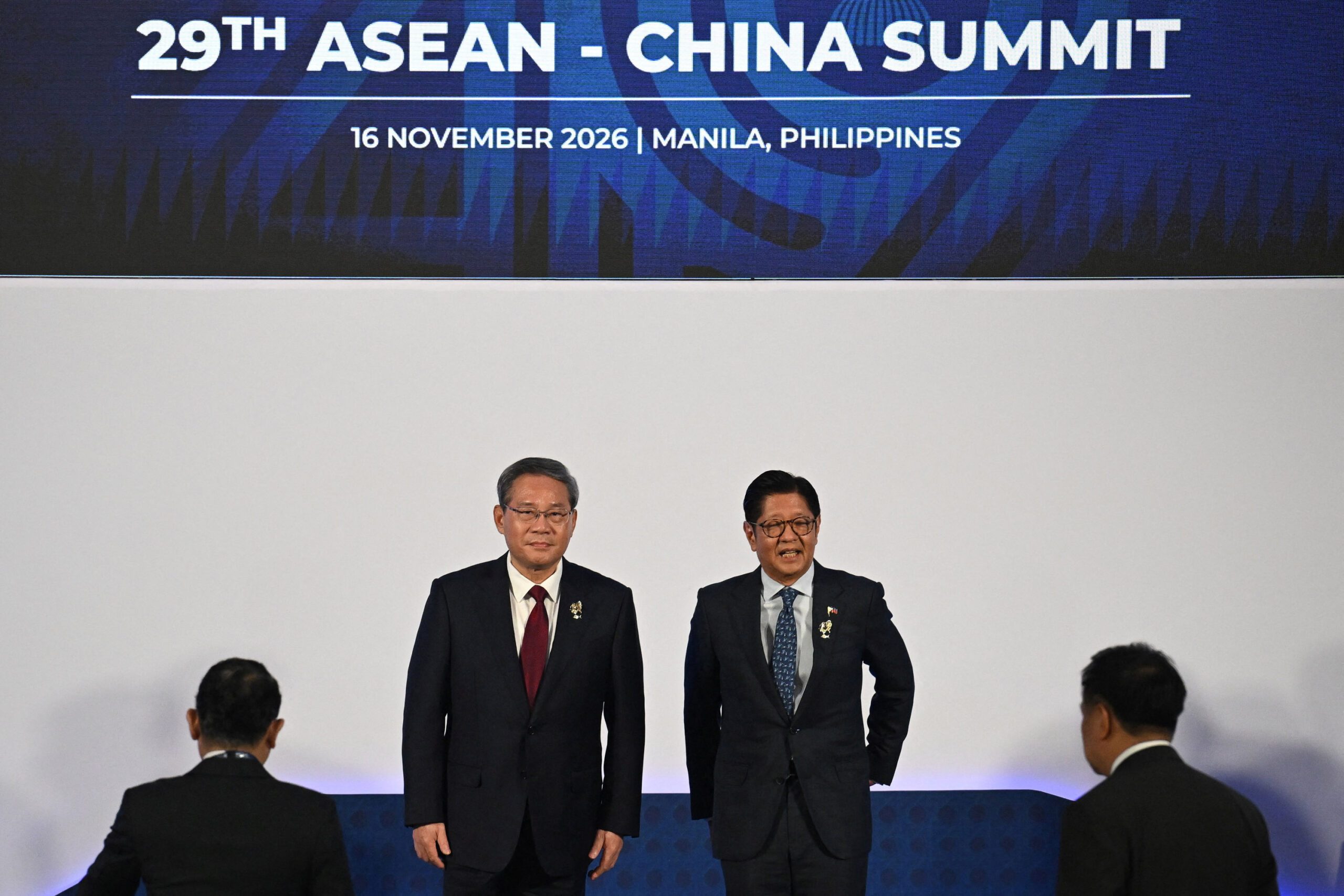
ASEAN-CHINA SUMMIT. Chinese Premier Li Qiang stands with Philippine President Ferdinand Marcos Jr. during the 29th ASEAN-China Summit in Manila on November 16, 2026. Ted Aljibe/Pool via Reuters A source familiar with past South China Sea Code of Conduct negotiations told Rappler that despite progress, the most contentious issue remains unresolved: whether the agreement will be legally binding ASEAN and China are reportedly close to finalizing their Code of Conduct (COC) in the South China Sea, with President Ferdinand Marcos Jr. claiming negotiations are 85% to 90% complete. Diplomatic relations with China are seen as crucial for settling the COC's legal status, and skepticism remains about the likelihood of completing negotiations under Singapore's upcoming chairmanship. This is AI-generated. Read the article for full context. Report any errors. After more than two decades of negotiations, ASEAN and China appear tantalizingly close to completing their Code of Conduct (COC) in the South China Sea. Or at least, that’s what the President is saying. As the Philippines’ ASEAN chairmanship ended on November 17, President Ferdinand Marcos Jr. said negotiations were 85% to 90% complete, with only definitions and wording left to iron out. “There are definitions, there are phrases, and there are paragraphs that need to be clearly defined. So that it is very understandable and it is very clear to everyone involved that these are the rules, these are the understood and accepted mores and norms that we will all be following,” Marcos told reporters. But a source familiar with earlier COC negotiations was hardly impressed. The source, who requested anonymity to speak candidly about the diplomatic process, said those percentages distract from the fact that the hardest questions remain unanswered. Chief among them is whether the COC will be legally binding. Without legal force, the source argued, the new code wouldn’t offer much of an improvement over the existing Declaration on the Conduct of Parties in the South China Sea (DOC), adopted way back in 2002. But while the new code remains unfinished, Marcos said ASEAN and China had reached a “tacit agreement” to continue observing the existing Declaration on the Conduct of Parties in the South China Sea (DOC), adopted way back in 2002. That is the very declaration the Philippines has previously accused China of violating. The DOC already calls on countries to exercise self-restraint, including by refraining from occupying previously uninhabited maritime features. In 2015, Manila accused Beijing of breaching this commitment through its island-building activities. China rejected the accusation. And of course, let’s not forget the landmark 2016 arbitral ruling that rejected the legal basis for China’s sweeping claims within its nine-dash line. Beijing doesn’t recognize that ruling too. The Philippines has clung to that ruling in defending its maritime rights, even as confrontations with Chinese vessels persist in the West Philippine Sea, including water-cannon attacks and dangerous maneuvers. What about the hard part? Talking about what remains to be done, Marcos focused on definitions without mentioning two other unresolved issues, geographical scope and, more importantly, whether the COC will be legally binding. He’s left that requirement out of past ASEAN remarks too. Is he leaving room for diplomacy? Has Manila shifted its stance? Whatever the intention, it wasn’t enough to get it done under his chairmanship. Foreign Affairs Secretary Maria Theresa Lazaro acknowledged that ASEAN and China had resolved only one of four milestone issues. Asked whether the code’s legally binding status remained unresolved, she was clear. “This is still pending. I told you, there’s only one among the four milestones [resolved]. It is the relationship between the DOC and the COC. That’s the only thing that’s finished. The three are still pending,” Lazaro said on Sunday, November 15. A little diplomacy might help The source believes the COC’s legal status won’t be settled until relations with China warm up, which requires building trust outside the negotiating table. One missed confidence-building opportunity, the source suggested, came when Lazaro was asked whether China could participate in the proposed ASEAN Maritime Center in the Philippines. Lazaro gave a bureaucratic answer, saying the center’s structure and operations still needed to be worked out. “The Maritime Center has not yet been set up, it has just been approved,” she said, adding that legal instruments still had to be signed. Fair enough, but the source argued that Lazaro could have extended an olive branch to Beijing by signaling openness to future Chinese participation. After all, ASEAN dialogue partners like China regularly participate in regional initiatives and help finance them. The source was equally skeptical that Singapore, ASEAN’s next chair, could finish negotiations in 2027, despite Lazaro’s confidence that another five or six months might have been enough. And so the burden of getting China, the region’s superpower, to agree to a deal now falls on the bloc’s tiniest member. – Rappler.com How does this make you feel? Loading
ASEAN’s South China Sea code is ‘85% to 90%’ done. Will it bind China?
Full Article
Original Source
Read the full article at Rappler →KhanList aggregates and links to publicly available news content. We do not host full articles from third-party sources. Always verify important information with original sources.