
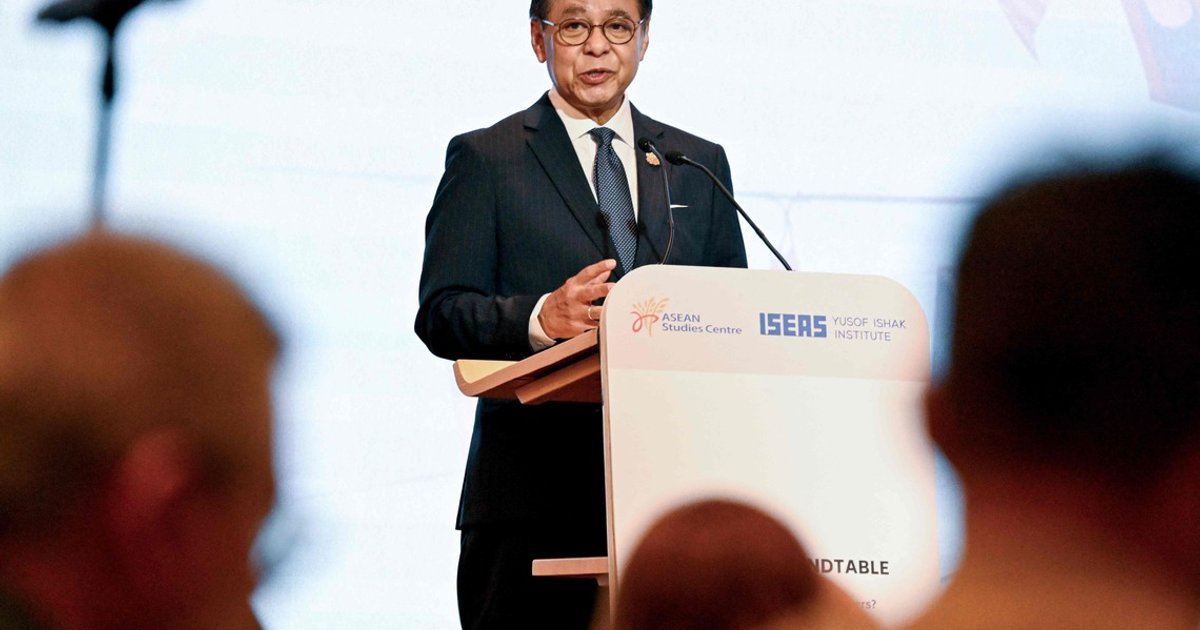
SINGAPORE – ASEAN’s recommended peace plan for embattled Myanmar is already five years old but it still lacks a “clear-cut strategy on its implementation”, Thai Foreign Minister Sihasak Phuangketkeow said at a conference in Singapore on Nov 5. Taking questions from the audience at the 41st ASEAN Roundtable, Sihasak said one frustration he has had with ASEAN discussions on Myanmar is that it usually begins with a reaffirmation of its Five-Point Concensus peace plan which was conceptualised in 2021, then ends with the grouping leaving the situation to ASEAN’s Special Envoy to Myanmar.This is a role that changes hands every year. Currently, the position is held by Philippine Foreign Secretary Ma Theresa Lazaro, who visited Myanmar as part of a humanitarian mission last week. Next year’s envoy will be appointed by Singapore.“We leave it to the Special Envoy to do whatever he or she wants to do – no guidance. Then we’ve done our job already, we go on to the next meeting,” said Sihasak, who is also deputy prime minister.“We have to think about what to do,” he said. “At the last summit meeting, one important point came up: an isolated Myanmar is not good for the region. We don’t want Myanmar to be an arena of geopolitical competition.”Myanmar’s political leadership has been excluded from the biannual ASEAN summits since a military coup ousted Aung San Suu Kyi’s civilian government in February 2021 and plunged the country into civil war.ASEAN drew up the Five-Point Consensus in April the same year, calling for a cessation of violence, among other things, but there has been little progress.Stronger ASEAN leadership neededThe Myanmar situation, said Sihasak, is a reminder that ASEAN’s long-standing principle of non-interference should not mean inaction or indifference.For this reason, he suggested strengthening the rotating ASEAN chair’s role in times of crisis, allowing him or her to convene urgent consultations and present practical options for timely responses.“We could also learn from the practice of the European Union (EU), where ministers can come together at short notice and address urgent developments in a day,” he said, adding that ASEAN should similarly explore more flexible arrangements.The roundtable, organised by ISEAS–Yusof Ishak Institute, centres on the theme of whether ASEAN can deliver “when it matters”.Addressing criticisms that ASEAN has often been seen as too slow to act, Sihasak acknowledged that it often takes a week or more for the consensus-based grouping to respond to developing situations, such as the Middle East crisis.“And in the end, the situation that we convey in the statement doesn’t matter very much,” he said.He noted that ASEAN has faced many challenges before, but the difference this time is that many challenges are now “converging at once and coming from all directions”.Even if consensus remains fundamental to ASEAN, “rigidly applying consensus in every circumstance on every matter” could impede new initiatives at a time they are most needed, he said. “We must find ways to preserve the spirit of consensus while allowing room for flexibility. Otherwise our decision-making process risks becoming a constraint than an instrument of collective action and progress.”He also pushed for the ASEAN troika mechanism to be made permanent, arguing that this would give ASEAN chairs that are “not so strong” more confidence to act. The arrangement, which comprises the immediate past, current and incoming chair, was set up to help the grouping deal with the Myanmar crisis.“If we really want ASEAN to be relevant, timely action is important,” he said.Calibrated re-engagement with MyanmarFor now, ASEAN member states appear to have become more visibly divided on how the grouping should re-engage Myanmar. Thailand is seen as leading the group leaning towards a softer stance, and Sihasak earlier this year had pushed for what he called “calibrated re-engagement”.At the roundtable, Sihasak reiterated Thailand’s position, noting that the kingdom is taking a “dual track approach” towards Myanmar.“We share a common border, we have problems every day, we have to engage and deal with these problems. And at the same time, we’re not abandoning the situation inside Myanmar,” he said.While Myanmar’s problems ultimately have to be solved by its people, what Thailand is trying to do, as a neighbouring country, is to encourage inclusive dialogue among the various parties.He added that this was a request he put forth to Chinese Foreign Minister Wang Yi as well, when they met at a Lancang-Mekong Cooperation meeting earlier in the week.“If all of us pitch in, maybe we will see progress,” he said.Cambodia-Thai disputeTouching on the Cambodia-Thai border clashes, Sihasak said he wanted to be frank that he does not know what the source of the dispute is.He acknowledged that their borders are not fully demarcated, but added: “This dispute is not the usual dispute. It’s something that involves personalities.”“We share a common border, we have problems every day, we have to engage and deal with these problems. And at the same time, we’re not abandoning the situation inside Myanmar,” he said.The two countries have frequently clashed over land and maritime disputes since July 2025. In June, Cambodia initiated a compulsory conciliation process under the United Nations Convention on the Law of the Sea, which got off to a fiery start in Singapore.Sihasak said Thailand’s approach has always been to resolve bilaterally and “not try to internationalise the dispute”, but added that “it doesn’t matter”.He noted that there is now a process for the two countries to work out their issues, adding that they have been very mindful to not let bilateral disagreements affect their engagement in ASEAN and other international forums.
ASEAN’s peace plan for Myanmar lacks ‘clear-cut strategy’ for implementation: Thai foreign minister
Full Article
Original Source
Read the full article at Straitstimes →KhanList aggregates and links to publicly available news content. We do not host full articles from third-party sources. Always verify important information with original sources.