
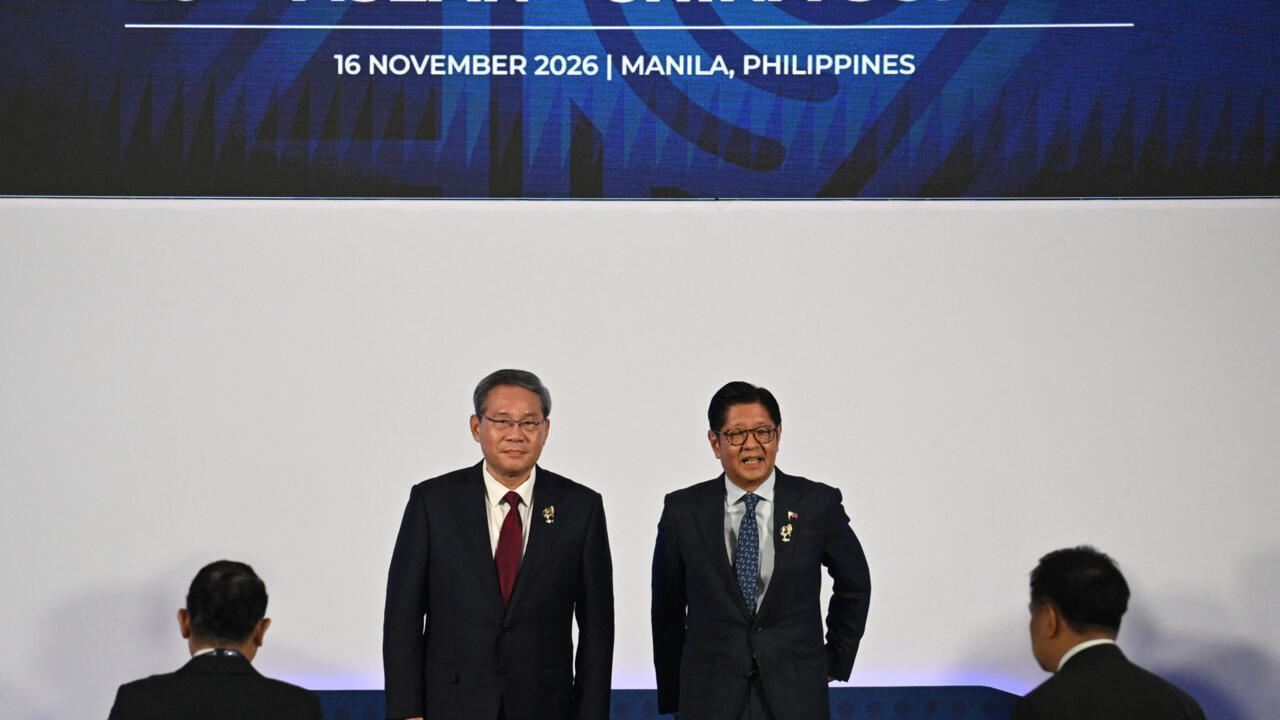
Southeast Asian leaders are wrapping up their annual summit in Manila on Tuesday amid concerns over trade disruption, energy insecurity and maritime tensions in the South China Sea. Issued on: 17/11/2026 - 08:01 3 min Reading time As United States President Donald Trump prepares to arrive for talks, France is seeking closer cooperation with the region on energy, security and climate resilience. Trump is due in Manila on Tuesday for talks with ASEAN leaders, a trade-related signing with Thailand and the first leaders' meeting of the Quad – comprising the US, Japan, Australia and India – in two years. The White House says the discussions will focus on peace, prosperity and security in the Indo-Pacific. The Quad meeting will add a geopolitical dimension to the summit. The grouping is widely viewed as a counterweight to China's growing influence in the region, although its members insist it is not directed against any one country. Critical-minerals supply chains, maritime security and threats to commercial shipping are expected to feature in the discussions. Trump's visit comes ahead of his trip to Shenzhen for the Asia-Pacific Economic Cooperation forum, where he is scheduled to meet Chinese President Xi Jinping and Russian President Vladimir Putin for three-way talks. A Philippine Coast Guard ship is seen near Thitu Island in the South China Sea on February 21, 2026. A Philippine senator called for deepening defence relationships and "continuous" pushback against China AFP - JAM STA ROSA Will France get closer to the Quad to counter Chinese threat in the Pacific? South China Sea tensions China, meanwhile, has sought to keep the focus on economic cooperation. Premier Li Qiang told ASEAN leaders on Monday that ties between Beijing and Southeast Asia had grown more mature and resilient, pledging continued support for free trade amid rising protectionism. But the South China Sea remains a major source of regional tension. ASEAN and China have failed to meet Manila's 2026 target for concluding a Code of Conduct governing the disputed waterway, despite reaching provisional agreement on around 80 percent of the draft text. Negotiations will continue under Singapore's chairmanship in 2027, with disagreements remaining over the code's legal status, geographic scope and definitions. Marcos urged restraint and a peaceful settlement of disputes, saying commitments to international law must be reflected in concrete action. The stakes are high. The waterway carries a significant share of global shipping and contains substantial energy resources, while China and several ASEAN countries maintain overlapping territorial claims. Overlapping claims of countries bordering the South China Sea. © Wikimedia Commons France strengthens regional cooperation For France, the Indo-Pacific is not a distant concern. Through New Caledonia, French Polynesia and its other overseas territories, Paris is a resident Pacific power with direct interests in maritime security, climate resilience, fisheries and the stability of shipping routes. Many of these priorities overlap with those of the Quad grouping, although France has pursued its own approach to regional cooperation. Growing anti-China alliance in Indo-Pacific a boon for French-Aussie relations At the sixth ASEAN–France Development Partnership Committee meeting in Jakarta earlier this month, Paris pledged an additional €1million to the ASEAN–France Fund for 2026. The funding will help advance cooperation in areas including renewable energy, regional electricity connectivity, food security, disaster management, public health and education. Both sides also identified opportunities for closer collaboration on combating online scams, green finance, cybersecurity and maritime security. (With newswires)
ASEAN leaders seek stability as Trump heads to Manila, France eyes closer ties
Full Article
Original Source
Read the full article at Rfi →KhanList aggregates and links to publicly available news content. We do not host full articles from third-party sources. Always verify important information with original sources.