
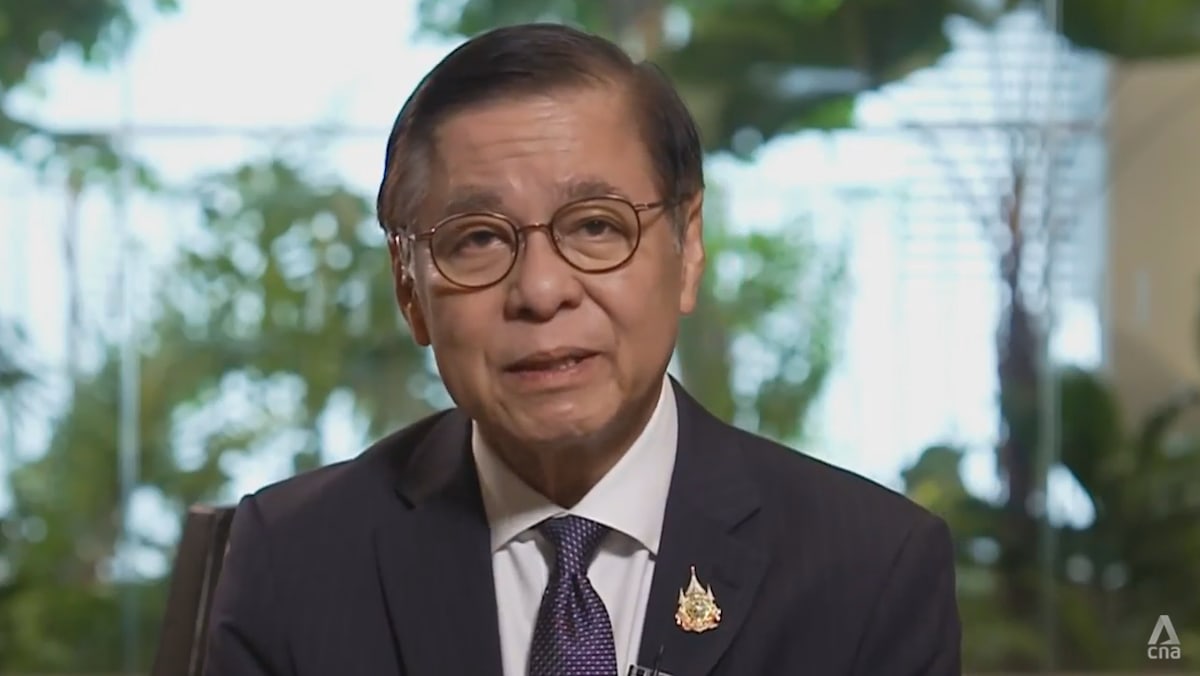
Asia Sihasak Phuangketkeow, who is also Thailand's deputy prime minister, tells CNA that while ASEAN will continue to avoid taking sides among major powers, neutrality also has its limits. Sihasak Phuangketkeow, who is also Thailand’s deputy prime minister, speaks to CNA ahead of the 49th Association of Southeast Asian Nations (ASEAN) Summit in Manila from Nov 15 to Nov 18, 2026. (Image: CNA) New: You can now listen to articles. This audio is generated by an AI tool. BANGKOK: The Association of Southeast Asian Nations (ASEAN) must continue to make decisions based on its interests as the regional bloc navigates growing geopolitical competition, said Thailand's Deputy Prime Minister and Foreign Minister Sihasak Phuangketkeow. Speaking to CNA on the sidelines of the ISEAS Roundtable on Nov 5, Sihasak said ASEAN would continue to avoid taking sides among major powers but acknowledged that neutrality has its limits. "We're not going to take sides definitely, (but) at the same time, we cannot be neutral all the time because we also have to make decisions consistent with what we consider to be our interests," he said. Sihasak stressed that ASEAN had to remain united in navigating competition among major powers, particularly China and the United States, while preserving the flexibility to engage with all partners. "We want to engage the other major powers who have interest in the region: India, Japan, South Korea, Australia, and the European Union. This will allow us to have greater strategic autonomy and greater freedom of choice," he added.CALL FOR A MORE RESPONSIVE ASEANBeyond great-power rivalry, Sihasak also pointed to broader challenges confronting the region, including conflicts, economic uncertainty and rapid global changes.He highlighted concerns over energy and food security, saying the conflict in the Middle East had underscored the need for ASEAN to strengthen existing mechanisms such as petroleum security arrangements and emergency rice reserves.Sihasak also cited longer-term initiatives such as the ASEAN Power Grid, saying the bloc should expand regional power connectivity and increase the use of clean and renewable energy."ASEAN has to rise to the occasion," he said."The challenges we face now are not challenges like we faced in the past. These are challenges that are converging at once, and the world is also going through a major transformation."Sihasak added that ASEAN should strengthen its ability to "act more quickly in times of crisis" and "make timely decisions". ASEAN CENTRALITYOn ASEAN centrality, Sihasak said it meant maintaining peace within Southeast Asia and contributing to stability in the wider Indo-Pacific region."Centrality first is keeping peace in our region. Centrality also means contributing peace to the broader region of the Indo-Pacific," he said.While acknowledging the challenges ASEAN faces in navigating competition among major powers, Sihasak expressed hope that Washington and Beijing would continue efforts to stabilise ties."Our hope is that the two major powers, whose relationship is so consequential to the region and to the world, would try to manage their relations and stabilise their relations as much as possible,” he said. FUTURE OF MYANMARSihasak will be travelling to Myanmar on Thursday (Nov 12) to push for de-escalation in its ongoing civil war and assess the country's readiness to re-engage with the bloc ahead of the ASEAN Summit in Manila from Nov 15 to 18. He told CNA it is still too early to determine whether the country's leaders could eventually return to high-level ASEAN meetings. The military government has effectively been excluded from the bloc's top gatherings since ASEAN leaders decided in 2021 to invite only non-political representatives following the military coup and subsequent failure to implement the bloc's Five-Point Consensus peace plan. ASEAN’s Five-Point Consensus Following a 2021 military coup, ASEAN has excluded Myanmar from high-level meetings as it has yet to make meaningful progress on the bloc's Five-Point Consensus to end hostilities. During a meeting in April 2021, all ASEAN leaders reached a consensus about the situation in Myanmar.The five points are:First, there shall be immediate cessation of violence in Myanmar and all parties shall exercise utmost restraint.Second, constructive dialogue among all parties concerned shall commence to seek a peaceful solution in the interests of the people.Third, a special envoy of the ASEAN chair shall facilitate mediation of the dialogue process, with the assistance of the secretary-general of ASEAN.Fourth, ASEAN shall provide humanitarian assistance through the AHA Centre.Fifth, the special envoy and delegation shall visit Myanmar to meet with all parties concerned. Collapse Expand In February, Sihasak called for a "calibrated re-engagement" with Myanmar after holding informal talks with his counterpart Than Swe in Phuket. The move drew criticism from those who accused Thailand of helping to normalise the military regime.Asked whether Myanmar's leaders could be allowed back by the time Thailand assumes the ASEAN chairmanship from Singapore in 2028, Sihasak said the decision would depend on developments inside the country and a collective decision by ASEAN member states."It depends on first how the situation in Myanmar evolves, and it also depends on the decision to be taken by ASEAN collectively," he said.“Our goal is to have Myanmar return to ASEAN, because ASEAN is not a complete family without the participation of Myanmar.”But Sihasak also noted that Myanmar has to “work hard to regain its place in ASEAN.”"It's not Thailand's decision,” he said.Sihasak added that he would carry that message during his visit to Naypyidaw, while expressing hope for progress on the Five-Point Consensus.
ASEAN 'cannot be neutral all the time' amid growing geopolitical competition, says Thai foreign minister
Full Article
Original Source
Read the full article at Channelnewsasia →KhanList aggregates and links to publicly available news content. We do not host full articles from third-party sources. Always verify important information with original sources.