
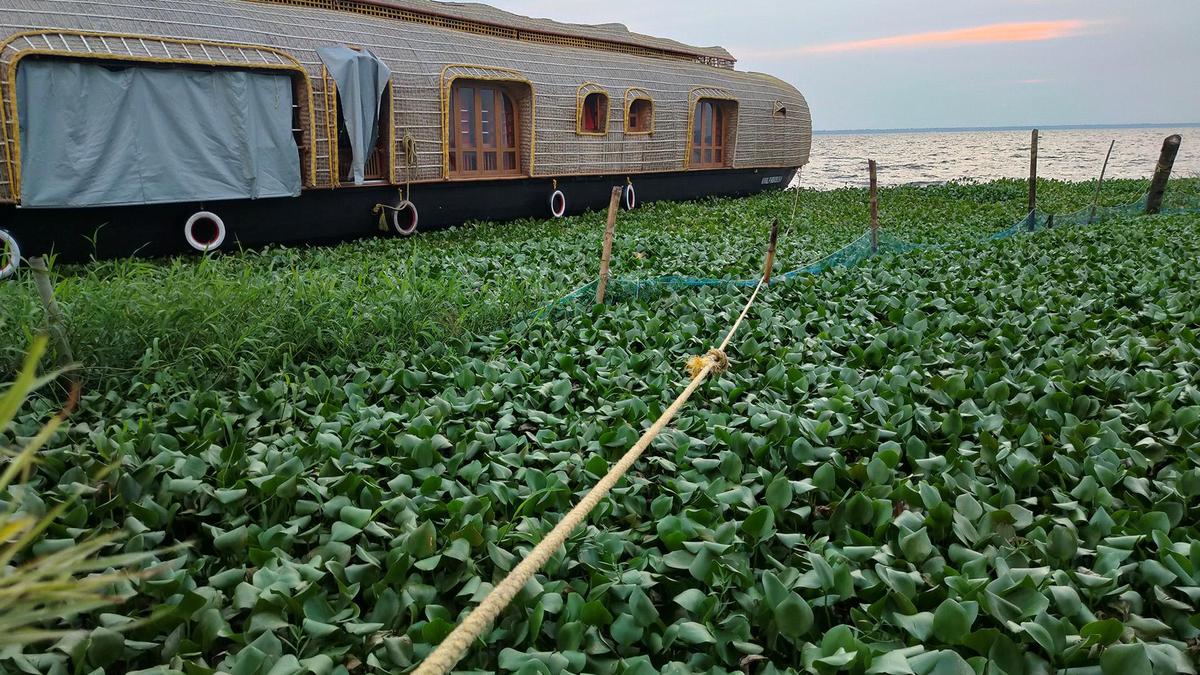
A thick blanket of water hyacinths that has infested a vast portion of the Vembanad lake. A scene from Kumarakom. | Photo Credit: File pic From handicrafts to compost, water hyacinth has found a range of uses. But its relentless spread across Vembanad Lake continues to overwhelm Kumarakom, prompting the backwater destination to turn to technology in a bid to bring the invasive weed under control.Starting September 10, the village will host a one-month pilot project that will deploy a robotic system to harvest water hyacinth from the lake and explore ways of processing the weed into value-added products. The initiative is being launched by the State Wetland Authority Kerala (SWAK) in association with stakeholders, including the Chamber of Vembanad Hotels and Resorts (CVHR).Led by the Centre for Water Resources Development and Management (CWRDM), the project will seek to turn harvested water hyacinth into value-added products for marketing through local channels. The Kochi-based Foundation for Environmental Research and Innovation (FERI) will serve as the implementing agency. The pilot will deploy an unmanned surface vehicle equipped with a robotic mechanism to collect water hyacinth from the lake. The weed will be shredded on the water before being taken ashore for drying and further processing, with the dried material to be used as a raw material for products such as soil supplements. An electric-propeller-powered boat will be used to minimise emissions during the operation.“The system includes an unmanned boat equipped with a robotic mechanism to harvest water hyacinth. The harvested weeds will be passed through a conveyor belt to a second boat, where waste such as plastic, cloth and other materials will be manually segregated. After segregation, the weeds will be shredded before being transported to the shore for processing,” said Rojith Gireendran, research scientist and director, FERI.The need for a more effective intervention has become increasingly evident as water hyacinth spreads across the lake, affecting tourism, inland navigation and fishing livelihoods. Thick mats of the weed have accumulated along the shores of resorts, forcing kayaking and boating activities to be suspended at several places. Houseboats, shikaras and speedboats are also struggling to navigate some stretches of the lake.“The accumulation of water hyacinths has badly hit tourism activities in Kumarakom. While a cruise through backwaters is the primary demand of guests, sometimes, we are unable to meet their demand due to the proliferation of water hyacinth,” said K. Arun Kumar, general manager, Lake Song Resorts.The infestation has also disrupted public transport. According to a State Water Transport Department official, six to seven of the 32 daily services between Muhamma and Kumarakom are being cancelled because the weed damages boat propellers. A journey that normally takes about 45 minutes can now take twice as long. The problem extends beyond tourism and transport, affecting the movement of agricultural produce in north Kuttanad, drinking-water supplies and the livelihoods of communities dependent on the lake.The project is being implemented under the National Plan for Conservation of Aquatic Ecosystems (NPCA) of the Union Ministry of Environment, Forest and Climate Change. If the field trial proves successful, the initiative will be expanded to other parts of Vembanad in association with the local bodies concerned.The Kottayam district panchayat has assured support for the initiative. “If the pilot project is successful, the district panchayat will prepare a project to help market the products and allocate the required funds,” said P.K. Vysakh, district panchayat member from the Kumarakom division. Published - September 01, 2026 07:42 pm IST
As water hyacinth chokes Vembanad, Kumarakom turns to robots
Full Article
Original Source
Read the full article at Thehindu →KhanList aggregates and links to publicly available news content. We do not host full articles from third-party sources. Always verify important information with original sources.