
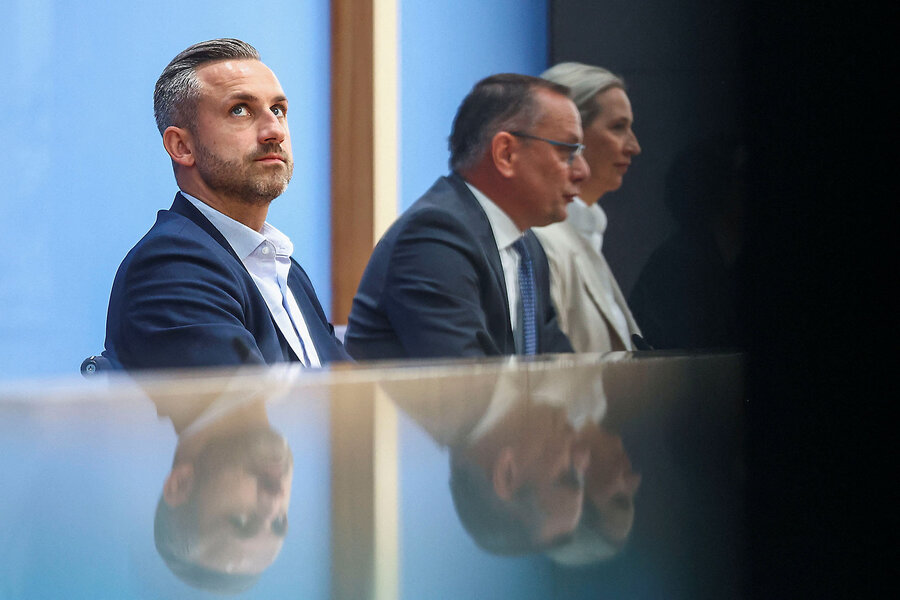
For a decade, many Europeans have looked on the political transformations in the United States with shock and alarm.The rise in incivility, the growing acceptance of misinformation, and the storming of the Capitol in 2021 all seemed to suggest the decline of the bedrock political values that the U.S. shared with Europe.But today, those norms are under mounting threat on this side of the Atlantic, too. With many academics saying democracy is in a global recession, Europe offers a different lens. On one hand, some European nations have held to those norms more strongly, primarily because of the resilience of their institutions and the fact that the European media landscape is not yet as fragmented as in the U.S. Others, such as Hungary, have gone to the other extreme, flirting with a near-total collapse of democratic standards only to come back from the brink.What emerges is a surprisingly similar picture worldwide, with far-right groups making significant headway in attacking the norms that defined Western democracy during the postwar era. Some experts suggest this shift is the outgrowth of an increasing sense of economic and cultural insecurity globally.What feels to some like the collapse of norms feels to others like a needed backlash against a social and political order ever more out of sync with their values. “If you want to change something in society, it’s all about trying to convince people of a different set of norms,” says Vivien Schmidt, the Jean Monnet Professor of European Integration at Boston University. “Europe might be on the same trajectory as the U.S., but just a decade later.”Many sociologists have been stunned by President Donald Trump’s ability to smash American political norms – the accepted patterns of behavior – that had held sway for decades.Europe offers a different laboratory, and Germany has, at least so far, gone in an opposite direction. As Mr. Trump has ridden his norm-smashing to the U.S. presidency, his political kin in Germany have been frozen out of power entirely.The far-right Alternative for Germany (AfD) shares much of Mr. Trump’s rhetoric – particularly his generalization of many migrant groups as criminals and burdens on the state. But the AfD has added a German twist. It wants to destroy postwar Germany’s Nazi guilt. Nazism is past, the group says, and remembrance makes the nation weak.But this “culture of remembrance” is one of the country’s most powerful postwar norms, and German institutions have responded strongly to defend it. The Federal Office for the Protection of the Constitution has named the AfD an extremist group, all other parties have refused to cooperate with it, and much of the national media takes a clear anti-AfD position. The result: Despite being the second-largest party in the Bundestag, the German Parliament, the AfD is part of no coalition and has no power – in Berlin or any state. But that resistance is cracking. The AfD won its highest-ever vote share (44%) in a recent election in the state of Saxony-Anhalt.Often, Mr. Trump has turned what once had been shame into defiance, says Ann Swidler, a sociologist at the University of California, Berkeley. “For some voters, ‘He says out loud the things I have been thinking.’”The AfD has arguably made that the center of its appeal.It points to how norms change. The media landscape is evolving, here and elsewhere.The current norms were created in a world in which there were three broadcast channels in the U.S. and most other countries had government-supported media, says Dr. Swidler. “We look backward through history and think everyone shared the same normative order,” she adds. But in the past, “there was a lack of ability for subcultures to express themselves.”To some experts, the growing backlash is a sign that the progressivism of recent years went too far for many people. In Germany, the country took in more than 1 million refugees in 2015. Combine that with an increasing sense of economic insecurity as many European economies stall, and the result is stress on prevailing political norms. Deepen your worldviewwith Monitor Highlights.Politics with respectGet political stories with respectful analysis.There‘s a world of new ideas in everyBooks newsletter.There‘s more to life, enrich yours withCulture & Learning weekly.Follow humanity‘s discoveries withScience & Nature stories in your inbox.Gain a spiritual perspectivefrom the stories in your inbox.Want to understand the deeper impact of critical events? Learn the Monitor‘s insight.Already a subscriber? Log in to hide ads. Hungary, however, recently moved in the opposite direction. Former Prime Minister Viktor Orbán ruled for 16 years with the professed goal of dismantling the neoliberal order. From control of the media to the courts to the economy, Mr. Orbán sought to create new social norms around national solidarity within the state. But when the economy stalled, and corruption skyrocketed, voters threw him out.“Did [Mr. Orbán] change norms or did he just control society?” asks Dr. Schmidt of Boston University. “He might have altered the norms for part of society.” But overall? “Clearly not as much as people thought.” ALREADY A SUBSCRIBER? LoginReal news can be honest, hopeful, credible, constructive.The Christian Science Monitor was founded in 1908 to lift the standard of journalism and uplift humanity. We aim to “speak the truth in love.” Our goal is not to tell you what to think, but to give you the essential knowledge and understanding to come to your own intelligent conclusions. Join us in this mission by subscribing.
As US drifts, Europe doubles down on its political values
Full Article
Original Source
Read the full article at Csmonitor →KhanList aggregates and links to publicly available news content. We do not host full articles from third-party sources. Always verify important information with original sources.