
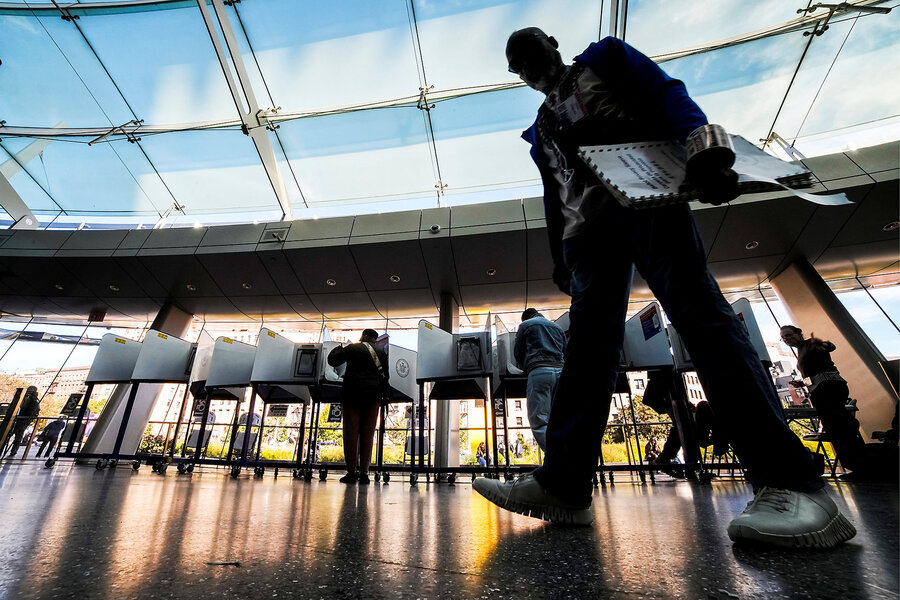
Washington | Oct. 30, 2026, 2:32 p.m. ET | 6 min read After the Trump administration recently demanded that California set aside midterm election ballots it claims could be from noncitizens, a federal judge there firmly rejected the effort.Elections are traditionally regulated and managed by states, and the judge said allowing the move would “wreak havoc” and potentially disenfranchise registered voters.If the executive branch “can discount votes and threaten an ongoing election due to unproven allegations, then our democracy is in danger,” U.S. District Judge David Carter wrote on Wednesday. Data shows noncitizen voting is rare, and there is no evidence to suggest it has altered election results. Yet President Donald Trump has threatened to prosecute California election officials if they count those ballots. The administration, which also told Washington state to set aside ballots, appealed the California ruling. On Thursday, the Justice Department issued federal grand jury subpoenas to California election officials. Mike Blake/ReutersCalifornia election workers process mail-in ballots in San Diego, Oct. 23, 2026. It’s among Mr. Trump’s efforts to make noncitizen voting a major issue ahead of next week’s midterms, in which analysts say Democrats could take control of both the U.S. House and Senate. And it’s one reason some election experts say the president is laying the groundwork to challenge the results.But across the country, lawmakers, election officials, and other groups are preparing: deploying poll observers, writing legal briefs, and gaming out how they would respond to scenarios such as federal law enforcement seizing voting equipment based on fraud claims.State and local election officials “are more prepared now than I have ever seen them in my life,” says Justin Levitt, an elections law expert at Loyola Law School in Los Angeles. Michael Hanmer, a politics professor at the University of Maryland, says he expects a smooth election. Still, he says, taking concerns seriously is the right approach.“Things can happen fast,” he says.Armed forces or ballot seizureElection experts are focused on two possibilities in particular: first, that the administration tries to seize ballots; and second, that it deploys military troops or Immigration and Customs Enforcement agents at or near polling places.The Justice Department this year seized ballots from an election warehouse in Fulton County, Georgia, connected to 2020 fraud claims Mr. Trump made without evidence. The New York Times reported also that the president said he should have ordered the National Guard to seize voting machines in 2020. Mike Stewart/APAn FBI employee stands inside a Fulton County, Georgia, election facility as the bureau confiscates ballots from the 2020 election, in Union City, Georgia, Jan. 28, 2026. Nick Brown, the attorney general in Washington state, is working with state and local election administrators on how to respond to “all of the attacks on our state sovereignty.”His office has trained officials on the difference between federal administrative warrants and federal judicial warrants, and what to do if the government sends law enforcement to the polls, or tries to halt vote counts or seize ballots.“It used to be that in elections ... our biggest concern was foreign interference or some rogue nation or data breach,” he says. “In this moment, we’re most acutely worried about the federal government.” In Michigan, state Attorney General Dana Nessel has held tabletop sessions for scenarios including federal lawsuits or the arrival of immigration agents to search for noncitizens attempting to vote.The president has declined to rule out sending the National Guard or ICE to polling locations. But U.S. law bars armed federal officers and troops at the polls. If the administration tried it, the move should legally fail, says Joseph Nunn, counsel at Brennan Center for Justice’s Liberty and National Security Program.A Department of Homeland Security spokesperson said in an unsigned email that ICE does not plan to target polling places, adding, “If an active public safety threat endangered a polling location, they may be arrested as a result.”In a letter to a Democratic U.S. senator this past summer, the chairman of the Joint Chiefs of Staff – the United States’ highest-ranking military officer – denied plans to deploy troops. The Justice Department, which oversees the FBI, has pushed back on similar concerns.“[The] DOJ has never said it would send federal law enforcement to the polls. Any suggestion otherwise is fearmongering,” Kiersten Pels, a department spokesperson, said in an email. Meanwhile, ICE has publicized a voter-eligibility door-knock campaign by its Homeland Security Investigations (HSI) agents. A second federal judge in California limited that operation in nine states last week amid concerns about the reliability of the government’s target lists. The Trump administration is appealing. Jae C. Hong/APHomeland Security Investigations agents leave a home in Commerce, California, after arresting a person suspected of illegally registering to vote, Oct. 19, 2026. On the one hand, door knocking is a “very typical law enforcement step,” says Jerry Robinette, a former HSI official.On the other hand, he says, operating this close to an election, with its heightened voter-intimidation concerns, “does leave yourself vulnerable to that accusation, even though it may not be true.”Various federal and state laws prohibit voter intimidation. But troops have been used during elections, as when National Guard units, under the command and control of governors, assisted at polling places during the pandemic.Democratic House Minority Leader Hakeem Jeffries and Senate Minority Leader Chuck Schumer, alongside other groups, sued the Justice Department in September to bar armed officers from being in the vicinity of polling places. That litigation is ongoing.Congressional Democrats hope they can get ahead of some scenarios, including by using election observers. Mr. Schumer and Sen. Alex Padilla of California plan to deploy more than 100 Senate staffers to monitor elections in key races.“It’s ideal for people to watch the election process. A true and transparent election requires monitors,” says Doug Spencer, an election law professor at the University of Colorado Boulder. And NPR and CNN both report that members of Congress are working with lawyers to prepare court filings in case, for example, federal agents try to take custody of uncounted ballots.Strong election systemsMany election observers say administrators are ready to deal with challenges. Moreover, courts have rejected the Trump administration’s legal efforts thus far.One pending case is a recent Justice Department lawsuit to block certification of Alaska’s U.S. Senate result if the Democratic candidate wins by a slim enough margin. An Alaska Supreme Court ruling in June found that another candidate who has the same name as Republican incumbent Dan Sullivan could remain on the ballot. Kerry Tasker/ReutersFormer Rep. Mary Peltola, a Democratic candidate for the U.S. Senate, visits with supporters in Anchorage, Alaska, Jan. 17, 2026. This week, the issue gained new life when The New York Times reported that Democratic operatives had recruited the other Dan Sullivan in an effort to confuse voters and split Republican votes. The state is investigating whether election laws were broken. The practice is generally considered legal. Mr. Trump called it fraud.The administration’s other efforts to use fraud allegations as a tool to exert federal control over elections have not succeeded. President Trump issued two executive orders since taking office to change the rules for mail voting and to require proof of citizenship for voter registration. Core parts of both orders have been blocked in court.The Justice Department has sued 30 states plus the District of Columbia to compel them to hand over voter files in its search for ineligible voters. The administration has lost 27 times in court, with the latest ruling coming this week in Utah. Oklahoma settled its case by providing information; three other cases are pending.Those cases highlight the Constitution’s delegation of election authority to the states.Ryan Macias, a consultant on technology and security for election officials across the country, says much of the doubt of local systems is based on a misunderstanding. “Our election process is completely resilient,” Mr. Macias says. He cites aspects tested over decades, including maintaining a chain of custody for ballot materials and equipment, and the two-person rule for validating vote counts in full transparency.Rebecca Green, a law professor at William & Mary Law School, worries that hypothesizing about worst-case scenarios could discourage people from voting. But they can be confident, she says.“It’s really important to emphasize how hard it is to disrupt the election process in this country because it is so decentralized,” she adds.Ms. Nessel, the Michigan attorney general, says she believes eligible voters’ ballots will be counted without interference. Her biggest concern, she says, is that President Trump has undermined faith in the accuracy of the results. Professor Levitt acknowledges that the president’s rhetoric might cause some voters to stay home. So far, however, early voting is up across the country compared to the 2022 midterms, driven largely by Democrats. Deepen your worldviewwith Monitor Highlights.Politics with respectGet political stories with respectful analysis.There‘s a world of new ideas in everyBooks newsletter.There‘s more to life, enrich yours withCulture & Learning weekly.Follow humanity‘s discoveries withScience & Nature stories in your inbox.Gain a spiritual perspectivefrom the stories in your inbox.Want to understand the deeper impact of critical events? Learn the Monitor‘s insight.Already a subscriber? Log in to hide ads. “If we all believe that the federal government’s in control here and we disenfranchise ourselves, that is in his world a raging success,” he says. “I like to think that the record early turnout shows that the American people are smarter than that.”Sarah Matusek reported from Denver. ALREADY A SUBSCRIBER? LoginReal news can be honest, hopeful, credible, constructive.The Christian Science Monitor was founded in 1908 to lift the standard of journalism and uplift humanity. We aim to “speak the truth in love.” Our goal is not to tell you what to think, but to give you the essential knowledge and understanding to come to your own intelligent conclusions. Join us in this mission by subscribing.
As Trump seeks influence in midterms, election officials focus on security
Full Article
Original Source
Read the full article at Csmonitor →KhanList aggregates and links to publicly available news content. We do not host full articles from third-party sources. Always verify important information with original sources.