
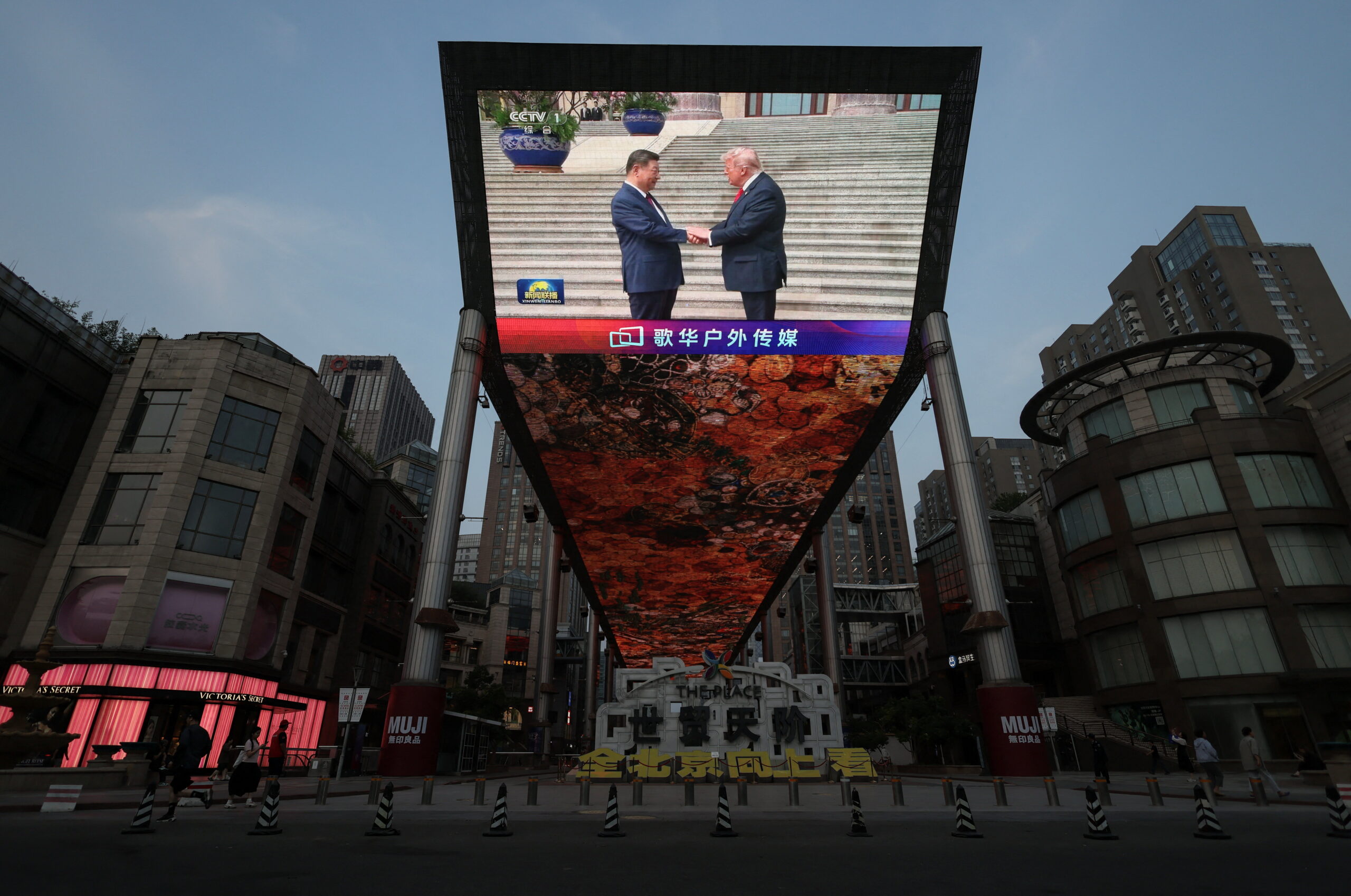
As the thirty-third Asia-Pacific Economic Cooperation (APEC) Leaders’ Meeting begins this week in Shenzhen, China has set an expansive agenda, including pushing for a roadmap for Asia-Pacific-wide free trade. While many eyes are on the last-minute trilateral meeting among Chinese President Xi Jinping, US President Donald Trump, and Russian President Vladimir Putin this Thursday, the separate Trump and Xi bilateral, their third this year, will bring economic issues to the fore. The Nvidia scandal that broke last week has added to tensions, and semiconductor export controls loom over the trade negotiations at a moment when both Washington and Beijing have reason to preserve the truce struck in October 2025. The smuggling of advanced US semiconductors into China, along with Chinese firms’ remote access to computing power abroad, have long concerned Washington. The Nvidia-Megaspeed controversy, in which a Singapore-based cloud provider is under investigation for allegedly diverting restricted chips to China, has further exposed potential gaps in the US export-control regime. Megaspeed has denied wrongdoing. The incident has raised questions as to whether export controls are effective in containing Chinese technological advancement and how the US can close existing loopholes. US-China trade is often shaped one economic restriction and one technical standard at a time. From outbound investment screening to various entity lists and other trade restrictions, neither side has ceased introducing new restrictions despite the trade truce, and all the while China’s April 2025 rare earth export licensing requirements remain in force. The Chinese espionage allegations surrounding a former Megaspeed executive with reported ties to Nvidia’s Jensen Huang have already given Congress and the Department of Commerce new fuel to pursue stronger semiconductor controls. In response to Huang’s resignation as CEO of Nvidia, Representative John Moolenaar, chairman of the Select Committee on China, called on Congress to “act quickly to pass bipartisan export control legislation in the year-end national defense bill.” Current legislative efforts include the AI Overwatch Act, the Chip Security Act, and the MATCH Act, which propose measures such as requirements for chip-location verification and alignment of allied controls on semiconductor manufacturing equipment. And over the weekend, Commerce released an interim final rule to address remote access to computing power—though it is still unclear how this rule will be implemented and enforced. Tighter US restrictions on advanced chips could invite Beijing’s retaliation through stronger rare earth controls or the reinstatement of the broader restrictions whose suspension China recently extended through January 10, 2027. The chokepoint that never loosened In April 2025, China’s Ministry of Commerce and General Administration of Customs issued Announcement No. 18 of 2025, which implemented export controls on seven rare earth elements. While not explicitly targeted at the United States, China’s dominance of critical mineral supply chains was heavily leveraged during the trade war escalation. These export controls disrupted supply chains globally, from automakers to electronics manufacturers. As part of the Busan trade truce, the White House announced that US companies would be provided with a general license for these and other elements, describing it as a “de facto removal of controls China imposed since 2023,” but China did not make a reciprocal announcement guaranteeing access. As shown in the chart above, US imports of selected controlled rare earth elements from China have not returned to pre–trade war levels, and US manufacturers continue to grapple with shortages of materials necessary for semiconductor production, automobiles, and national defense. International companies, including US firms, have expressed frustration over the Byzantine licensing regime, which requires extensive reporting on supply chains, while shipments remain limited even when licenses are approved. If the US Congress capitalizes on the momentum from Nvidia’s shakeup, more semiconductor legislation could trigger tighter rare earth controls from China. Beijing could counter by reinstating its currently suspended October 2025 regulations, which would restrict transfers of Chinese-made rare-earth refining equipment and extend export controls to foreign-made products containing Chinese-origin rare earths. And despite new investments in domestic and allied critical mineral supply chains, the United States is not yet better equipped to deal with the implementation of these controls, as alternative mining and refining projects are years away from production. The realities of long-term strategic competition could expose the limits of Trump’s personal diplomacy with Beijing and potentially jeopardize cooperation through initiatives such as the AI Safety Dialogue or the Board of Trade. China could link progress in these forums to concessions on semiconductor controls, for instance. The fallout from Nvidia is galvanizing Congress and other US agencies to intensify oversight of trade and investment with China in the next few months, and Washington will have to consider how far it can push when faced with Beijing’s rare earths chokehold. Both Trump and Xi have reason to preserve steady relations ahead of the December Group of Twenty (G20) Leaders’ Summit in Florida, where these conversations will continue, and through the trade truce’s January expiration. But instead of tariffs and trade agreements, export controls could become the major point of contention in negotiations in 2027. While the United States cannot fully diversify its rare earth supply or rebuild a stockpile overnight, China has used its rare earth export controls since April to squeeze companies in Japan, South Korea, and the European Union as well. Diversifying supply will take long-term planning and investment. But as trade negotiations continue, Washington would benefit from a coordinated response to China’s licensing regime and its broader nonmarket practices. Jessie Yin is an associate director at the Atlantic Council’s GeoEconomics Center. Image: A giant screen at a shopping area shows news footage of Chinese President Xi Jinping meeting US President Donald Trump at the Great Hall of the People, in Beijing, China, on May 14, 2026. (REUTERS/Tingshu Wang)
As the Nvidia scandal threatens to reignite trade tensions at Trump-Xi talks, Beijing still holds the rare earths
Full Article
Original Source
Read the full article at Atlanticcouncil →KhanList aggregates and links to publicly available news content. We do not host full articles from third-party sources. Always verify important information with original sources.