
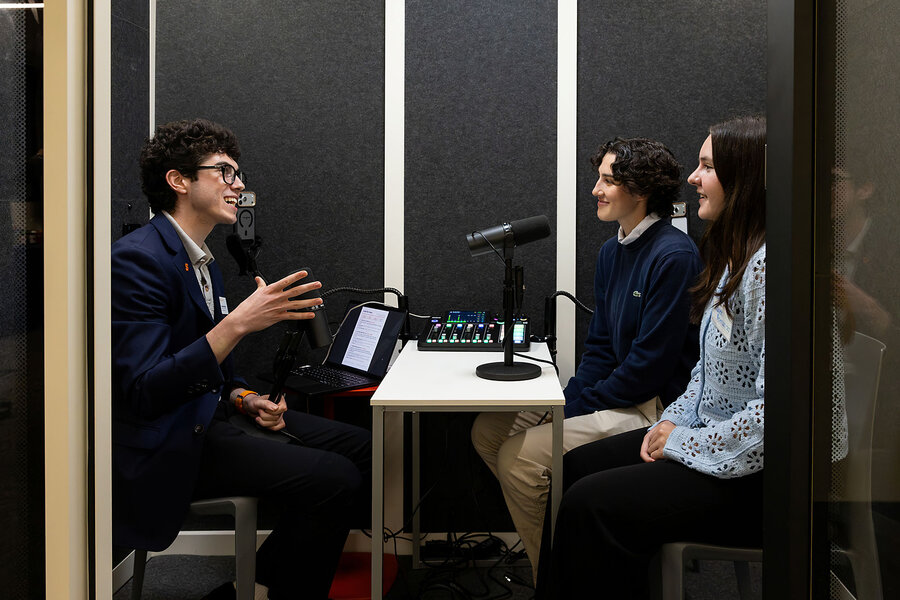
Zachary Glatt hosts a monthly podcast called “The Business Leaders of America,” where people watch his interviews with entrepreneurs, CEOs, and education leaders across various social media platforms.Mr. Glatt films at Syracuse University in New York, where he is a sophomore journalism major with a minor in content creation.After Syracuse launched the Center for the Creator Economy last year, Mr. Glatt transferred from another university. He was looking for more support for his budding online endeavor. Syracuse’s S.I. Newhouse School of Public Communications and the Martin J. Whitman School of Management combined resources to provide space for creators, including a state-of-the-art studio, and multidisciplinary course offerings that this year became an 18-credit minor. “I hear that there’s talk of turning it into a major next year, which, if possible and all the ducks line up in a row, I actually would make that my major,” Mr. Glatt says.Programs for influencers reflect shifting interests and resources – at Syracuse, Arizona State, St. Bonaventure in New York, and elsewhere. As colleges face a shrinking pool of applicants, known in higher ed circles as the “demographic cliff,” as well as financial pressures caused by the loss of foreign students and curtailed federal research funding, they are retooling their offerings to attract students such as Mr. Glatt.This year, Syracuse announced it was cutting or pausing 93 academic programs. The school’s provost said at the time that it was not a cost-cutting move, but rather to rightsize the school’s offerings and align them with student demand. Content creator academic programs, including AI-focused majors and minors popping up across the country, also reflect where there’s investment in the economy. “Sometimes, I think there’s a part of it where it’s like you’re trying to chase a trend, but I do think that, like with anything, they are following the money, and there’s money going into influencing right now,” says Jacob Hiler, an associate professor of marketing at Ohio University.Dr. Hiler, who teaches influencer marketing and is himself a content creator, says that colleges do this in cycles, whether they lean into marketing esports as a recruiting tool or build programs that prepare people for specific career paths. Influencing is lucrative right now, but it could change, he warns.He adds that, when it happens, people will have to pivot to different careers, but that a strong content creation program teaches students marketable skills.A career pathLearning to use audio and video equipment was important to Mr. Glatt.Now, he films his show with the latest cameras and has a designated podcast space where he and fellow creators can share feedback. One recent guest was the Center for the Creator Economy’s executive director, Ryan Schram, who is a former executive at a marketing technology firm that connects brands and social media influencers. Courtesy of Matthew Nerber/Syracuse UniversityStudents at Syracuse University's Center for the Creator Economy work together to prepare online content. Mr. Schram says that the center will respond to the changing interests of students, industry demand, and the college’s demographic pressures. It will teach a program of content creation, production, distribution, monetization, representation, management, finance, intellectual property, brand marketing, and new technology.“Becoming a content creator is one of the top career paths that young people are seeking presently,” he says. Investment firm Goldman Sachs released a report in 2023 that forecast the content creator ecosystem to double by 2027 to nearly $500 billion. Influencers make money via branding deals and can get a share of advertising revenue on their platforms. But only 4% of creators were making more than $100,000 annually, according to the report.“Some incoming young adults just believe that this is a get-rich-quick move. ‘Oh, I want to go and start up a TikTok and, suddenly, I’m going to have millions of dollars just pouring in because, I’m creating content,’” Mr. Schram says. “It doesn’t work that way.”Faculty members have honest conversations with young people and tell them hard work doesn’t mean that anything is promised to them, he says.“We start with the same level of honesty and rigor that we use for any other career path,” Mr. Schram says.And if they try and don’t become (insert your favorite influencer here), they will have learned about marketing, production, camerawork, branding, and entrepreneurship, which is the focal point of the program. Students need to learn to brand themselves to stand out as entrepreneurs or in traditional nine-to-fives, he adds.Skill trainingArizona State University started a media content creation minor in 2024 and, because of its popularity, launched a major this fall. Students are learning to produce and hone their craft, deal with agency representation, brand marketing, and camera-adjacent roles that will make them employable. Ross D. Franklin/AP/FileThe Walter Cronkite School of Journalism and Mass Communication in Phoenix is part of the Arizona State University system. The school launched a content-creation major this fall. “We train people to become content creators in the same way that we train journalists, in the same way that we train strategic communicators,” says Jessica Pucci, senior associate dean and professor of practice at the university’s Walter Cronkite School of Journalism and Mass Communication. “Whether you want to become a video content creator, a newsletter creator, a journalist or a PR specialist, all of these things require great writing, and great writing begins with summarizing information,” she says.Being an influencer filming tasty food on a weekend trip out of town or showing off apparel sponsored through a brand partnership requires summarizing information, she says. She often teaches students to boil complicated academic reports down to 75 words, or to pretend they are pitching CEOs during a one-minute elevator ride.Students are taught photo and video skills, how to manipulate spreadsheets, create data visualizations, and use data analytics to better understand content performance and how to improve and connect with audiences in real time. They also learn media law and about intellectual property and the rights that content creators have when they sign brand deals.“Communication is in and of itself not a solo act,” Ms. Pucci says. “It’s an act of connection, and at the end of the day, we’re teaching students how to connect with people.”Building a brandBack at Syracuse, Matty Weisholtz is the inaugural president of the ‘Cuse Creative Studios student group. The content creator minor wasn’t started in time for the senior to pair it with her marketing major. But she has benefited from the center’s support as she built an online profile for content and secured paid brand deals lucrative enough to allow her to pay for studying abroad last school year without asking her parents for money. “Anyone can pick up their phone and start recording, but not everyone can keep an audience maintained,” says Ms. Weisholtz. She gives career advice for internship seekers and promotes brands to her more than 24,000 followers on TikTok, 6,000 on Instagram, and 4,000 LinkedIn connections.“I chose a school that, as I was making it in the content creator world, built this center, and now I have guidance and people who want to help me build my brand and give students opportunities,” she says. ALREADY A SUBSCRIBER? LoginReal news can be honest, hopeful, credible, constructive.The Christian Science Monitor was founded in 1908 to lift the standard of journalism and uplift humanity. We aim to “speak the truth in love.” Our goal is not to tell you what to think, but to give you the essential knowledge and understanding to come to your own intelligent conclusions. Join us in this mission by subscribing.
As the influencer economy expands, colleges are offering instruction
Full Article
Original Source
Read the full article at Csmonitor →KhanList aggregates and links to publicly available news content. We do not host full articles from third-party sources. Always verify important information with original sources.