
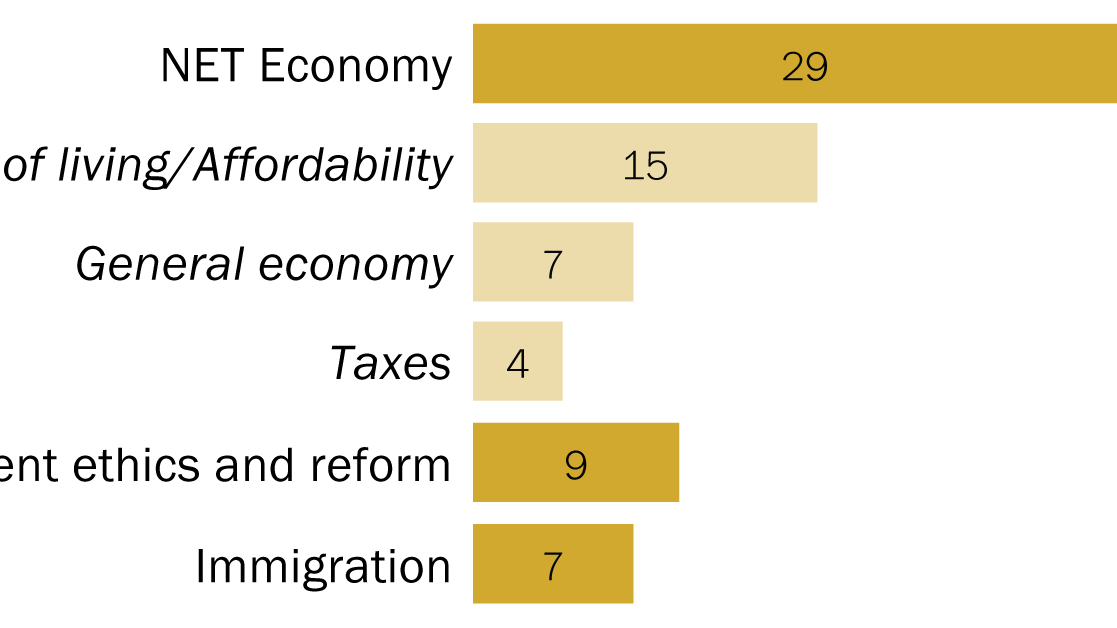
About this research This Pew Research Center analysis examines views of Congress and issues for the upcoming midterm elections, including the economy. Why did we do this? Pew Research Center conducts research to help the public, media and decision-makers understand important topics. We have studied Americans’ views of politics and major policy issues for decades. Learn more about Pew Research Center. How did we do this? We surveyed 3,554 U.S. adults from July 6 to 12, 2026. Everyone who took part in this survey is a member of the Center’s American Trends Panel. The survey represents the views of the full U.S. adult population. Here are the survey questions used for this analysis, the detailed responses and the survey methodology. By a wide margin, voters most want candidates running for Congress to talk about economic issues – with many specifically mentioning prices and affordability. Economic issues are top of mind for voters in the midterms this year What one issue would you most like to hear the candidates running for Congress in your district talk about during the campaign? (open end, % among registered voters) Note: Based on registered voters. Only response options that made up 4% or more of responses are shown here. Refer to topline for full question wording and response list. Source: Survey of U.S. adults conducted July 6-12, 2026. PEW RESEARCH CENTER Economic issues are top of mind for voters in the midterms this year What one issue would you most like to hear the candidates running for Congress in your district talk about during the campaign? (open end, % among registered voters) Category%GroupNET Economy29subgroupCost of living/Affordability15subgroupGeneral economy7subgroupTaxes4subgroupGovernment ethics and reform9groupImmigration7groupHealthcare5groupForeign policy4groupTrump4group Note: Based on registered voters. Only response options that made up 4% or more of responses are shown here. Refer to topline for full question wording and response list. Source: Survey of U.S. adults conducted July 6-12, 2026. PEW RESEARCH CENTER But with the November elections on the horizon, neither party is seen as having an advantage on these issues. Americans are now almost evenly split over which party they most agree with on economic policies: 37% say the Democratic Party, while 36% say the Republican Party. At this early stage, Democrats have both an edge in voters’ congressional candidate preferences and an engagement advantage among their coalition. Among registered voters: 43% say they would back a Democratic candidate for Congress if the election were held today, while 37% would back a Republican. Two-in-ten say they are not sure or would back another candidate. 70% of Democrats and Democratic-leaning independents say “it really matters” which party controls Congress in November, while 60% of Republicans and Republican leaners say the same. 39% of Democrats have thought a lot about the election, compared with 22% of Republicans. At a similar stage of the 2022 midterm campaign, Republicans held a modest edge on both engagement measures. These are among the key findings of a new Pew Research Center survey conducted from July 6 to 12 among 3,554 U.S. adults, including 2,779 registered voters. The survey also finds that President Donald Trump looms large in the campaign. Most voters say the president is a factor in their vote – though by roughly two-to-one, voters are more likely to say they think of their vote this fall as a vote against Trump (42%) than to say they think of it as a vote for him (22%). Views of Trump are a bigger factor for voters today than views of then-President Joe Biden were at a similar point four years ago. Most voters say Trump is a factor in their midterm vote, including 42% who view their vote in opposition % of registered voters who think about their vote for Congress this fall as … Note: Based on registered voters. No answer responses are not shown. Source: Survey of U.S. adults conducted July 6-12, 2026. PEW RESEARCH CENTER Most voters say Trump is a factor in their midterm vote, including 42% who view their vote in opposition % of registered voters who think about their vote for Congress this fall as … Against TrumpFor TrumpTrump is not much of a factorAll registered voters422235Rep/Lean Rep54450Dem/Lean Dem81118 Note: Based on registered voters. No answer responses are not shown. Source: Survey of U.S. adults conducted July 6-12, 2026. PEW RESEARCH CENTER Democrats overwhelmingly say they consider their vote for Congress this fall a vote against Trump – 81% view their vote this way. In contrast, half of Republicans say Trump is not much of a factor in their vote, while 44% say their vote is a vote for him. Views of the parties on key issues Before the start of Trump’s second term, Americans were more likely to agree with the Republican Party than the Democratic Party on economic policy. Continuing a trend since Trump took office, the public is now about evenly split (37% say they agree with Democratic Party, 36% the Republican Party). Neither party holds a clear advantage on economic policy % who say they agree with __ on the following policy issues Note: No answer responses are not shown. Source: Survey of U.S. adults conducted July 6-12, 2026. PEW RESEARCH CENTER Neither party holds a clear advantage on economic policy % who say they agree with __ on the following policy issues The Democratic PartyThe Republican PartyNeitherR-D advantageCrime policy294325R+14Immigration policy364121R+5Policies related to the use of military force353627R+1Policies related to AI222351R+1Economic policy373625D+1Foreign policy363528D+1Policies to deal with the budget deficit333133D+2Policies related to LGBT people373427D+3Education policy413225D+9Abortion policy423224D+10Healthcare policy422828D+14Environment and climate policy443024D+14 Note: No answer responses are not shown. Source: Survey of U.S. adults conducted July 6-12, 2026. PEW RESEARCH CENTER Similarly, Republicans no longer hold an advantage on policies to deal with the budget deficit. For more on Americans’ economic views, including views of the impact of Trump’s economic policies on the economy, jump to “Americans’ evaluations of the economy remain negative.” Neither party has an advantage on foreign policy or policies related to the use of military force, or on policies related to lesbian, gay or transgender people – a Democratic strength in 2022 and 2023. And when it comes to policies to deal with artificial intelligence, 51% of adults say they agree with neither party. Areas where Republicans hold an advantage Americans continue to be more likely to agree with the Republican Party (43%) than the Democratic Party (29%) on policies to deal with crime. Republicans also hold a 5 percentage point edge on immigration policy. This compares with a 9-point Republican advantage in September. Areas where Democrats hold an advantage Democrats hold 14-point advantages on both healthcare and environmental policy, a 10-point advantage on abortion policy, and a 9-point advantage on education policy. Other key findings Trump’s approval rating stands at 34%, while 64% of Americans say they disapprove of his job performance – unchanged since April. About seven-in-ten Republicans (69%) currently approve of his performance, while roughly three-in-ten (29%) disapprove. Democrats continue to overwhelmingly disapprove of his performance (93% disapprove, 6% approve). Voters who disapprove of Trump, but not strongly, are divided in House candidate preferences % of registered voters who say that if the election were held today, they would vote for/lean toward the __ for the U.S. House of Representatives in their district Note: Based on registered voters. No answer responses are not shown. Source: Survey of U.S. adults conducted July 6-12, 2026. PEW RESEARCH CENTER Voters who disapprove of Trump, but not strongly, are divided in House candidate preferences % of registered voters who say that if the election were held today, they would vote for/lean toward the __ for the U.S. House of Representatives in their district GroupRepublican candidateDemocratic candidateAnother candidateNot sureNET Another candidate/Not sureAll registered votersAll374351420Approve very strongly (26%)Among those who ___ of the way Donald Trump is handling his job as president882189Approve not so strongly (11%)Among those who ___ of the way Donald Trump is handling his job as president73242125Disapprove not so strongly (12%)Among those who ___ of the way Donald Trump is handling his job as president3131102838Disapprove very strongly (49%)Among those who ___ of the way Donald Trump is handling his job as president57671218 Note: Based on registered voters. No answer responses are not shown. Source: Survey of U.S. adults conducted July 6-12, 2026. PEW RESEARCH CENTER The narrow slice of registered voters who disapprove of Trump, but not strongly (12%), are split in their midterm preferences: 31% back Republicans, 31% back Democrats. And many (28%) say they are not sure, while 10% back “another candidate.” In contrast, voters who approve of Trump back Republican candidates in the fall by an overwhelming margin, while those who strongly disapprove of Trump largely back Democrats. Demographic differences in voters’ midterm preferences largely track patterns familiar to past elections. Today, Republican candidates have a 10 percentage point edge among White voters, while Democrats hold wider advantages among Hispanic, Black and Asian voters. For more on demographic differences in candidate support, jump to “Midterm voting preferences by race and ethnicity, age, and other demographics” and explore the detailed tables. Views of Congress are near record lows % of have a(n) __ view of Congress Note: No answer responses are not shown. Source: Survey of U.S. adults conducted July 6-12, 2026. PEW RESEARCH CENTER Views of Congress are near record lows % of have a(n) __ view of Congress DateFavorableUnfavorable8/4/1935641/19/2033658/2/2035634/12/2136611/17/2228708/14/2231664/2/2326727/16/23267212/3/2323747/7/2430684/13/2534648/1/2532657/12/262572 Note: No answer responses are not shown. Source: Survey of U.S. adults conducted July 6-12, 2026. PEW RESEARCH CENTER Just a quarter of Americans now hold favorable views of Congress. Current ratings are near record lows and down from 32% last August. Republicans (35%) remain more likely than Democrats (16%) to view Congress positively.
As the 2026 Midterms Approach, Economy Is Front and Center
Full Article
Original Source
Read the full article at Pewresearch →KhanList aggregates and links to publicly available news content. We do not host full articles from third-party sources. Always verify important information with original sources.