
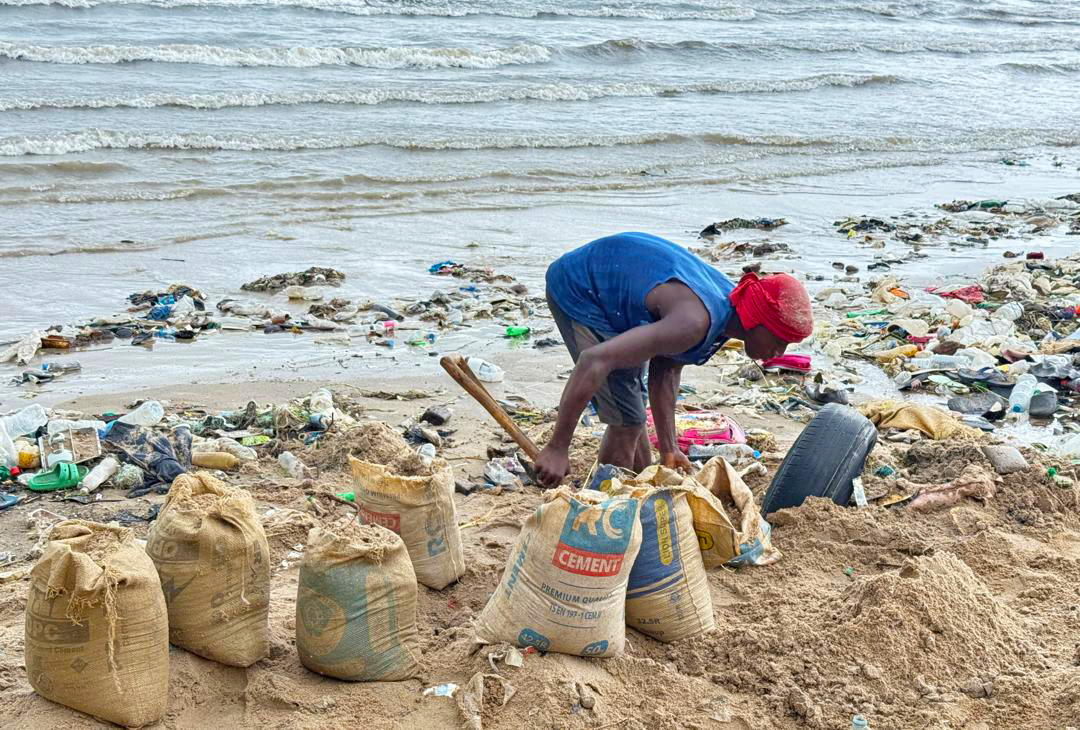
Sand mining at Sierra Leone’s Mahera Beach is impacting local tourism and coastal ecology while also defacing the landscape.Nearly 50,000 cubic meters is extracted from Mahera Beach annually, even as communities are torn between eking out a living and conserving coastal ecosystems.Many involved in the sand value chain are women and they disproportionately bear the economic and social burden of the trade. PORT LOKO, Sierra Leone — When the tide pulls away from the beach in the agricultural regions in Mahera in Lungi, about 27 kilometers (17 miles) across the sea from the country’s capital, Freetown, the digging commences. Young men shovel sand into cement bags and carry them to a flat open area to pile sand into heaps to be sold by local women to truck drivers. These women are dedicated sand sellers. They negotiate prices, buy sand from the shovelers and sell to heavy-duty truck drivers to be transported to Lungi, Port Loko and other areas. The income helps pay for food, school fees and other basic needs of their families. However, their work relies heavily on the seasonal tide: The sellers can buy sand during low tide but are banned from doing so during high tide. In Mahera, the sand trade began as a survival strategy for 14 women who became family breadwinners, mostly due to absent partners. Aminata Kargbo is the chairperson of the sand sellers in the locality in Mahera, and entered the business to support her seven children after her husband’s death. “Most of these women have lost their husbands, and the money we make goes to support our children,” she said. She oversees about 19 sand sellers, the majority of them women. Many of these women have become widows after losing their husbands to Sierra Leone’s civil war (1991-2002) and various illnesses. Aminata Kargbo, chairperson of the sand sellers in Mahera, stands in front of piles and bags of sand waiting for truckers. Image by Patricia Sia Ngevao. The sand trade in Mahera has created a small supply chain involving young men who extract the sand, women who buy and resell, landowners who provide storage facilities and truck drivers who transport the sand. It has also thrown a lifeline at women without an income. In March this year, the World Bank published an assessment on the scale and impact of sand mining on select tourism and coastal communities in Sierra Leone. Around the world, rising demand has turned sand into a valuable resource, linking its trade to construction, transport and environmental concerns. Globally, sand and gravel are the second-most extracted natural resources by volume, after water. A global study by the U.N. Environment Programme on sand sustainability, too highlighted the environmental and social risks of rising extraction, recording how the global demand for sand is exceeding ecological limits, with large-scale sand extraction from marine and coastal ecosystems leading to biodiversity loss, damage to coastal communities and increased risks due to climate change. Role of women The World Bank’s Sierra Leone Circular Economy Project shows sand extraction’s ecological cost and impacts on the Lungi community. As uncontrolled sand and beach mining severely erode coastlines, destroying local tourism across the country, in the informal mining economies, women frequently shoulder heavy physical labor such as carrying massive weights and manual sorting, driven by severe poverty, agricultural disruption and a lack of alternative employment. While poverty touches men and women alike, the women continue to bear a disproportionate burden not just in Mahera, but globally. Globally, women often depend on sand mining for income while being disproportionately affected by the social and environmental costs. A 2023 investigation showed how women in Cambodia, India, Kenya and Indonesia resisted against powerful sand mining operations in their respective communities. A 2023 research paper highlighted the gender roles in sand extraction in the Usumacinta River in Guatemala and Mexico. Media reports from India show how women from coastal communities become economically dependent on sand mining but are forced to deal with increased environmental costs. At present, sand mining provides an income in a place where alternate work is scarce. The earnings, though woefully inadequate, help meet basic needs. Even though many widowed women in Mahera rely heavily on sand trading and despite high reliance on the extractive industry, women like Kargbo welcome economic alternatives so they could quit the sand trade. They are aware of the impacts caused by the unregulated trade that weaken their environment landscape and acknowledge that their landscape is changing. “Since we started three years back, the changes have affected the way water moves on the beach area,” said Kargbo. A woman carries a loaded sack of sand on her head while walking away from the beach in Sierra Leone. Image by Patricia Sia Ngevao. Ecological impacts Their fears are confirmed by the World Bank assessment report which offers detailed insights on how coastal sand extraction could disrupt sediment flows, increase erosion and damage ecosystems and tourism assets. The report estimates approximately 50,000 cubic meters (1.8 million cubic feet) of sand are extracted annually from Mahera Beach alone and calls for stronger monitoring and clearer limits on extraction. Demand for sand in Sierra Leone is driven largely by local construction. The study notes that local construction accounts for 61-77% of sand use in the country, while the Mahera-Lungi corridor meets about 8% of that demand. The trade supports shovelers, women sellers and truck drivers along the supply chain. The sand trade sits at the intersection of livelihoods, construction demand and coastal protection. Sierra Leone’s sand mining is governed mainly by the Environment Protection Agency Act of 2022, Mines and Minerals Development Act of 2022 and the Local Government Act of 2004. Collectively, the laws require environmental assessments and mining licences to engage in extractive activities. The Environment Protection Agency (EPA) is responsible for monitoring and enforcement, the National Minerals Agency for mining regulation and the Local Councils Authority for issuing permits and collecting fees. However, weak coordination and regulatory gaps, particularly around artisanal beach and river sand mining, contribute to limited oversight. Pa Morlai Kargbo, senior headman of Mahera town, told Mongabay that once Mahera Beach was considered among the best beaches in Lungi, attracting people from as far as Freetown for recreational outings. He said those visits have declined as the beach has increasingly become a hive of sand mining rather than a location for recreation. To reduce the impact of sand mining, he said the community has demarcated mining areas that also protect nearby fishing zones. Pa Morlai Kargbo, senior headman of Mahera town. Image by Patricia Sia Ngevao. A large pile of sand sits in front of a house under construction. Image by Patricia Sia Ngevao. For Aminata Kargbo and other women in Mahera, sand trading offered a way to earn money without raising yet another loan for family support. “When we get sand, we sell it,” she said. The trade has since developed into a small chain involving the women who buy the sand, young men who extract it, landowners who provide areas where it is stored and truck drivers who transport it to buyers. Constituency 077, which includes Lungi and Mahera, is home to more than 60,000 people. With limited work opportunities, sand trading provides an income for many residents. The World Bank report adds that Sierra Leone needs to generate 75,000 new jobs each year, with more than 88% of nonagricultural self-employment concentrated in the informal sector. Nineteen-year-old Abdulai Conteh is a sand miner and loader. A former tailor, he left the job, as the income was inadequate. “I am doing this work to support my family,” he said. A shoveler like him earns 2 leones ($0.08) per bag and can carry 20-30 bags a day. Conteh told Mongabay that sand mining offers work for unemployed youth, and halting the trade without offering alternatives could lead the youth to vices like theft. “If sand mining is stopped, stealing could increase. Right now, many young people depend on this work,” he said. In the artisanal and commercial sand extraction trades, it is the women who are often exploited and underpaid. According to Pa Morlai Kargbo, women earn less compared with the transporters and truck owners who buy sand cheap but resell at much higher prices. While exact prices vary by quantity and destination, the figures suggest truckers earn more than the miners and sellers. Men work together to load sand into a truck. Image by Patricia Sia Ngevao. A stack of cement bags loaded with sand sits on the ground. Image by Patricia Sia Ngevao. Residents told Mongabay that enforcement is limited, with no inspections, permit checks or penalties, also noted by the World Bank study, which recommends stronger coordination and monitoring. But residents are concerned about mining restrictions taking their livelihood away. Kargbo agrees that mining should eventually stop but not before offering economic alternatives. “We cannot simply tell them to stop without offering an option to survive,” he said, adding that he has engaged microfinance institutions to help women access lower-interest loans. But both the women and young men want alternative livelihoods, not more loans or bans. Until then, they will continue to sand mine even as Mahera’s coastline continues to erode. Arnaud Vander Velpen is an engineering geologist, sand governance expert and a research associate at the University of Geneva. He described Sierra Leone’s coastal erosion as “staggering.” Velpen noted that continued beach sand mining would threaten the country’s beaches, tourism and environment, particularly around Freetown, Lungi and Mahera. Considering the ecological vulnerabilities, Vander Velpen called for a gradual transition from beach sand mining by supporting alternative livelihoods such as tourism and fisheries, improving access to alternative construction materials and strictly enforcing construction standards. Velpen also recommended “radical transparency” and independent monitoring of sand extraction in the construction-material supply chain. “Sierra Leone can address the problem while protecting communities that currently depend on the sand trade,” he said, adding that willingness, combined with the availability of alternative materials and economic activities, provides an opportunity for Sierra Leone to transition from unsustainable beach sand mining while preserving the community structures they have developed around the trade. In an email to Mongabay, Abu-Bakar Massaquoi, executive chairman of the EPA, said the agency has yet to conduct a site-specific assessment or establish extraction quotas for Mahera. He said the EPA is verifying operators’ licences and compiling inspection records, while acknowledging the need for scientifically defined extraction zones and stronger inter-agency coordination. According to him, the agency also acknowledges that women and young people depend on sand trading for their livelihoods. He recommends a phased transition involving alternative employment, sustainable construction materials, affordable licensing and community participation to balance environmental protection with economic needs. Banner image: A man shovels sand into bags on Mahera Beach. Image by Patricia Sia Ngevao. 19,000 Great Pyramids a year: Report flags unsustainable rate of sand mining Citation: Sand and Sustainability: An Essential Resource for Nature and Development. (2026). Retrieved from United Nations Environment Programme website: https://www.bothends.org/uploaded_files/document/Under_Embargo_12_May_noon_CET_Sand_and_Sustainabili.pdf Credits Topics
As sand becomes more valuable, Sierra Leone’s Mahera Coast grows more vulnerable
Full Article
Original Source
Read the full article at News →KhanList aggregates and links to publicly available news content. We do not host full articles from third-party sources. Always verify important information with original sources.