
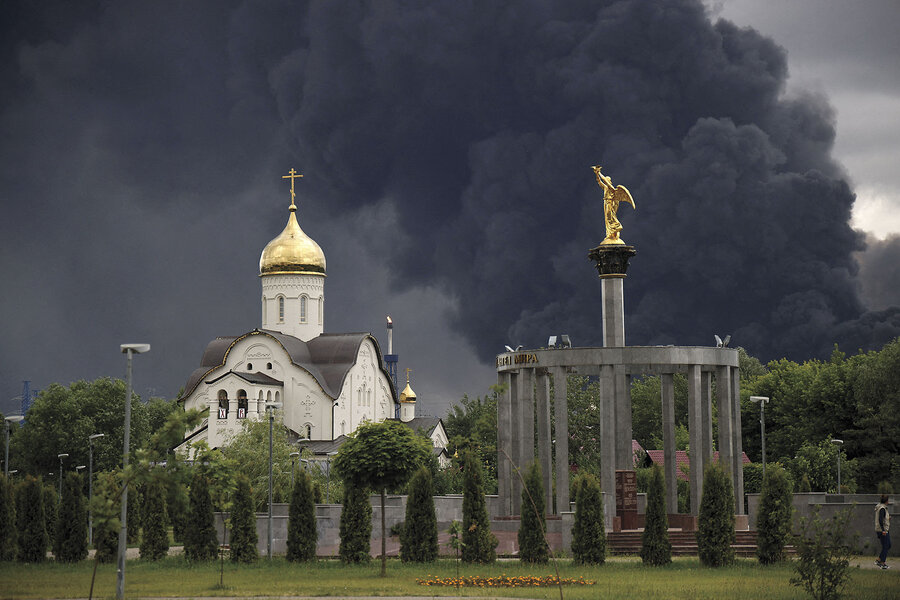
Russians have voted nine times for their Duma, or lower house of parliament, since it was formed in 1993, as the Russian Federation emerged from the dissolution of the Soviet Union. But these days, it’s hard to find much public enthusiasm for the exercise.Democracy in Russia has always been “managed.” Russian elections have never looked like congressional or parliamentary races in the West, with their robust debates and sometimes fiery public protests.Instead, experts say, Russians accepted that their vote was a tit for tat. For voting in line with the Kremlin, citizens were promised stability that was unthinkable in the chaotic 1990s; or a redistributed slice of national oil profits; or a sense that, together, they were helping rebuild Russia’s status as a great power, especially after it annexed its former territory of Crimea in 2014. But now, after five years of war in Ukraine and growing economic strains, the vote that starts Sept. 18 finds a nation weary. And with President Vladimir Putin under pressure to maintain his place at the pinnacle of Russia’s power structure – one he has held since the turn of the century – the public will have little room to express its opinions at the polls.“These will likely turn out to be the most inconspicuous elections in the history of post-Soviet Russia,” says Andrei Kolesnikov, an independent political analyst and Kremlin critic in Moscow.Maintaining a “systemic opposition”While many in the West view Mr. Putin’s Russia as simply a dictatorship, the reality is a lot more complicated.After a period of social turmoil and economic collapse in the 1990s, which featured a destabilizing struggle between irreconcilable political forces, Mr. Putin set out to tame the country. He banished wealthy oligarchs from politics, ushered in an era of social stability and relative consumer prosperity, and fostered a political system that critics quickly dubbed “managed democracy.” Sputnik/Alexander Kazakov/ReutersPresident Vladimir Putin, meeting with the chair of the Central Election Commission in Moscow, Aug. 5, 2026, says that Russia’s ability to hold elections during wartime shows national stability. The new system ensured that a certain amount of competition took place between distinctly different parties, and real political debates were sometimes aired. But the Kremlin set the limits and used various methods to ensure that no big electoral surprises ever occurred. That system has evolved over time, mostly in the direction of making it more reliable and predictable from the Kremlin’s point of view. The spectrum of parties is partly genuine, reflecting real political forces that speak to different social constituencies. But the garden has been heavily landscaped over the years to include only parties that play by an accepted set of rules; these are known as the “systemic opposition.”Those parties whose differences with the Kremlin seem fundamental, or who are seen as tied to foreign interests, are excluded. That “nonsystemic opposition,” personified by the late populist leader Alexei Navalny, is now mostly in exile and deeply divided, seemingly unable to agree among themselves on what to do – if anything – about Russian elections.Alexei Venediktov, the founder and longtime editor of the independent Echo Moskvi radio station, says the Kremlin’s key goal was to ensure effective management of the country at every level. “And that doesn’t involve endless discussions and disputes.”“The task in the upcoming elections is to reproduce the same composition the parliament has now. What is wanted is a simulacrum of a parliament, basically a printer to produce the needed laws with a minimum of discussion,” he says.Echo Moskvi was forced off the air in early 2022 for allegedly spreading “deliberately false information” about the war in Ukraine. When Russians go to the polls starting Sept. 18 to elect a new State Duma, there will be no anti-war candidates on the ballot, the only party advocating for such a position having been barred from competing.The war’s effectMr. Putin kicked off the election campaign of United Russia, the ruling party that supports him – but which he does not formally lead – with a speech on Aug. 22, Russia’s National Flag Day. In it, he stressed national unity, a determination to win the war without concessions to Ukraine or the West, and economic self-sufficiency for Russia. The fact that Russia is holding these elections amid war, he said, demonstrates the “stability of the state [and] the maturity of our political system.” But over the summer, the war escalated and moved much closer to home for many Russians.A new generation of Ukrainian drones has been striking deep into Russia’s heartland, destroying oil refineries and laying waste to consumer distribution centers. Most attacks receive detailed coverage in Russian social media.The psychological impact on average people of seeing huge explosions erupt in their own neighborhoods, and the subsequent shortages of gasoline and other consumer disruptions, is hard to gauge. Polls show that about two-thirds of Russian respondents favor a negotiated end to the conflict, though large majorities still say they support their troops in Ukraine, and only a quarter support making concessions to Ukraine in order to end the conflict.It’s hard to tell how the ongoing hardships might affect voting patterns, but a surprising surge in popularity of Yabloko, the only party that was on the ballot that explicitly opposes the war, from around 1% to as much as 5%, suggests that anti-war sentiment might be on the rise. In mid-August, Russia’s Supreme Court disqualified Yabloko from running candidates in the elections, taking that option away from voters.A shrinking playing fieldAn impressive 11 parties will be on the ballot, most of whom describe themselves as opponents of the ruling pro-Kremlin United Russia party. They range from the Communists, the social-democratic Fair Russia, and the quasi-liberal New Peoples’ Party on the left to the nationalist Liberal Democratic Party on the right. At least five of them are likely to surpass the 5% barrier required for gaining representation in the Duma. Ramil Sitdikov/ReutersNikolai Rybakov, chair of the anti-war party Yabloko, reacts after a hearing at the Supreme Court in Moscow, Aug. 17, 2026. The range of available choices narrowed when the Supreme Court barred Yabloko – which has run in every Duma election since 1993 – from fielding any candidates. The court cited alleged violations of election laws, such as using copyrighted material in their campaign literature and some candidates receiving funds from abroad. Regardless, the result was to exclude the only party in the race that explicitly opposes the war in Ukraine.Analysts pointedly note Yabloko’s recent surge in opinion polls. “People ask why the authorities allowed Yabloko to be registered, then removed it,” says Mikhail Vinogradov, head of a Moscow-based independent political think tank. “Even though Yabloko had hardly started campaigning, the sudden interest in it from a part of society that has grown tired of the war caused alarm in some government circles, and the authorities decided they didn’t want this precedent of a legally permitted anti-war stance to stand. “It won’t make much difference,” Mr. Vinogradov adds, “since critics of the war don’t have high expectations from the Duma elections anyway.”The court case against Yabloko was instigated by a rival, the small nationalist Rodina party, which accused it of being “unpatriotic.” At least seven Russian political parties – including the Communists, Fair Russia, and New People – subsequently issued statements vilifying Yabloko.Eliminating competitors by denouncing them to the law seems to be a growing trend in Russian politics. In the Volga region of Samara, a local court stripped a popular incumbent Communist deputy, Mikhail Matveyev, of his right to run after a candidate from the Party of Pensioners accused him of using copyrighted Microsoft fonts in his campaign material. The Communist Party, the largest in the systemic opposition, is outraged but appears helpless to do much about it.“In many regions, the election campaign is far from clean, honest, and transparent,” says Dmitry Novikov, a Communist Duma deputy and party official. “The electoral laws are overregulated, and we are accused not actually of violating them, but of things like copyright infringement.“How on earth can a candidate, who is not an investigator, know which publicly available fonts are copyrighted and which aren’t?” Mr. Novikov asks. “All this leaves us very critical of the way the election is being conducted.” AP/FileVoters line up at a polling station in St. Petersburg, March 17, 2026. But they will not be able to cast a ballot in September for Yabloko, the only anti-war party in Russia’s “systemic opposition,” after the Supreme Court barred the party from running. Public disinterestSociologists say public enthusiasm for elections has waned over the years, with up to 80% of pensioners voting mostly out of a sense of duty, but only a third of people under age 30 doing so.“I won’t take part in the elections,” says Anna, a student in St. Petersburg. She declined to give her full name for fear of potential repercussions from being quoted in a Western publication, a common public concern. “There is no real choice for me; it is all an imitation of a democratic process. There is an authoritarian regime in Russia, and there is no party I feel any reason to support.” Deepen your worldviewwith Monitor Highlights.Politics with respectGet political stories with respectful analysis.There‘s a world of new ideas in everyBooks newsletter.There‘s more to life, enrich yours withCulture & Learning weekly.Follow humanity‘s discoveries withScience & Nature stories in your inbox.Gain a spiritual perspectivefrom the stories in your inbox.Want to understand the deeper impact of critical events? Learn the Monitor‘s insight.Already a subscriber? Log in to hide ads. Kseniya, a homemaker in Moscow, agrees. “I gave birth to my third child, and I don’t think I’ll have time or wish to go to vote, even if there was any real choice,” she says.“At this point, public interest in the elections is very weak,” says Lev Gudkov, scientific director of the Levada Center, Russia’s only independent public opinion agency. “People just don’t associate electoral outcomes with the solution of their everyday problems. It’s the authorities who need the election to promote the illusion of nationwide support, and to rotate the ranks of the deputies. It’s become a largely bureaucratic exercise.” ALREADY A SUBSCRIBER? LoginReal news can be honest, hopeful, credible, constructive.The Christian Science Monitor was founded in 1908 to lift the standard of journalism and uplift humanity. We aim to “speak the truth in love.” Our goal is not to tell you what to think, but to give you the essential knowledge and understanding to come to your own intelligent conclusions. Join us in this mission by subscribing.
As Russia votes, the Kremlin offers the public few options – or incentives
Full Article
Original Source
Read the full article at Csmonitor →KhanList aggregates and links to publicly available news content. We do not host full articles from third-party sources. Always verify important information with original sources.