
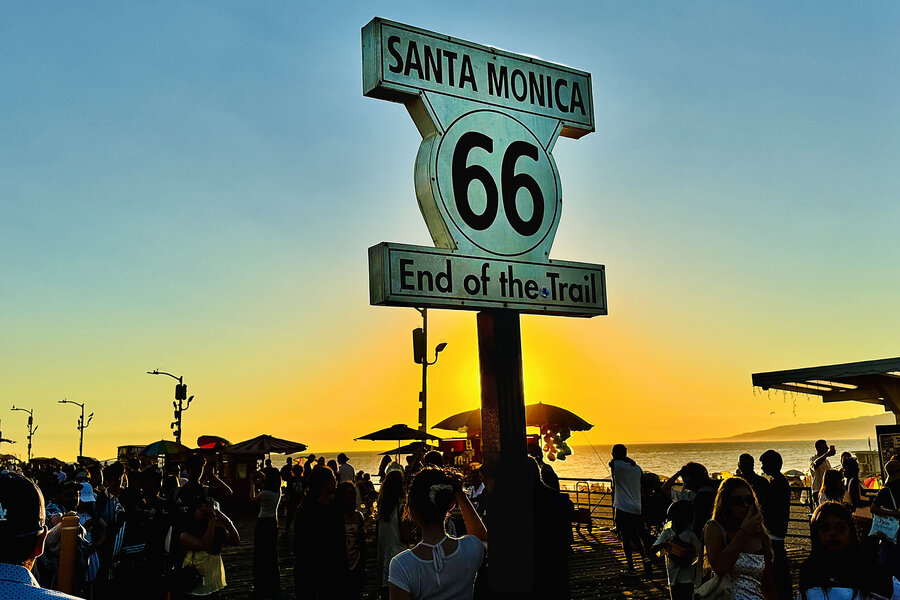
Santa Monica, California | Nov. 09, 2026, 1:29 p.m. ET | 3 min read After months of traveling west on Route 66, I reached the end of the trail with one final problem to solve: finding a parking space.It was metro Los Angeles. Traffic was crazy. Parking garages couldn’t accommodate my pickup. Then, somehow, I found a space on the street. After all those miles, a vacant stretch of curb felt like a small miracle.There was something fitting about having to attend to this last practical detail. A journey requires a certain amount of planning, patience, and serendipity, right down to the moment when you turn off the engine. In April, I had set out from Chicago with my motorcycle in the pickup bed and a 24-foot RV in tow. In Route 66’s 100th year, I was looking for stories of American transformation and reinvention in the communities along its path, how the old highway had carried generations west in search of work, freedom, and a fresh start.Now it’s a Sunday evening in October, six months and thousands of miles later, and the sun is setting over the Pacific. I’m walking toward the “End of the Trail” sign on the Santa Monica Pier to take some photos, make one last Instagram reel.“Well,” I said, explaining to my phone’s camera that this was the end of my Route 66 journey, “I’m a little sad.” That seemed about right. After months of having another place to go, I had arrived somewhere whose principal significance, for me, was that I could stop.I measure the journey in encounters. The reinvention I found was often rooted in places people loved, histories they were still reckoning with. They were finding new uses for old buildings, rebuilding after loss, trying to make a future in communities they already called home.One of my first stories took me to the vast intermodal center in Joliet, Illinois, the central hub for America’s retail economy. For practically the entire trip, I watched trains along the old highway stacked with intermodal containers heading east.In Joplin, Missouri, I listened to people describe the long work of rebuilding a community after a devastating tornado. Then a small community college in Tucumcari, New Mexico, preparing students to be wind turbine technicians, one of the fastest growing jobs in the country, despite recent federal hostility to the industry.And most recently, the legacies of uranium mining in the Navajo Nation, just as the United States is planning to ramp up domestic production in the region once again.Those places had become familiar through the work of reporting. A name on the map acquired faces, conversations, and complications. By the time I left, I had something more to carry into the next town. Over time, the next stop had become a dependable part of my days. There was always another stretch of road to follow, another person to meet, another question that required getting out of the truck.I’d had six months to linger in the country’s heartland, an unusual privilege: time to listen, to return with another question, to let places become familiar through the people who lived there.Now the itinerary had brought me to a sign.On the beach, with the sun halfway down over the Pacific behind me, I recorded a more formal farewell.“This is Harry Bruinius, the heartland correspondent for The Christian Science Monitor, signing off.” Deepen your worldviewwith Monitor Highlights.Politics with respectGet political stories with respectful analysis.There‘s a world of new ideas in everyBooks newsletter.There‘s more to life, enrich yours withCulture & Learning weekly.Follow humanity‘s discoveries withScience & Nature stories in your inbox.Gain a spiritual perspectivefrom the stories in your inbox.Want to understand the deeper impact of critical events? Learn the Monitor‘s insight.Already a subscriber? Log in to hide ads. It was a rather grand sentence for a man who had recently been so grateful for a parking space. But I meant it.I had reached the end of the trail. I was a little sad. Endings are sometimes strange and difficult places to navigate. But for the moment, I had found a place to stop. ALREADY A SUBSCRIBER? LoginReal news can be honest, hopeful, credible, constructive.The Christian Science Monitor was founded in 1908 to lift the standard of journalism and uplift humanity. We aim to “speak the truth in love.” Our goal is not to tell you what to think, but to give you the essential knowledge and understanding to come to your own intelligent conclusions. Join us in this mission by subscribing.
As Route 66 turns 100, reporter found stories of a vibrant America
Full Article
Original Source
Read the full article at Csmonitor →KhanList aggregates and links to publicly available news content. We do not host full articles from third-party sources. Always verify important information with original sources.