
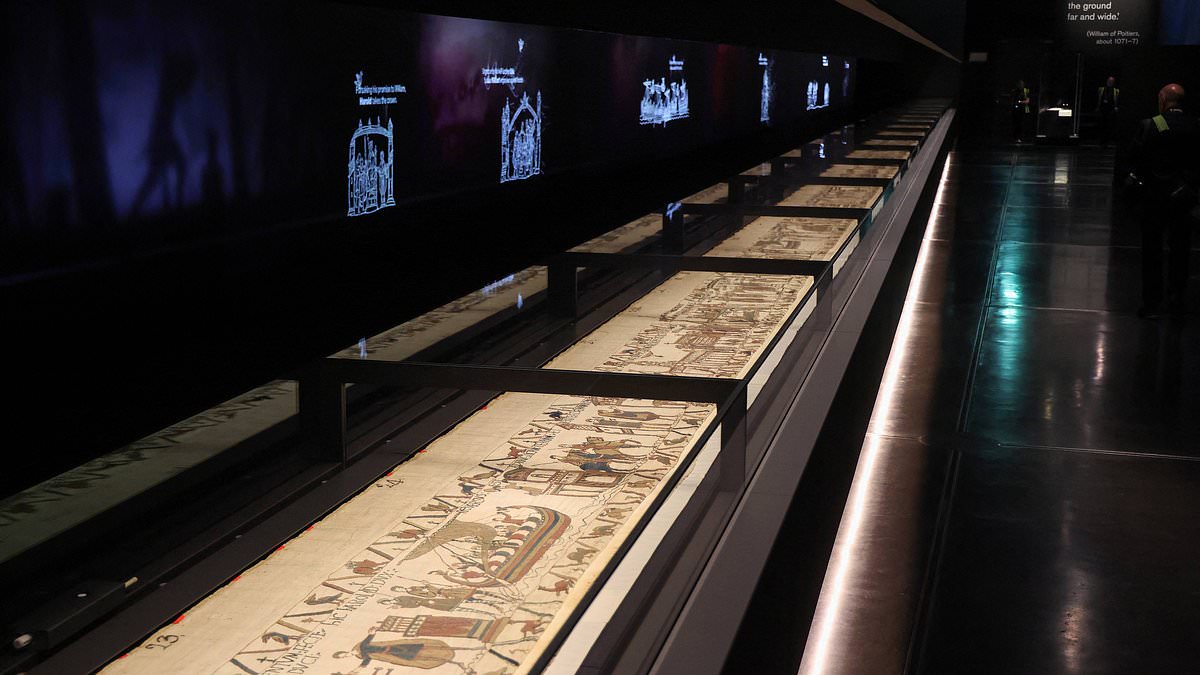
You actually have to look quite hard to spot the climax to the entire story: That arrow in the royal eye. It’s quite faint and King Harold appears to be holding it in his right hand.However, there are two clues that this is the epicentral moment in the Bayeux Tapestry. The first is the Latin caption above it: ‘Hic Harold Rex Interfectus Est’ (‘Here King Harold has been killed’).The second is the smudge of fingerprints all over the glass case immediately above it, left by previous visitors excitedly jabbing away and saying: ‘There it is!’Given that the last visitors before me were the King and Queen, the Macrons and the Burnhams at the previous evening’s VIP preview, I suppose these are very illustrious dabs.However, they also illustrate how extraordinarily intimate the British Museum’s astonishing new exhibition of the Bayeux Tapestry really is, as I learn during a sneak preview of my own, ahead of next week’s public opening.For every visitor – from sovereign to schoolchild – is able to get within proper ogling distance of the most famous cartoon strip in history. We are so close that we can see every stitch and stain – and even nail holes – along its full length, all 224 ft and one inch of it. How the Bayeux Tapestry is laid out at The British Museum for its grand return to these shores The likes of Andy Burnham, French president Emmanuel Macron and Charles saw it this weekThe museum and its French partners might like to state that it is 68.3 metres long but its creators had never heard of metres. They were sewing and stitching away in feet and inches centuries before metrication.But then the Bayeux Tapestry is neither from Bayeux nor a tapestry. As the King remarked on Wednesday evening, we might as well call it ‘the Canterbury Embroidery’. For the use of needle and thread is embroidery (whereas a tapestry is woven). It is also now accepted that this was crafted by expert seamstresses in Kent following William the Conqueror’s invasion of England in 1066.Only then was it despatched across the Channel. Quite where and how is unclear since the first proper record of its existence is in a 1476 inventory of cathedral treasures in Bayeux. And there it remained ever since, barring a couple of short trips to Paris.So this week’s return to Britain after the best part of a millennium is properly historic.Before those of a jingoistic footballing persuasion start crowing that ‘it’s coming home’, it is worth remembering that it is only here for a year until it returns to Bayeux, where its museum home is being updated.Rather than leave it in storage during the building work, the curators were persuaded to lend it to the British Museum, thanks to some intensive lobbying and the personal intervention of President Emmanuel Macron.And it is proving to be a masterclass in cultural diplomacy.For the French emerge as generous benefactors while also reminding the English of who beat whom in 1066. The two heads of state even found time for a laugh and a joke while inspecting the artefact It is the first time in nearly 1,000 years that the tapestry has come back to EnglandThe British, meanwhile, can say that they really know how to put on a show, laying out the ‘tapestry’ in dramatic style, end-to-end (British Museum ticket sales are on course to dwarf the annual Bayeux footfall of 200,000 visitors within just a few months). Here, also, is the very first depiction of our national church, Westminster Abbey. And the public in both countries are reminded of the ancient ties that bind us.They also now enjoy a souped-up experience. The allocated visitor time in Bayeux is 25 minutes whereas, so British Museum chairman George Osborne tells me, it’s 40 minutes here.The latest audio-visual tricks make for a more atmospheric show (featuring seagulls, wood-chopping noises and a low, brooding ambient soundtrack).Most people think of the ‘tapestry’ as a pictorial account of the Norman invasion. There is so much more to it than that, as you soon discover when you are half way through its 58 scenes and you realise Harold and William are still best buddies.The story actually opens in the Sussex village of Bosham from where the childless King of England, Edward the Confessor, sends Harold, Earl of Wessex, to Normandy for reasons which are not made clear (a lot of all this is unclear, like the delightful decorative borders featuring eels, nudity, birds and grave robbery).Harold arrives across the Channel only to be captured by a Count Guy who is later forced to hand him over to William.Harold then joins William’s victorious campaign against Brittany and is later rewarded with new armour before taking an oath before William (generally understood to be a pledge to support William’s claim to the throne of England).Harold goes home to find King Edward on his deathbed, whereupon Harold is crowned at Westminster Abbey. It is notable that the caption does not say he seized power. Rather, it states: ‘Here they have given Harold the crown of the King’.His reign gets off to an inauspicious start, however, as a mysterious shooting star (later to be known as Halley’s Comet) haunts the new monarch.Word of Harold’s treachery reaches a William who orders the construction of a vast navy.Loaded with armour, horses and wine (the French are not going to drink the local stuff), the fleet sails for England, lands at Pevensey and the rest is history. It’s only when you stand here moving alongside the artwork that you feel the true sense of movement, as the Norman cavalry goes from massed ranks to a full charge. The final words translate as: ‘And the English have turned in flight.’The ‘tapestry’ was on occasional display in Bayeux Cathedral for several centuries, with little fanfare. It was even about to be used as a canvas covering for wagons during the French revolution until a local lawyer saved the day.Napoleon later appreciated its propaganda value as he plotted an invasion of England and put it on display in Paris for a while before it returned to Bayeux.It became a popular tourist attraction during the 19th Century when curators created a new gallery to show the embroidery.They also added in the numbers marking each scene. During the Second World War, it was sent for safekeeping at a chateau near Le Mans, until the Allied invasion of Normandy in June 1944.The Germans ordered that it be sent for safe storage at the Louvre in Paris, surviving a 150-mile journey in a military truck, sitting alongside a 200-litre drum of petrol under constant threat of aerial attack. Following liberation by British and American forces, it was put on public display in the Louvre once again.Interestingly, with an impending visit from Winston Churchill, the hosts diplomatically decided not to unfold that final scene (showing the English running away).As remarkable as anything is the story of the embroidery’s survival. For centuries, it was literally nailed on to boards. Latterly, it was hung like a curtain, placing great strain on its upper edges. With the temporary closure of the Bayeux museum, a decision was made that, henceforth, it should be laid out flat for ever after – as we see for the first time here in London.Look closely and you’ll see small orange markers denoting places where the curators must take special care when folding it up again.Most powerful of all is the sense of timelessness. Look at Scene 43 – Bishop Odo blessing the pre-battle feast – and it’s Christ’s Last Supper. Then look at Scene 30, Harold’s crowning. As the King remarked on Wednesday night: ‘That looks just like my coronation.’ As indeed it does.The Bayeux Tapestry experience opens from September 10, see britishmuseum.orgClick here to listen to Robert Hardman discussing the Bayeux Mysteries on the Queens, Kings, and Dastardly Things podcast
As ROBERT HARDMAN gets a sneak preview of the Bayeux Tapestry, he tells all about nudity, eels, robbing graves and why King Harold and William were once the best of buddies
Full Article
Original Source
Read the full article at Dailymail →KhanList aggregates and links to publicly available news content. We do not host full articles from third-party sources. Always verify important information with original sources.