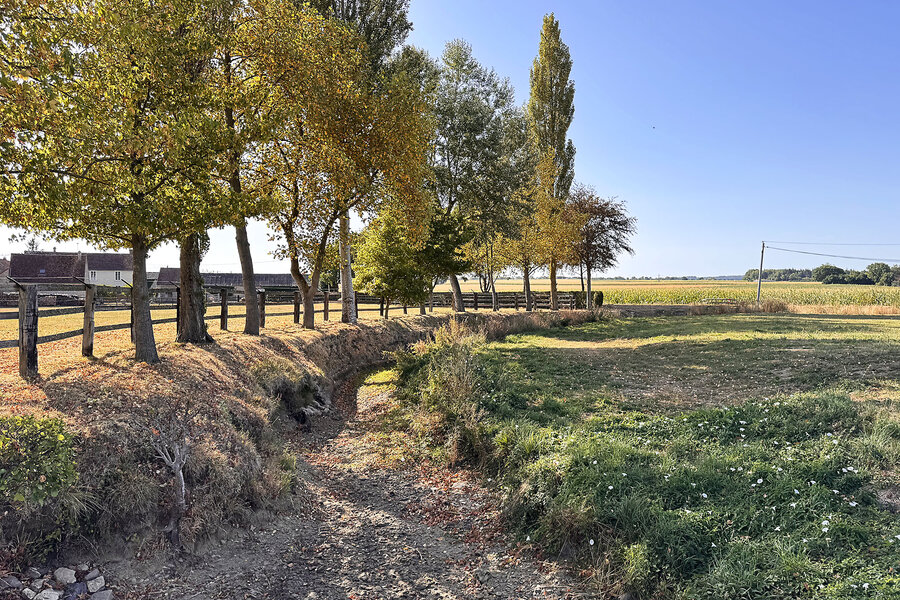
With the sprightly energy of a schoolboy, Jean-Paul Doron bounds into an empty creek, his red suede shoes scraping pale rocks. Just weeks ago, this stretch of the Sennevière River, on Normandy’s southern edge, was rich with trout, bullhead and otters.Today, it is dry.“Look, those are the survivors,” Mr. Doron says, pointing to minnows circling in a pool of putrid gray water. “Pretty soon, they won’t have anything left to eat.” Why We Wrote This Europe’s drought and falling river levels are having more than an economic and environmental impact across the continent. It’s cultural, too – prompting Europeans to consider how waterways shape communities, economies, and sense of place. For more than three decades, the amateur fisherman and retired heritage architect has fought to protect France’s waterways. He travels to Paris to lobby policymakers and leads a local branch of the National French Fishing Federation running a “Save Our Rivers” campaign. That fight is becoming more urgent. There is little water to save.“Will people only realize there’s a problem when they turn on the faucet and no water comes out?” asks Mr. Doron. Jean-Paul Doron shows where water levels should be in the Sennevière River, a tributary in Normandy that normally spills into the Orne River and then into the English Channel, in Mortrée, France, Aug. 10, 2026. Scientists are also alarmed. “We are in a situation that is extraordinary,” says Luis Samaniego, professor of data science and hydrology at the University of Potsdam, whose modeling places modern droughts in the context of centuries of European climate history.Parts of France, enduring a fifth summer heat wave and still reeling from devastating wildfires, are experiencing what scientists classify as exceptional drought. Rivers and creeks have fallen to historic lows, while water restrictions are in force across much of the country.The dried creeks of Normandy are a fleck in a much larger European drought. Major river systems from Germany’s Rhine to Italy’s Po and the Danube basin have come under severe pressure in a summer marked by prolonged dry spells and intense heat, taking a growing toll on economies and ecosystems.It’s forcing Europe to confront drought as more than a seasonal emergency. Governments are trying to strengthen the monitoring of such events and improve resilience, while communities along shrinking waterways are left to manage the damage.Europeans increasingly wonder whether the world’s fastest warming continent is adapting to climate change fast enough.What concerns scientists is how quickly severe droughts are following one another.The situation now is approaching the severity of what happened in Europe in 2022. That followed major droughts in 2003, 2015, and 2018. The concern is that intervals between such events are becoming too short for soils, ground waters, and rivers to fully recover.The World Meteorological Organization notes that the weather patterns driving drought across Europe are not new. What has changed is the temperature of the planet. “It’s not going to take just one summer storm to replenish river levels and replenish soil moisture,” WMO spokesperson Clare Nullis told journalists in Geneva.Mr. Samaniego likens the landscape to a bank account. Rain and snow are the income, while evaporation, plant use, runoff, and human withdrawals are the expenditure. When less water comes in and heat drives losses higher, the system slips into deficit. Another drought arriving too soon pushes the account further into the red. A lightly loaded tank ship travels on the Rhine river in Düsseldorf, Germany, Aug. 5, 2026. Low water levels have been caused by a heat wave and prolonged drought. “Recovery becomes harder and harder,” Mr. Samaniego says. “It’s like ending up in a bankruptcy.”This summer has underscored how quickly water deficits can turn into economic and energy deficits. In Germany, where Mr. Samaniego is based, ship operators have cut the size of their cargo along portions of the Rhine river to avoid running aground. This has disrupted the movement of fuel, chemicals, and industrial goods along one of Europe’s most important commercial waterways. Cargo ships are carrying only around 20% of their normal loads.“In the past, it was not normal,” Mr. Samaniego says, noting that Germany’s road network was not designed to absorb the enormous volumes of steel, coal, and other bulk goods that usually travel by water. “This is why the whole economy was built around the Rhine. They can trust the Rhine.”Falling levels on the Danube have disrupted energy production in Hungary and Romania, where power plants depend on the river for cooling. In northern Italy, rice farmers in the Po Valley are bracing for heavy losses due to lack of irrigation. Households from southern Europe to Britain are confronting water restrictions.The European Central Bank increasingly views water scarcity as a financial risk as well. Its research estimates that an extreme drought could put up to 24% of the Eurozone’s economic output at risk. “Drought is really affecting all the different economic sectors, and also ecosystems,” says a European Commission official.That growing exposure is one reason Europe is investing more heavily in drought monitoring and early warning systems. Drought monitors combine measurements of rainfall, soil moisture, vegetation, and river flows to identify where conditions are deteriorating, giving governments, farmers, and water managers more time to adjust water use and protect vulnerable sectors.The European Commission says there must be a systematic approach and coordinated action because the issue goes beyond borders and affects many different sectors and industries.Coordinated action is exactly what Mr. Doron craves.He traces the country’s dependence on waterways with his hand. “These are the small creeks up here, and down here is where all that water flows, into larger rivers,” he says, running a finger from his fingertips toward his forearm.“If you don’t fix what’s wrong at the beginning of the chain, you’ll have problems at the end.”France’s great rivers depend on networks of tributaries like the Sennevière River. Those waterways feed drinking-water supplies, agriculture, industry, and transport. When small streams dry up, Mr. Doron argues, the effects eventually travel downstream.And the damage is already visible.In northern France, hobby fisherman Nicolas Danhiez recently helped rescue fish trapped in a shrinking section of the Sensée River. A local couple had found ray-finned stickleback concentrated in a small pocket of water as the surrounding riverbed dried. With oxygen running low, Mr. Danhiez grabbed his nets and helped move the fish downstream. Resident André Lucilius built this wooden bench in front of the Sennevière River next to his house. Now, the river is all dried up, in Mortrée, France, Aug. 10, 2026. “I grew up with a fishing rod in my hands,” he says. “When you see this level of degradation, it just makes you think, ‘I need to save this river for my kids.’”Similar rescue operations have been repeated across France as water levels drop. Trout farmers are trying to protect their fish by increasing oxygen levels in the water and introducing more shade, while conservation groups are doing what they can to help preserve local ecosystems.Such measures can buy time. They cannot replace the water itself.For Mr. Doron, that is why protecting small creeks matters as much as safeguarding famous rivers like the Seine or Rhine.“The only way to save them is from the ground up,” he says.For many people here, however, rivers mean more than natural infrastructure.André Lucilius bought his family home outside Mortrée from his parents, just feet from the Sennevière River. He grew up fishing and playing in the brook.A few years ago, he built a simple wooden bench beneath a weeping willow on the riverbank. Until recently, he would sit there between chores in his vegetable garden and watch the water flow past.Now there is no water to watch.“When I see the state of things, I think, ‘This is surreal,’” Mr. Lucilius says. “How can we lose this? It’s just not possible.”
As river levels fall during drought, Europeans reflect on their connection to waterways
Full Article
Original Source
Read the full article at Csmonitor →KhanList aggregates and links to publicly available news content. We do not host full articles from third-party sources. Always verify important information with original sources.