
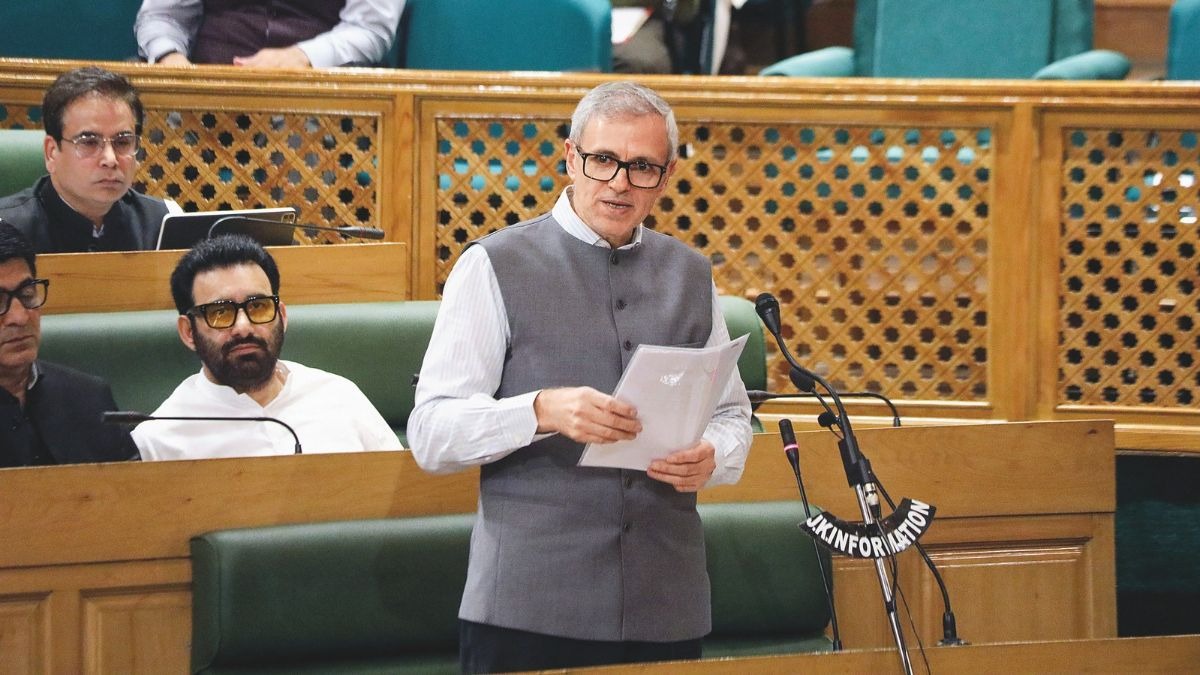
The Omar Abdullah government has approved the J&K Hydropower Policy 2026, a comprehensive framework aimed at accelerating hydroelectric projects up to 100 MW through private participation. The policy also proposes water-usage charges on new hydel projects.The policy seeks to unlock Jammu and Kashmir’s vast untapped hydropower potential—estimated at around 14,636 MW, of which only about 24 per cent has been harnessed—while supporting India’s clean-energy goals guided by the Nationally Determined Contribution (NDC) targets and strengthening grid reliability.Under NDC targets, India aims to reduce the emission intensity of its GDP by 47 per cent by 2035 from the 2005 level, achieve 60 per cent of installed capacity from non-fossil fuel sources by 2035, and reach net-zero carbon emissions by 2070.The draft policy was approved during a cabinet meeting chaired by chief minister Abdullah on November 13. It awaits lieutenant governor Manoj Sinha’s assent and comes against the backdrop of a significant J&K and Ladakh High Court ruling on October 29 that struck down water-usage charges on hydropower generation as an unconstitutional tax on electricity production. Recognising the challenges of high capital costs, geological uncertainties, remote locations and limited private-sector interest in the past, the new policy introduces several developer-friendly measures. By focusing on smaller and medium projects that can be executed relatively quickly, the government hopes to improve peak-power availability, support grid-balancing amidst rising variable renewable energy, drive socio-economic development in remote hill areas, and contribute to the NDC targets.J&K possesses an identified hydropower potential of approximately 14,636 MW, concentrated mainly in the Chenab basin (about 11,283 MW) and the Jhelum basin (about 3,084 MW). Some estimates place the overall potential closer to 18,000 MW.Despite this vast resource, only 3,540.15 MW—roughly 24 per cent—has been commissioned to date, states the background note in the policy. This includes 1,197.4 MW under projects of the J&K State Power Development Corporation Limited (JKSPDCL), 2,250 MW in central sector projects of NHPC, and limited contributions of just over 90 MW by private independent power producers. The untapped capacity, particularly in the small and medium segment, forms the core rationale for the new policy’s focus on private investment.“The small hydropower projects (SHPs) involve relatively less construction period, less issues with respect to rehabilitation and resettlement, low impact on environment, etc.,” the policy states, adding that a range of measures have been incorporated to harness the vast hydropower potential, particularly in SHPs and projects up to 100 MW.The large hydropower projects (LHPs) currently under construction in J&K are the 1,000 MW Pakaldul project, 624 MW Kiru project, 540 MW Kwar project, 850 MW Rattle project, 37.5 MW Parnai project and 12 MW Karnah project. The upcoming projects are 1,856 MW Sawalkote, 258 MW Dulhasti-II, 240 MW Uri-I Stage-II, 930 MW Kirthai-II, 390 MW Kirthai-I, 93 MW New Ganderbal and other small projects.As per the new policy, independent power producers and public-private partnerships can develop projects on build-own-operate-transfer (BOOT), design-build-own-operate-transfer (DBOOT) or similar bases for a concession period of up to 40 years from the commercial operation date. At the end of the period, all assets revert to the government free of encumbrances.A key incentive in the new policy is the staggered free-power regime. While developers must ultimately supply 12 per cent of energy generated as free power to the Union territory, the obligation is deferred and phased in over the initial years—more lenient for projects up to 25 MW than for those between 25 MW and 100 MW.Under the policy, government land is offered on non-transferable lease at a nominal Rs 1 per annum. The designated agency (primarily JKSPDL), along with the J&K Energy Development Agency (JAKEDA) sharing responsibility for projects up to 10 MW, will obtain forest and environment clearances before floating tenders and recover the costs from the successful bidder, reducing early-stage risks for developers.Other facilitations include the right of first refusal for the government’s trading utility to buy power for six months at a regulator-determined tariff, possible integration with solar or wind projects, limited tourism infrastructure development with prior tourism department approval, and eligibility for central financial assistance schemes.Under the policy, “environmental and social safeguards are non-negotiable”. Developers must maintain environmental flow, contribute 1 per cent of energy to the Local Area Development Fund, and ensure that drinking-water and irrigation needs take priority over power generation. Developers also remain responsible for private land acquisition and other statutory clearances.Projects will be allotted through open, transparent competitive bidding. The policy applies only to new projects up to 100 MW; earlier allotted projects continue under previous regimes. It also covers renovation and modernisation of existing small plants through private participation.By balancing investor incentives with public safeguards and prioritising smaller, quicker-to-build projects, the 2026 policy aims to attract private capital, expand clean energy capacity, improve peak-power availability and drive socio-economic development in the remote hill areas of J&K.On water charges—a significant revenue stream for the government—the policy offers no blanket exemption. “There is substantial revenue accruing to the government of J&K on account of water charges. Besides, water charges are levied under the law applicable to the UT of J&K. The policy cannot go beyond the law,” states the document.However, the designated agency may recommend case-by-case relief for new projects of 10 MW or less whose power is purchased by the government, subject to approvals. Similar case-by-case consideration applies to State GST refunds under the same restricted conditions. Any such concessions will be transparently stated in the tender documents.The policy document, as seen by INDIA TODAY, suggests that if the tariff (including water charges) finds a market, the burden is expected to pass to consumers. Similar restricted conditions apply to possible State GST refunds.The policy’s approach to water charges acquires particular significance in light of the October 29 judgment of the J&K and Ladakh High Court. The court held that the water usage charges levied under the Jammu and Kashmir Water Resources (Regulation and Management) Act, 2010, on hydropower projects were, “in pith and substance”, a tax on the generation of electricity rather than a genuine charge for the use of water.The bench observed that hydropower use is non-consumptive, that the regulatory authority fixed rates on the basis of head height—a generation parameter—rather than the volume of water drawn, and that the taxable event was therefore the production of electricity.Under the constitutional scheme, Entry 53 of List II of the Seventh Schedule empowers states only to tax the consumption or sale of electricity, not its generation, which falls within the exclusive domain of Parliament.The court ruled that Entry 17 of List II (water) is a regulatory entry and does not confer power to impose a tax. There is no corresponding taxing entry for water in the State List, and attempts to treat water as “land” or “mineral” were rejected by the court.“The question whether the levy of duty on the production of electricity falls within the domain of Parliament or the State Legislature was directly considered by the Supreme Court in MP Cements Manufacturers Association v. State of Madhya Pradesh (2004), and it was held that Parliament has exclusive legislative competence to legislate with respect to the levy of duty on the production of electricity”, the high court division bench observed.The draft policy’s insistence on water charges for new projects, even while allowing limited case-by-case relief for the smallest schemes whose power is sold to the government, therefore sits against a legal backdrop in which similar levies have already been struck down.So far the Abdullah government has not challenged the high court order in any forum. Amid this backdrop, how the administration reconciles the final policy with the high court judgment once it receives the lieutenant governor’s assent will be closely watched by both developers and legal observers.Subscribe to India Today Magazine- Ends
As Omar Abdullah govt eyes J&K hydropower boost, why water charges face legal hurdle
Full Article
Original Source
Read the full article at Indiatoday →KhanList aggregates and links to publicly available news content. We do not host full articles from third-party sources. Always verify important information with original sources.