
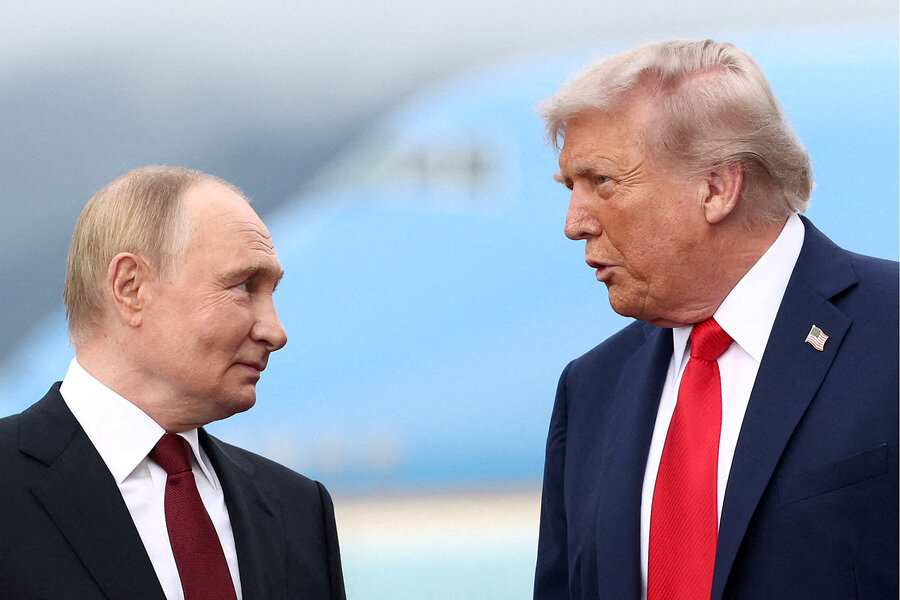
To address global security issues, Donald Trump has long espoused a worldview that favors big-power relations over U.S. leadership of values-based alliances.Perhaps no relationship captures that preference for dealing with big powers, and in particular authoritarian ones, so clearly as President Trump’s decadelong affinity for Russian President Vladimir Putin. And no conflict has crystallized this attraction to the world’s stronger nations over their weaker victims of aggression as has Russia’s war in Ukraine.This week, the Trump-Putin relationship and its implications for world affairs have been on full display. White House envoy Steve Witkoff met with Mr. Putin in Saint Petersburg on Wednesday, presenting a proposal for renewed three-way peace talks on the Ukraine war between Russia, Ukraine, and the United States. Later, the Kremlin said it accepted the proposal in principle, though only at a lower, technical level.For his part, Mr. Putin announced the release of detained American citizen Stephen Hubbard – a move that prompted Mr. Witkoff to praise as a “true humanitarian” the same Russian leader who is pursuing a military campaign in Ukraine that has deliberately targeted civilian infrastructure.Mr. Putin teased with another carrot, citing Russia’s “special, trusting relationship with Iran” and pledging his willingness to do “anything we can” to resolve the “crisis” between Washington and Tehran. ReutersStephen Hubbard, second from left, an American citizen held in Russian custody since 2022, poses with family members and U.S. officials aboard a flight to the United States after his release from prison, in this handout photograph released on Oct. 21, 2026. The Russian offer of mediation came amid growing indications in Washington, Jerusalem, and across the Middle East that a reprise of U.S. and Israeli airstrikes on Iran could be imminent. President Trump said Wednesday that something on the Iran front would happen “fairly soon.” He has hinted for months that he could relaunch the unpopular Iran war once the midterms were out of the way.“Two impulses” on UkraineSince his return to the White House 18 months ago, the president has vacillated in matters pertaining to the Ukraine war between an inclination for the Russian side and an occasional, begrudging show of support for Ukraine and its leader, President Volodymyr Zelenskyy. But now, as Mr. Trump faces the prospects of adverse midterm election results and a lame-duck presidency – a period during which modern U.S. presidents traditionally have shifted attention to foreign policy – signs are mounting that he could set free his affinity for big powers and their leaders, starting with Mr. Putin and Russia.“Trump’s policy towards Ukraine has been defined by two impulses: a positive one that seeks a Ukraine that is sovereign and secure at the end of this war, but then another impulse that is not so positive, and that is his fascination with Russia and Putin,” says John Herbst, senior director of the Atlantic Council’s Eurasia Center in Washington. “What we’re seeing more of now is this second impulse,” he adds, “and steps aimed at appeasing the aggressor.”The coming months might well offer a domestically clipped president the opportunity to pursue with even greater zeal the kind of big-power “spheres of influence” vision of the world he demonstrably favors.When Mr. Trump blasted Mr. Zelenskyy recently by saying “He wants to make problems for the world,” the comment underscored a perspective that sees the world’s lesser countries – Mr. Trump calls them “weak” – as standing in the way of a global order fashioned by the few strongest. Omar Havana/APUkrainian President Volodymyr Zelenskyy arrives for a press conference at a gathering of European Union leaders in Brussels, Oct. 16, 2026. On Monday, President Trump said he would accept Mr. Putin’s invitation to meet next month with him and Chinese leader Xi Jinping to resolve the war in Ukraine. Notably absent from the confab would be Mr. Zelenskyy, whose country Mr. Putin is seeking to carve up and weaken.The proposal for a three-way summit to resolve Europe’s biggest conflict since World War II shocked many European leaders, some of whom said it was reminiscent of the Yalta Conference of 1945, which awarded the Soviet Union the countries of Eastern Europe that had been conquered by Nazi Germany. “The first Yalta recognized Soviet domination over the areas of Eastern Europe that the Red Army controlled,” Radoslaw Sikorski, Poland’s minister of foreign affairs, wrote on social media Monday. “Now, Putin wants Ukrainian territories that he can’t manage to conquer as a gift.”Mr. Trump’s readiness to take part in Mr. Putin’s proposed summit on Ukraine underscores the U.S. president’s attraction to big-power relations, some experts say.“The risk here is that, given Trump’s inclination towards the powerful, he could agree to some new kind of Yalta where he sells out Ukraine and the allies for the sake of improved strategic relations with Xi and Putin,” says Charles Kupchan, director of European studies at the Council on Foreign Relations in Washington.“I’m all for increased dialogue and improved relations with Russia and China,” says Dr. Kupchan, whose new book, “Bringing Order to Anarchy,” argues for American leadership to focus on bridging the ideological divides hindering action on the world’s biggest challenges. “But I think our allies and many others worry that this president could make decisions with his Russian and Chinese counterparts that leave out much of the world and work against Taiwan, perhaps, and Ukraine.”Missile defensesFollowing an hourlong phone call between Mr. Trump and Mr. Putin this month, and in the run-up to Mr. Witkoff’s Russia trip, the White House has been signaling both frustration with Ukraine and a desire to curry favor with Mr. Putin.This week, the Trump administration put the brakes on the transfer of Patriot missiles by partner countries to Ukraine – even as Russia continued its deadly ballistic missile attacks against Ukrainian cities. The slowdown of delivery of the sought-after missile-defense systems followed the recent announcement of a diesel-fuel deal with Moscow. Gleb Garanich/ReutersA woman stands near destroyed cars at the site of an apartment building hit by Russian drones, in Kyiv, Ukraine, Oct. 21, 2026. Mr. Trump claimed the agreement would help bring down diesel prices in the United States, but critics – including Republican members of Congress – say it is a lifeline to Mr. Putin to help finance his Ukraine onslaught. “It’s unconscionable that this administration is capitulating to a Russian dictator who illegally invaded Ukraine and butchers innocent civilians every single day,” Sen. Thom Tillis, Republican of North Carolina, wrote over the weekend on X.“The president is prolonging the war, not ending it,” Rep. Don Bacon, Republican of Nebraska, wrote on social media.And if Mr. Trump’s embrace of the Russian leader were not yet clear enough, the U.S. last week inexplicably degraded the Pentagon-controlled portion of the Starlink satellite system that allows Ukrainian drones to find and strike Russian targets.The U.S. also briefly cut off critical intelligence sharing with Ukraine that provides some forewarning of Russian ballistic missile launches, though on Sunday, Mr. Zelenskyy said he was “very thankful” that the intelligence had been “unblocked.”Foreign policy independenceStill, the through line that many diplomats, members of Congress, and analysts see is a U.S. president increasingly unpopular at home turning to foreign policy – and to his perceived friends like Mr. Putin – for wins and legacy building.“We’re seeing considerable unhappiness on the Republican side, with some Republicans saying they will block Trump’s agenda in the post-midterm period,” says Mr. Herbst of the Atlantic Council, who also served as U.S. ambassador to Ukraine from 2003 to 2006. Deepen your worldviewwith Monitor Highlights.Politics with respectGet political stories with respectful analysis.There‘s a world of new ideas in everyBooks newsletter.There‘s more to life, enrich yours withCulture & Learning weekly.Follow humanity‘s discoveries withScience & Nature stories in your inbox.Gain a spiritual perspectivefrom the stories in your inbox.Want to understand the deeper impact of critical events? Learn the Monitor‘s insight.Already a subscriber? Log in to hide ads. But even a politically weakened lame-duck president will have more independence on foreign policy. That is a truth that an astute Mr. Putin appears to understand, Mr. Herbst adds.“Putin knew that the meeting he’s proposed [with him, Mr. Trump, and Mr. Xi] would appeal to Trump’s ego,” he says. It affirms to the U.S. president that he is “one of the world’s three biggest strongmen.” ALREADY A SUBSCRIBER? LoginReal news can be honest, hopeful, credible, constructive.The Christian Science Monitor was founded in 1908 to lift the standard of journalism and uplift humanity. We aim to “speak the truth in love.” Our goal is not to tell you what to think, but to give you the essential knowledge and understanding to come to your own intelligent conclusions. Join us in this mission by subscribing.
As midterms near and Putin beckons, Trump embraces big-power diplomacy
Full Article
Original Source
Read the full article at Csmonitor →KhanList aggregates and links to publicly available news content. We do not host full articles from third-party sources. Always verify important information with original sources.