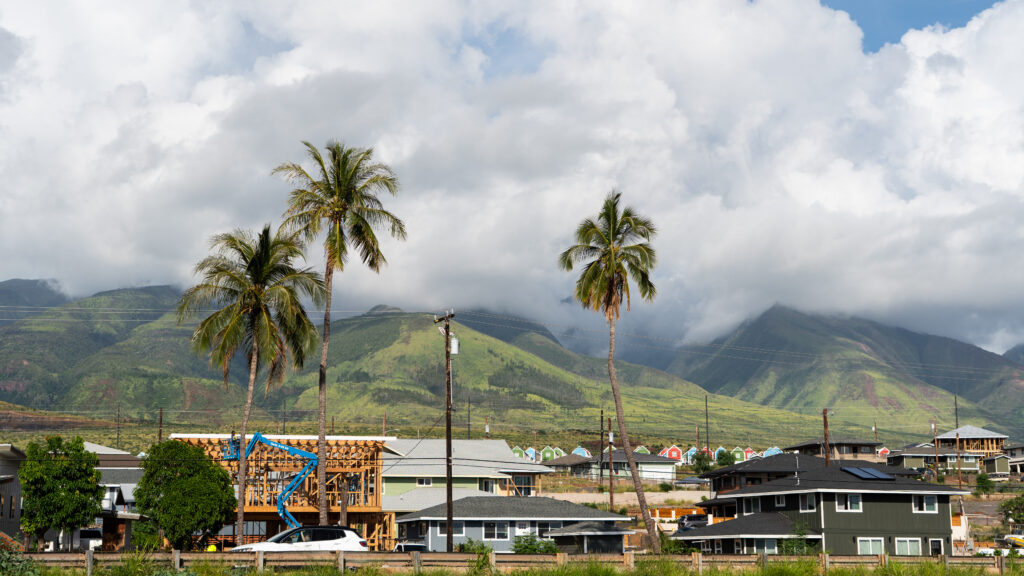
Highlights Researchers Alika Maunakea and Ruben Juarez are conducting one of the largest studies on the long-term health effects of wild and urban fire exposure. The study, which follows survivors of the 2023 fires that burned down Lāhainā, may provide key insights that could help protect people exposed to future fires anywhere. To the researchers’ surprise, the study has become an important piece of health infrastructure in Maui’s rural areas. They hope to build a nonprofit to continue health monitoring and research, creating what they see as a new model in rural health. LĀHAINĀ, Hawai‘i — About once a month, Alika Maunakea and Ruben Juarez and their staff fly medical equipment from the University of Hawai‘i on O‘ahu to the west side of Maui. On the edge of the Lāhainā burn zone, the two researchers transform the local health center into an impromptu lab. They collect blood, urine, DNA, and health measures like mental health and lung function scores for the Maui Wildfire Exposure Study or MauiWES, one of the largest and most comprehensive postfire investigations in the country. Scientists still understand little about how wildfire exposure harms health, particularly wildland and urban ones like the fires that burned down Lāhainā and thousands of acres on Maui in August 2023. The hope is that data collected over the decade after the fire will show how to better mitigate the risk of cancers, lung diseases, or other health conditions that have been linked to fire exposure. It’s also knowledge that’s urgently needed, as the threat of wildfire is growing throughout Western states and beyond. Over the months, though, MauiWES has become more than just a research project. It’s become a de facto health hub and the inspiration for a new framework for rural health that would integrate academic research with community health services and disaster recovery. These ambitions began with the determination of the lead investigators, Maunakea and Juarez, that the data in the study be useful to the local community. MauiWES, in providing data that include primary care screenings and wildfire-tailored monitoring, has become a vital source of health information and support that locals need and struggle to get elsewhere. “Maui is very different from other disaster areas. It’s a rural island,” said Juarez, a health economist at the University of Hawai‘i. Like many rural counties, Maui struggles with a severe physician and nursing shortage, a problem that the fires also exacerbated. That can make getting routine health care more difficult for residents, and especially hard when it comes to advanced care. Maui Memorial hospital is the sole major, acute care hospital on the island, roughly an hour away from Lāhainā where most of the damage occurred. Most patients who need specialty care have to fly to O‘ahu or out of state, Juarez said. “It became part of a community service. People said they are using this as a way to check on their health. I was surprised by that. That was never our intent,” Maunakea, an epigeneticist at the University of Hawai‘i, told STAT. “It’s not a clinical setting. It’s a community setting where we do some preclinical stuff. It’s an interesting thing to witness.” That observation, alongside study results that may indicate long-term exposure to fire-related toxins, has got Maunakea and Juarez planning to grow a nonprofit out of the study called HO‘ALA. The dream is for the organization to become a home for the health services that the community has been asking for from the study, Maunakea said. “MauiWES will evolve into this space that’ll be an umbrella for these community services and support the health system, especially in rural areas, and foster innovation,” Maunakea said. “That’s what excites us the most.” But these wildly ambitious goals that Maunakea and Juarez have for the study face some formidable obstacles. For one, the researchers have found themselves at odds with the state’s Department of Health, whose leadership has been critical toward the study. MauiWES also initially launched with cobbled-together funds from private donors, the state of Hawai‘i, and the National Institutes of Health. Nearly all the grants underwriting the project have now run out, except for money the county of Maui earmarked in July to keep the study running until the end of 2026. That’s left the study nearly frozen, as the researchers have had to fight to defend their work and come up with more long-term support over the last year. If they succeed, they may be able to build what experts told STAT is an innovative model for rural health and disaster recovery. “It’s really science as service,” said Jen Runkle, an environmental epidemiologist at the North Carolina Institute for Climate Studies at North Carolina State University. “It’s time, if any time, to think outside the box to help communities understand the longer-term impacts of events like wildfires, and do actionable science that can safeguard health and well-being. The work in Hawai‘i is a true model for it.” Big unknowns after urban wildfires Fires have become increasingly common on Maui over the last couple of decades. Sugarcane plantations had stripped down the landscape, once stewarded under the Native Hawaiians’ ahupua‘a land management system, and then businesses abandoned agriculture to move toward tourism. Swaths of land left uncontrolled grew into carpets of invasive buffelgrass nearly right up to the jagged edge between the mountain and the sky. These grasses turn bright green when the rains come, then dry into a bed of tinder in the summer. An extreme high-pressure system struck the match on Aug. 8, 2023. Winds gusted up to 80 miles per hour, bowing palm trees and knocking down power lines that sparked the fires. The blazes that engulfed the island ultimately killed over 100 people and burned thousands of acres, including more than 2,000 buildings in Lāhainā. It ripped across the grassy hills just above the town, stopping before a weeping fig tree outside the health center where Maunakea and Juarez host the study. Half its boughs were brown and bare for a while afterward. Soot from shrubs and grasslands is one thing, but Maunakea worried about the ash from Lāhainā town. “It’s a mixture of not just brush fire, forest fires, but a combination with whatever you find in urban settings,” he said. “The cars, the batteries, the homes, the metals, all the chemicals we use in buildings. All that creates a more toxic mixture that can be mobilized, hard to clean up, and hard to prevent being exposed to.” What happens when people are exposed to smoke from the combustion and whatever residues might have settled across the mountainside, streams, and soils is a scientific black box. “There’s not much understood about the long-term health impacts of wildfire exposure,” Maunakea said. “We know that they are not good for health, but what will that actually look like, who will be more vulnerable, and how will that impact generations is unclear.” There are reasons to suspect the burden of serious illnesses is set to rise on Maui, experts told STAT. Ash analyses from Lāhainā showed elevated levels of heavy metals including antimony, arsenic, and, in leachate testing, chromium. Carcinogenic chemicals known as furans and dioxins were also found in the ash, though not at levels that crossed certain public health remediation thresholds. One recent paper showed that urban fires can produce chromium-6, a highly toxic and carcinogenic form of the metal, and another study found an association between wildfire smoke exposure and significantly increased risk of cancer. “We would be really naive if we don’t expect higher incidences of cancer here,” said Bridget Bongaard, a physician on Maui and founder of the nonprofit Maui Cancer Resources. All that makes the data coming out of MauiWES extremely valuable, experts told STAT, since it has the potential to help link toxin exposures to certain health outcomes over a long period of time. Roughly 2,000 participants have enrolled in the study, and the team collects a broad set of health metrics. That includes a standard blood panel, blood pressure, body mass index, and lung function through spirometry and oscillometers. The study also banks blood, urine, saliva, and cheek swabs from participants for planned analyses, including epigenetic studies on fire survivors. Those data provide some insight on how fire exposure has already been affecting the community’s health. For one, results released in 2024 and 2025 suggest that this cohort’s lung health overall has declined over time, as has locals’ mental health. More recent work suggests that residents continue to experience exposure to heavy metals, a finding that the MauiWES investigators believe is partly related to the wildfire and plan to publish soon in an analysis. “This is really one of a kind. It can lead to a lot of insight in terms of what’s happening in the body after the exposure and the acute, sub-chronic, and chronic consequences,” said Shuguang Leng, a wildfire researcher at the University of New Mexico who isn’t involved with the study. “And this kind of health surveillance program can really help improve the health of the community.” In post-disaster rural areas like this, the immediate health feedback that comes through MauiWES can be critical, said Mary Johnson, a physician and environmental health researcher at the Harvard T.H. Chan School of Public Health who doesn’t work on the study. “Ideally, this is how all research studies should go,” she said. “The fire causes such an extreme situation, especially in areas where they are not equipped to deal with it. At least they get help in some way.”` ‘This program saved my life’ STAT spoke with eight participants who said they were grateful to the study for providing care navigation and health screenings, especially since some of the workup isn’t routine at annual checkups like lung function and heavy metals testing but would be related to fire exposure. According to data collected through the study, this additional health information and social support is something that participants are acting on. In the first year, Juarez said 60% of participants said that MauiWES was also their first health check since the fire, and more than 800 of the 2,000 participants followed up with their health care providers following participation. Some 300 participants also accessed mental health counseling through the study. Study managers were able to halve the number of participants without health insurance coverage, “thanks to a partnership with Kaiser,” Juarez said. Volunteer physicians on site help participants interpret some of the health information they receive with the study, and MauiWES also began a partnership with Maui College’s nursing program to provide additional clinical support for the studies and training opportunities for nursing students. “They volunteer to provide some of the vitals and actually learn to do spirometry and stuff,” Maunakea said. “That’s something we created. The study requires that infrastructure to support what we’re doing.” An aerial view shows the destruction of the historic Lāhainā town on Maui after the wildfire in 2023. Over 100 people died in the fire, and dozens fled from the blaze by swimming into the ocean by Front Street. Over 2,000 buildings burned down. So far, fewer than 300 building permits have been completed.Patrick T. Fallon / AFP via Getty Images In some extreme cases, the study seemed to catch signs of life-threatening health conditions. Amy Jackson, a 52-year-old woman from Makawao, learned about MauiWES from a social media post. The promise of a $100 incentive drew her in. Her daughter’s birthday was coming up, and she wanted to give her the cash as a gift. If she hadn’t signed up, she doesn’t think she’d be alive today. “This program saved my life,” she said. The day the fire rushed through Lāhainā, Jackson had been doing Uber Eats deliveries. Practically everybody has to work two or three jobs to keep up with the cost of living on this island, she said. Jackson had heard that the fires on the west side of the island had been put out. “So, for $34, I agreed to drive over to Lāhainā,” she said. She got stuck in the town on her way back. Traffic was blocked going out of the town to the north and the south. Jackson found herself driving back and forth through clouds of smoke. As embers flew past her windows, she began to panic. “I was gathering my stuff and was going to run for it down to the ocean,” she said. “I was going to record goodbye videos to my family.” She tried one more time to escape. She turned and drove to where emergency responders were cutting downed power lines blocking the road leaving to the south, and was finally able to drive out. She could smell the fire, harsh chemicals, and burnt plastic clinging to her clothes and skin as the air cleared. Over the next few months, Jackson started losing weight and would get easily winded. By the time she joined MauiWES, she would be out of breath from climbing a flight of steps. At the study’s collection event, the on-site volunteer physician examined her test results. “She said, ‘Your hemoglobin didn’t show up, so you need to go to the ER,’” she said. Jackson went to confirm the results with a primary care doctor, who called later and also told her to go to the emergency room. Her hemoglobin was 2.2 g/dL. “I was an ICU nurse,” Jackson said, adding that hemoglobin for an adult woman should be 12 to 16 g/dL. “I have not ever seen an alive person with 2.2.” Initially, Jackson said, the doctors suspected she had lymphoma or another blood cancer, but ultimately they diagnosed her with pernicious anemia, an autoimmune condition that can be fatal if not treated. It’s still not clear to her if the wildfire exposure or the stress of the event triggered the illness or if the fire exacerbated a preexisting condition, but she’s certain the disaster led her to this brush with death. “My contact with MauiWES is really what helped my healing begin,” she said. Besides helping her catch the condition in the first place, Jackson said, the study staff provided much more: “Having someone to listen. Resources, and contact to resources. I got an air filter, that kind of thing. For the healing of the island, the study gave people information that was so sorely missing.” Amy Jackson was driving through Lāhainā when the fire struck the town. Over the year after the fire, she found herself struggling with health problems that MauiWES helped her uncover. Friction with local officials Jackson and other community members told STAT that MauiWES has been an important source of information about the community’s health recovery. There’s been an undercurrent of frustration directed toward leadership in state agencies like the Department of Health and government, residents told STAT. Many in the community felt that relief had come too little, too late, and that concerns about ash pollution and the safety of the region were not taken seriously by leading officials. “It was very concerning, because we knew that there were water concerns, air quality, dust exposure,” said Dayna Moore, a Maui-based nurse who volunteers with MauiWES and is the founder of Hawai‘i Community Health. Without the study, she said, “we would just be in a data vacuum. We wouldn’t have transparency. We wouldn’t know where the needs are.” The state Department of Health had conducted blood lead testing about six months after the fire to see if residents had toxic exposure to ash. That testing showed that less than 3% of residents had elevated blood lead at that time, and the DOH said that the agency didn’t expect residents to face ongoing health impacts from wildfire pollution and didn’t recommend ongoing toxins screening based on that result. “On the basis of these results with lead as an indicator of exposure, we do not expect to find health impacts caused by toxins in the wildfire ash,” State Health Director Kenneth Fink said in a statement. Multiple experts told STAT that this conclusion didn’t make any sense to them. While lead is an important toxin, it cannot be used as a general indicator for any kind of toxic ash exposure, said Harvard’s Johnson. “That’s much too broad of a statement to make,” she said. “There’s a lot of metals.” The main issue is that different chemicals behave differently in the environment and in the body. The half-life of lead in adult blood is roughly one month, so it should be no surprise that lead was mostly undetectable in locals’ blood six months later if they aren’t continually exposed to it, said Lorrin Pang, the district health officer for Maui. He spoke to STAT as a private citizen and Maui resident, though, not as a DOH employee. Pang said he was seriously concerned about potential exposure to other chemicals detected in the Lāhainā ashes, including furans and dioxins, chemicals linked to several cancers. Dioxins have a half-life in the body of seven to 11 years, according to the World Health Organization, and lead can also be undetectable in blood but still remain in the body, bound to bones, for decades. The U.S. Army Corps of Engineers and other organizations cleaned up hundreds of thousands of tons of ash, debris, and contaminated material, but experts said they didn’t believe it possible to completely remove everything. “We work with firefighters and their gear — even though it’s washed, you smell smoke on it 2 feet away,” Harvard’s Johnson said. “I don’t think it’s possible to completely eliminate it. We don’t know yet if it’s possible to eliminate to the point we don’t have health repercussions.” Dayna Moore volunteers with MauiWES as a nurse, helping to take vitals and collect biospecimens from participants. Rains, floods, wind, and more may also have distributed pollution from the fire over areas that weren’t completely cleaned up. “During the one or two years after we opened the Lāhainā Civic Center, people said, you know, what’s that smell? There was no fire. Nobody was really concerned about it. But one of my staff died of ALL, quickly. Then I was like,” Pang turned his hands upward in a helpless gesture. ALL is a type of acute leukemia, though it’s not clear if that one case is related to fire exposure. However, he said, it felt like a call to continue long-term monitoring, like in MauiWES. MauiWES has come under scrutiny by the Department of Health. STAT obtained a letter through public records requests that DOH director Fink sent on Oct. 28, 2025, to University of Hawai‘i President Wendy Hensel criticizing MauiWES’ methods and conclusions. In the letter, Fink disputed Maunakea and Juarez’s claims that they detected elevated levels of heavy metals related to the fire in participants. Fink also criticized the methodology of other scientists who had published results in JAMA journals that suggested suicide- and drug overdose-related outcomes worsened after the fire. In the letter, Fink stated if the university chooses not to correct or retract any of the publications, “an explanation of why would help our understanding,” and also asked to “review work prior to public dissemination” from the researchers in the future. In the university’s response, Chad Walton, interim vice president for research and innovation, said that researchers worried such review raised concerns about undue “review, oversight, or influence over findings and dissemination,” and defended the university scientists’ results and methods. Scientists told STAT it felt like Fink sought to discredit this research through private channels, perhaps because their findings run counter to what the DOH has publicly said in the past. “The way I interpreted this letter was basically they were trying to censor some of the stuff we were doing,” Juarez said. “My take is there’s a communication agenda. That may include things like, the Maui fire is over, let’s focus on the next disaster, and this is just interfering with that. That’s just my hypothesis.” The DOH did not respond to a request for comment. Harvard’s Johnson, NC State’s Runkle, and other experts told STAT that MauiWES investigators Maunakea and Juarez’s work is high quality. Experts not involved with the study also said it was highly unusual for a state health department director to send a letter like this to university leadership. Political pressure to move on is common after disasters, said Runkle, who has been studying recovery in North Carolina after Hurricane Helene. “There’s a lot of political pressure to move on, especially if their local economies may be tied to a disaster going away and going away quickly,” she said. “That’s where studies like this are so deeply important. It sets the community up to use their voice and advocacy on why more resourcing is needed, why longer-term studies are needed.” A model for rural health Natural disasters often inspire an initial flood of national attention and support, as the Maui fires did. The trouble is that recovery from major wildfires takes much longer. “After the two-year mark, it is increasingly difficult to find resources to support long-term recovery,” Runkle said. “We know that this recovery can last 10-15 years.” MauiWES has been grappling with that. The study started mostly with funds structured around immediate disaster relief. Earlier this year, the researchers exhausted funds from philanthropy like the Hawai‘i Community Foundation and Kaiser Foundation and public dollars from the state of Hawai‘i, which was the study’s main funder. They also reached the end of the first two years of their NIH grant, a “phased innovation” grant where they needed to show they met certain milestones to continue receiving funding. However, the state did not renew funding this year, putting the study’s future at risk until Maui County rescued it in July, providing enough money for the study to continue until the end of this year. The NIH approval just came this month as well, and should provide about a quarter of the study’s annual cost for the next three years. The scientists are still searching for more funding to keep the study running until it reaches its planned 10-year horizon and even expand their work. Research studies are finite by definition, and Maunakea said he and Juarez want all the support and infrastructure they built for MauiWES to persist. To that end, they have even greater ambitions in mind, if they can find the funding. The two initially met as neighbors in faculty housing and began dating not long after. They got engaged with a pair of matching silver rings and, lately, Juarez said at least half of their conversations revolve around work. He thinks that’s part of the reason MauiWES has made it this far: the energy they pour into the project as a couple. From left, Maunakea’s mom, Alexis; Maunakea; his great-grandmother Katherine; his great-great-grandmother Mary; and his grandmother Yvonne on the family’s Hawaiian homestead in Nānākuli, O‘ahu.Courtesy Alika Maunakea At the last study collection event, Maunakea said he felt a sense that no matter what obstacles they faced, he could not stop pushing for the work. “It’s my kuleana,” he said, using a Hawaiian word that means both responsibility and privilege. Maunakea grew up on a Native Hawaiian homestead in the town of Nānākuli on the west coast of O‘ahu under the family matriarch, his great-grandmother Katherine Maunakea. “She was a native speaker of Hawaiian and a traditional Hawaiian healer, a kahuna lāʻau lapaʻau,” he said. “She opened her doors and literally our garage was a classroom. She invited people to come learn about their own culture. She taught me how environment shapes health. If you take care of the land, the land will take care of you.” She was also from Maui, and when the fires happened, he thought of her and her values. The connection to land in Hawaiian culture is sacred, Maunakea said, and the land is also seen as part of one’s own family. That’s what inspired him to seek a career as an epigeneticist, studying interactions between the human body and the environment in which we live. It also inspired his grand idea for the future of MauiWES: to wrap much of what they’ve created into a nonprofit. Something he sees as “a more sustainable solution,” he said, “that works really well with the model of rural health in those communities.” The planned name for the nonprofit, HO‘ALA, means “to awaken” and “revitalize” in Hawaiian language. It also stands for an acronym as large as the hopes Maunakea has for the project: Health Outreach ‘Āina-based Life-course Alliance. The Hawaiian word ‘āina means land. Through HO‘ALA, Maunakea envisions something akin to a community health center integrated with an environmental and academic research lab. It would institutionalize the groundwork that MauiWES built for research, serving as a springboard for research into the connection between health and environment, particularly after a climate-related disaster like wildfire or flood. For instance, since MauiWES’ data suggests that locals continue to have elevated levels of heavy metals in their urine or other toxins, Maunakea said that must be coming from the land where they live or work. That could be byproducts of plantation agriculture or contaminants from the fires. An example of how that infrastructure can support research is already ongoing. A study called MARI, a joint project between researchers at Duke University and others at the University of Hawai‘i, is able to collect environmental samples from homes around the island to test for certain fire-related toxins because they borrow MauiWES’ event space to recruit participants. A nonprofit like HO‘ALA, Maunakea said, would be a way to help take care of people and the land and would be good for the community’s health generally, not just post-disaster recovery. “It’s practices that reduce health risks regardless of being exposed to fires,” he said. “The fires were a wake-up call to realize we just don’t have the infrastructure in place to prevent chronic conditions that were already pervasive in our community.” The idea could be helpful for rural communities overall, said NC State’s Runkle, where people do have less separation from the environment and the land. “Things in this entrepreneurial spirit that’s rooted in the community and what they want has great potential to do something we haven’t seen yet,” she said. Having such an institution in place could help communities respond to disasters faster in the future, too. When it comes to that, Maunakea feels the clock is ticking. “Being in Hawai‘i, it’s more of a pressing issue because we’re so remote, you know,” he said. “We don’t have the infrastructure that some other states benefit from.” Across the landscape, Maunakea looked at the open slopes above the fenced-off empty lots in Lāhainā town where scorch marks and concrete stumps still remain. The L is stamped high on the mountainside on Maui, where the buffelgrass shines green in the sun, the Kona storms batter the island, the earth rumbles, and Mount Haleakalā rests. STAT’s coverage of health inequities is supported by a grant from the Commonwealth Fund. Our financial supporters are not involved in any decisions about our journalism.
As Maui recovers from devastating fires, a study offers vision for new rural health model
Full Article
Original Source
Read the full article at Statnews →KhanList aggregates and links to publicly available news content. We do not host full articles from third-party sources. Always verify important information with original sources.