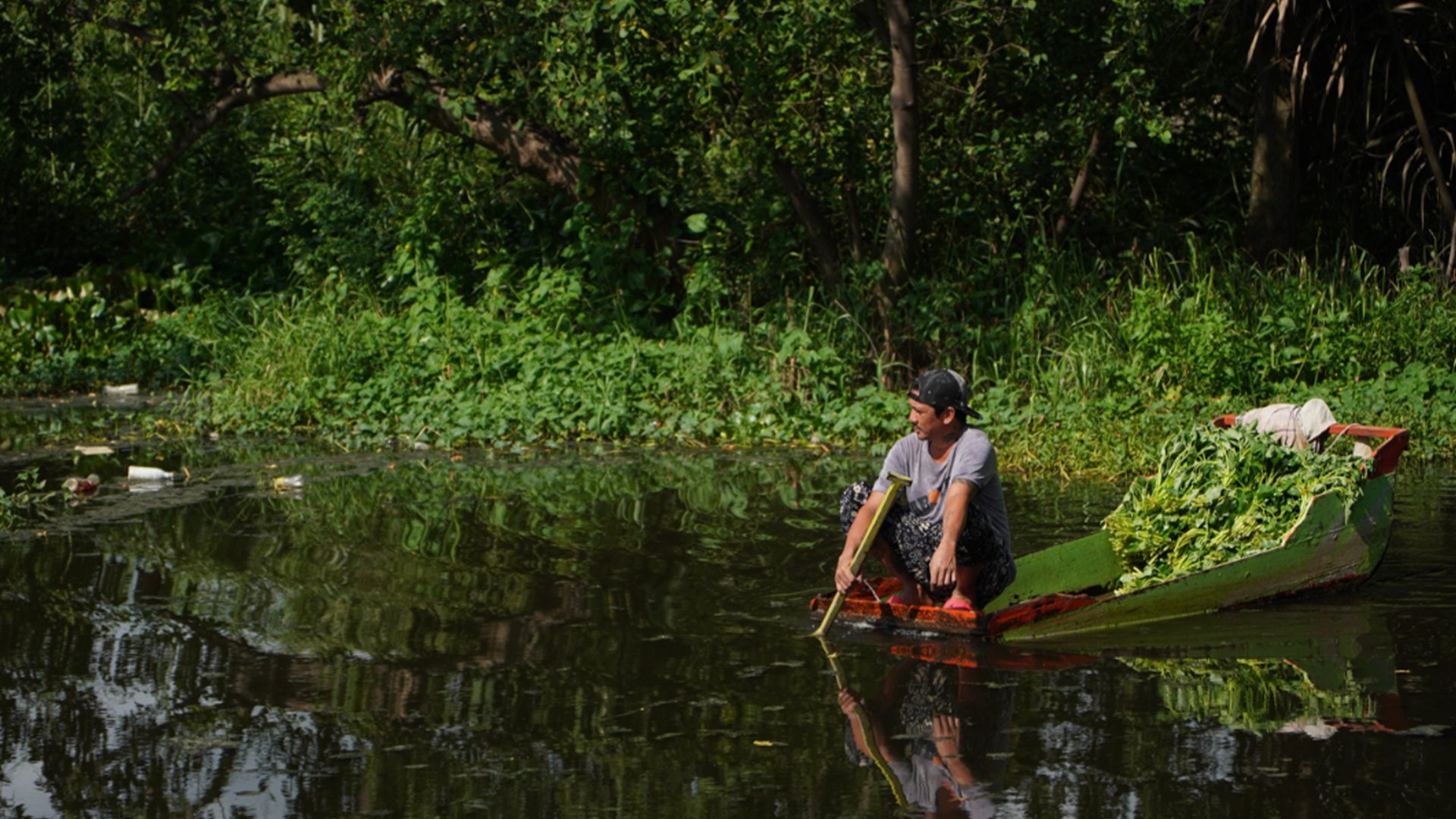
BULACAN, Philippines – While the town of Guiguinto has built a reputation around its ornamental plant industry, it also sustains another community of growers. Away from its roadside nurseries, generations of mangangangkong cultivate kangkong crops (water spinach) that feed not only Metro Manila’s markets, but also their own households. Stretching nearly five kilometers toward barangays Ilang-Ilang and Poblacion, the Guiguinto River serves as the municipality’s largest floating vegetable patch — the livelihood of generations of mangangangkong (kangkong farmers). But each year, saltwater from Manila Bay halts their harvest. Flood control projects also clear sections of the river for months at a time, while restrictions in kangkong cultivation continue to threaten the farmers’ livelihood. The kangkong farmers use bangkang de-yero, flat-bottomed boats that they themselves build from discarded roofing sheets bought from junk shops. Measuring roughly seven by ten feet, each boat is small enough to get through more narrow stretches of the river, and wide enough to carry dozens of freshly cut bundles of kangkong without sinking. In the afternoon, the mangangangkong head for the nearest bridge, where biyaheros purchase the day’s harvest. Their orders are usually placed ahead of time, allowing farmers to harvest only the number of bundles they need. These buyers do rounds across Bulacan’s vast river system every day — from Guiguinto to neighboring towns of Balagtas and Plaridel — before hauling the kangkong to markets in Metro Manila. Leaving factory work For more than three decades, 62-year-old Cesar dela Cruz from Barangay Poblacion has been making a living as a mangangangkong. He used to work in a factory, but he was told that the river could earn him as much as the factory did. CHANGING SEASONS. Cesar dela Cruz has been a kangkong farmer for three decades. Kangkong seeds are pressed into beds of straw tied between bamboo stakes pierced through the riverbed. After two to three weeks, the first shoots will be ready to cut. Dela Cruz has been harvesting kangkong every day, moving from one patch to another. On a good day, he can finish as many as 30 bundles before heading home. According to him, the biyaheros purchase as many as 1,000 bundles of kangkong per day. Depending on the volume they harvest, individual farmers can earn as much as ₱1,500 a day. Dry spell But the river does not yield the same harvest year-round. Between March and May, saltwater from Manila Bay creeps upstream, turning the kangkong yellow and stunting its growth. Harvests slow to a trickle, sometimes stopping altogether, until the first rains of June freshen the river once again. “‘Yun ang kalaban ng kangkong. Nasisira ‘yung kangkong, dumidilaw, hindi makausad. ‘Pag sumobra na ang alat, nalulusaw na siya. Kaya pagdating ng ulan, panibagong tanim uli kami,” Dela Cruz said. (“That’s the enemy of kangkong. It gets damaged, turns yellow, and stops growing. When the water gets too salty, it just dissolves. So once the rain comes, we plant all over again.”) For all its promise of daily income, kangkong farming leaves little room to save. Whatever the farmers earn during the harvest season must carry them through their months of waiting until the river becomes productive again. “Tiis tiis lang,” he added with a laugh, “Pagka mahina ang kita, tiis muna, kasi dumarating naman ‘yung taglamig, ‘yun na lang kami babawi. Medyo tumataas din [ang benta],” he continued. (“We just endure.” “When the income is low, we just endure because the colder season eventually comes. That’s when we make up for it. The price goes up a bit too.”) The Guiguinto River serves as the municipality’s main drainage channel, collecting floodwaters from neighboring towns such as Plaridel and Balagtas before emptying into Manila Bay through Bulakan. During heavy rains, however, the river overflows, flooding adjacent communities. Municipal disaster records from 2023-2025 estimate that flooding affects at least roughly 11,300 households. BETWEEN BOTH WORLDS. A kangkong farmer in Guiguinto. To keep the water from spilling into the community, the municipal government began constructing concrete embankments along sections of the Guiguinto River as early as 2016. Every year, a fragment of the riverbank would be fenced off to build parts of the floodwall. Local residents would seek out information from the workers to know which section would soon have to be cleared. “Ang lagay kasi ng dike rito, paganon-ganon, laktaw-laktaw. Taon-taon naman meron, kaso hindi mo malaan kung saan may ginagawang dike,” Dela Cruz said. (“The problem with the floodwall here is that it’s built in bits and pieces. Every year, there’s construction, but you never know where they’ll build next.”) Big contracts Procurement records from the Department of Public Works and Highways (DPWH) showed that, from 2023 to 2025, embankment contracts for portions of the Guiguinto River had reached more than ₱40 million each. Since 2017, DPWH has awarded multiple embankment contracts along the Guiguinto River to L.R. Tiqui Builders, Alpha & Omega General Contractor & Development Corp., and SYMS Construction Trading — companies that have previously been linked to Bulacan’s flood control controversies. (See data from the Guiguinto municipal records below.) Altogether, Guiguinto has received a total of 49 DPWH infrastructure contracts amounting to about ₱3.07 billion from 2021 to 2024. Whenever construction reached their plots, the mangangangkong would dismantle their bamboo stakes and leave the river behind. A single project could keep them away for up to nine months, Dela Cruz said. During this period, the kangkong farmers appealed to the contractor for financial assistance. Each of them received ₱5,000 to help offset the months they were unable to harvest. For Dela Cruz, this barely covers the interruption caused by the project to their livelihood. “Nabigyan naman kami kahit papaano, nagtiis kami ng siyam na buwan. Pero hindi sapat ‘yung nakuha namin sa kanila. Kasi nga, biruin mo siyam na buwan kami,” he remarked. (“They gave us something, so we endured for nine months. But what we received wasn’t enough. Just imagine, we went nine months like that.”) Other mangangangkong crossed into the neighboring rivers of Balagtas, where they can continue with their harvest. Around the same period, the municipal government of Guiguinto also ordered farmers to limit their plots to two meters wide. Dela Cruz said local officials believed that the crops were obstructing the river’s flow and worsening the floods. The mangangangkong initially complied with the directive. But as their harvests dwindled, they appealed to the municipal government to reconsider the restriction. “Kaya lang, nung sumunod kami, halos wala na kaming kitain, e. Kasi ang kailangan ng kangkong, araw-araw mo ma-harvestan. Para kumita ka ng pang-araw-araw mo,” explained Dela Cruz. (“But when we followed their order, we barely earned anything. Kangkong has to be harvested every day. That’s the only way you can make enough to get by each day.”) Road to Ilang-Ilang While some of the kangkong farmers remained where they had always been during the construction, some were forced to leave. Among them were the 21 families who now reside at the Laviña Compound in Barangay Ilang-Ilang. Before being relocated, many of them lived by the river in Barangay Poblacion. When the landowner sold the property to make way for the floodwalls, the families were offered ₱500,000 to divide among all households. However, Maricar Lupanggo urged her neighbors to think beyond the immediate payout. Instead of splitting the money, she proposed that they pool the amount to purchase a portion of land where they could build permanent homes instead of continuing to rent. “At least kahit papaano masasabi natin na atin na [‘yung lupa]. Dahil hindi na tayo umuupa, hindi na tayo mangungupahan, wala nang magpapaalis sa atin, hindi na tayo mangangamba kasi nga iyong [tinitirhan] na natin, sarili na natin,” she said. (“At least we can finally say the land is ours. We won’t have to rent anymore, no one can force us to leave, and we won’t have to keep worrying because the place we’re living in already belongs to us.”) The lot cost ₱600,000 — a hundred thousand pesos more than what they had received. Then-barangay captain Darsee Alvarez agreed to shoulder the difference, asking only that the families repay the amount in small monthly installments. After seeing that many of the families were struggling to make the payments, the barangay eventually waived the debt. Having settled into their new homes, the mangangangkong returned to the same livelihood they had known before their relocation. Dwindling numbers One of them is Maricar’s 51-year-old father, Marlon, who has been working as a kangkong agent for nearly twenty years. His job is to coordinate with the biyaheros for orders and oversee the mangangangkong assigned to fill them. At the height of the harvest season, as many as 14 farmers work under Lupanggo’s supervision. But for now, their numbers have dwindled to just six. Together with other mangangangkong, he spends his own money to buy chemicals to clear patches of water lily that accumulate along the river and restrict the waterflow. The cleanup, he said, is both a way of protecting their livelihood and of showing the municipal government that the farmers are willing to help maintain the river rather than merely profiting from it. “Ang dapat bawalan diyan kasi ‘yung mga basura na itinatapon sa ilog. Dapat iyon ang bawalan, hindi ‘yung kangkong,” Marlon explained firmly. (“What they should stop are the people throwing garbage into it. That’s what should be banned, not the kangkong.”) Despite repeated efforts to remove the kangkong from the river, Lupanggo said the farmers have no plans of giving up the livelihood they have depended on for decades. “Talagang nagtatanim pa rin kami kasi dito lang talaga kami umaasa sa pamumuhay namin sa ilog,” he said. (“We’ll keep planting because this is the only livelihood we have in the river.”) Finding gold Maricar credits the family’s years in kangkong farming for putting two of her younger siblings through college. She said losing the river would leave many longtime mangangangkong, particularly those with little formal education, with few opportunities to earn a living. “Hindi na po namin alam kung saan na po sila maghahanap ng trabaho kasi, ‘di ba, iyong mga walang pinag-aralan, tapos ‘di ba, iyong ‘di po tapos ‘di ba sila po ‘yung hindi natatanggap sa trabaho,” she expressed sadly. (“We won’t know where they’ll find work. Those who didn’t finish school are usually the ones who don’t get hired anywhere else.”) Yet, Maricar recognizes that without formal permits and ownership over the water they cultivate, the mangangangkong can only do so much should local officials eventually decide to remove them for good. “Kung mawawala man talaga ay siguro ihiling na lang sa munisipyo na parang magbigay ng pangpanimula sa mga business.” (“If we really have to leave, then I just hope the municipality can provide some start-up capital so people can begin other businesses.”) “Para po sa amin, ito po ‘yung ginto sa amin. Marumi man po sa paningin ng ibang tao, pero para sa amin ito po ang kayamanan kasi dito po kami nabubuhay, dito po namin na-provide ang pang-araw-araw namin sa bahay, nakakaraos,” she ended. (“To us, this is gold. Other people may see it as dirty, but to us it’s our wealth because this is what keeps us alive. This is how we’ve been able to provide for our family’s daily needs and get by.”) – Rappler.com Mark David Silencio is an Information Technology student at Bulacan State University in Plaridel, Bulacan. An Aries Rufo Journalism Fellow for 2026, he is also the managing editor for Administration of Pacesetter.
As floodwalls rise along Guiguinto River, kangkong farmers fight to stay afloat
Full Article
Original Source
Read the full article at Rappler →KhanList aggregates and links to publicly available news content. We do not host full articles from third-party sources. Always verify important information with original sources.