
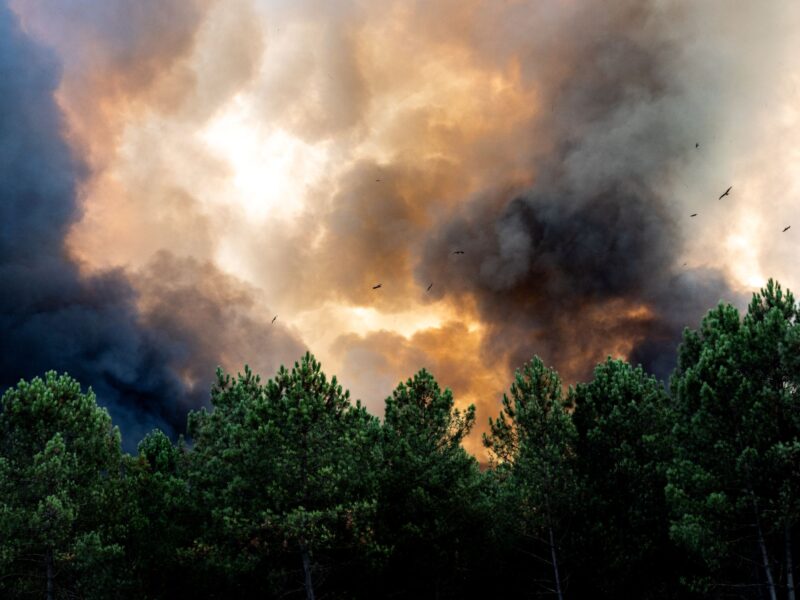
PARIS (CN) — Bordeaux, the city associated with fine wines and sprawling vineyards, has evacuated thousands of residents as firefighters continued Wednesday to battle flames that have burned an area roughly four times the size of Paris.As temperatures were forecast to hit 104 F in a fresh heat wave, experts warned of the chance for hot spots to reignite.Across the border in Spain, emergency workers are fighting to contain the country’s biggest blaze on record along the outskirts of Madrid, where 14 people had died as of Wednesday. However, Spanish Prime Minister Pedro Sánchez said Tuesday he’s starting to see a “light at the end of the tunnel.”Experts say the severity of the fires was fueled by climate change. However, some argue that directing efforts toward firefighting alone might not be the best strategy.“We’re always happy to buy more airplanes and more fire trucks,” Lindon Pronto, a senior expert at the European Forest Institute and wildfire consultant, said. “But when it comes time to investing a fraction of that into supporting communities to conduct risk reduction and mitigation measures, when it comes to investing in things like goats and sheep in the landscape, targeted technical measures to buffer communities … That money seems to not be there, and often that comes down to kind of the who’s responsible for what area, what jurisdiction.”Firefighters are on site to extinguish the wildfire on the Camp de Souge military training ground, near the town of Martignas-sur-Jalle, Gironde, on July 28, 2026. (Gauthier Bedrignans / Hans Lucas via AFP)The fires in France and Spain broke out in mid-July, fueled by high temperatures that left vegetation especially dry and flammable. Strong winds from different directions hastened the spread. The exact cause of the fires — usually sparked by human activity or electrical infrastructure glitches — is unknown.Météo-France said Wednesday would be the hottest and driest day of the week, with elevated wildfire danger across every region of France. Drought now covers mainland France and Corsica, with soils nearing the record dryness reached in August 2022.“So we have the preconditions; an extreme, long-lasting drought, desiccated vegetation,” Johann Georg Goldammer, the director of the Global Fire Monitoring Center, said. “So as a consequence, in this Euro-Mediterranean landscape, we have vast areas that have higher loads of biomass than historically, and if this is now associated with these extreme droughts and heat waves and the igniting spark, then the scene is set for extremely intense and severe fires.”Heat isn’t the only element adding fuel to the fire. Pronto said Western Europe’s very wet spring led to massive growth for vegetation. This was followed by record-breaking temperatures that dried everything out, creating a “cocktail of conditions” for fires.“So then you had all this abundant material which contributes to the fast fire spread, extreme fire behavior and intensity, now being completely dried out and very available,” he said. “And then comes the wind.”More than 448 square miles have burned across France this year, according to the Interior Ministry.Europe is the world’s fastest-warming continent, warming at more than twice the global average, according to the European Union’s Copernicus climate service. Western Europe recorded its hottest June on record, the EU’s Earth observation program Copernicus said.Lluís Brotons, a senior researcher at the Center for Ecological Research and Forestry Applications known as the CREAF, explained the level and the intensity of the fires, and the emergency response as a result, had been largely unheard of until recently.“We’re starting to not speak about one fire here, one fire there, but complexes of fires that interact and converge,” he said. “And this is relatively new in Europe at that scale, interacting with populations, with habitation, a lot of evacuations, and that’s creating a large-scale emergency that’s relatively new.”At the height of the crisis, roughly 330,000 people were driven from homes and vacation sites across France and Spain, though many have started to return home.Brotons added that now, there are “almost storm clouds” forming above the fires, which cause flames to interact with the atmosphere and generate their own winds.“That also means that within the fire, conditions are more uncertain than they used to be,” he said. “So when you have these storm clouds forming over the fire, the weather within the fire is very uncertain with high winds, and it’s much more difficult to actually develop a strategy to stop it when the fire is active.”View of the remains of homes after the fires passed through the town of Le Porge, Gironde, on July 29, 2026. Over seven days, the fire near Bordeaux ravaged 42,000 hectares and forced 220,000 people to evacuate the region. (Gauthier Bedrignans / Hans Lucas via AFP)Pronto has firefighting in his DNA. His father was a wildland firefighter in Northern California during his childhood, so he was exposed to prescribed burning and fuel management by the age of 5.When he was a teenager, he became a wildland firefighter himself before turning to a master’s degree in environmental policy. This ultimately led Pronto back into fires from an environmental governance standpoint.In his view, France would benefit from changing its strategy of “aggressive fire suppression.”“On one end of the balance sheet, it looks like they’ve been doing very effective firefighting,” Pronto said. “On the other hand of the balance sheet, every fire that you put out now that doesn’t burn out the fuel, clean out the landscape, reduce the biomass … if you don’t have equal efforts on the other end of the balance sheet to deploy sheep and goats and mechanized treatment and controlled fire … the fire debt that continues to build.”He wonders if the current wildfires will prompt a reckoning in France, similarly to what he called the “wake-up moment” for the U.S. a few decades ago.“In order to get ahead of the game, we need to invest in making the landscape more fire resilient, better managed so that the preconditions aren’t there for catastrophic fires like the ones we’ve seen now,” Pronto said.Subscribe to our free newslettersOur weekly newsletter Closing Arguments offers the latest about ongoing trials, major litigation and rulings in courthouses around the U.S. and the world, while the monthly Under the Lights dishes the legal dirt from Hollywood, sports, Big Tech and the arts.Additional Reads
As Europe burns, experts insist on wholistic strategies to fight record-breaking blazes
Full Article
Original Source
Read the full article at Courthousenews →KhanList aggregates and links to publicly available news content. We do not host full articles from third-party sources. Always verify important information with original sources.