
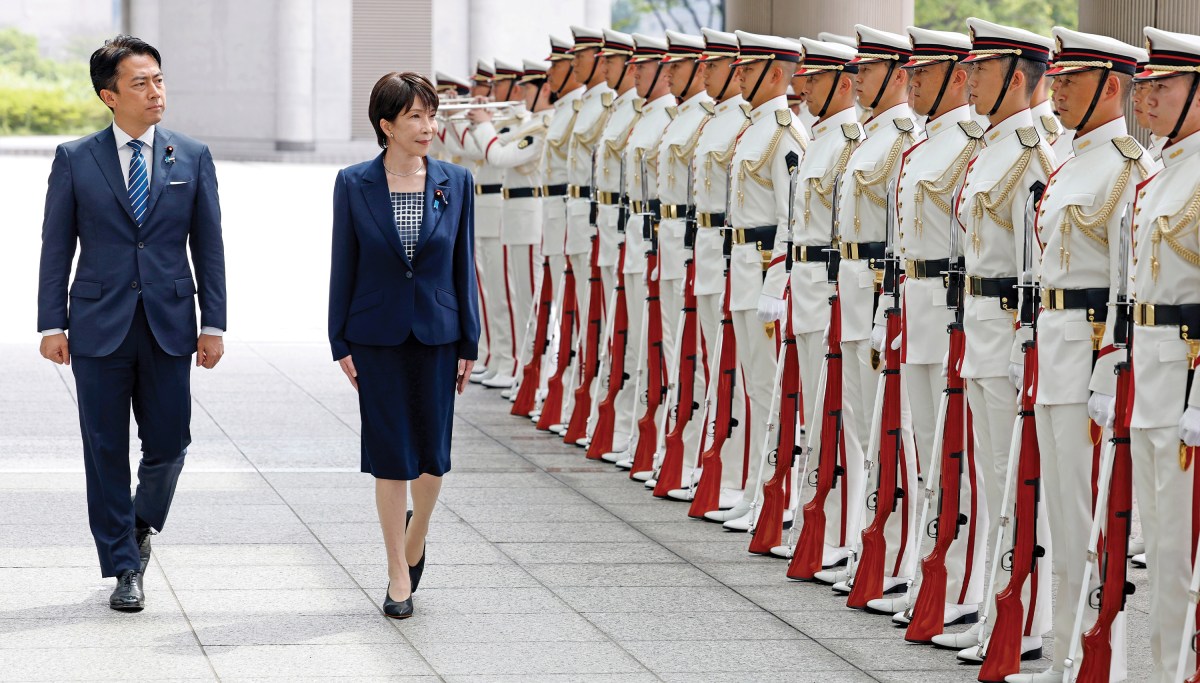
TOKYO — In this land of wonders, a bastion of liberal democracy in a continent dominated by imperial powers, contradictions abound.The Japanese sit silently in metro cars and stroll noiselessly to work on bustling streets, but cheer raucously at baseball games. Bullet trains whisk by at 200 miles per hour, and impossibly sophisticated toilets adorn even cheap hotel rooms, but its ecosystem of startup companies ranks 18th worldwide. More than 40 million foreigners visit the country every year, but it boasts barely 150,000 annual immigrants. Yet these inconsistencies pale in comparison to the asymmetries facing the Land of the Rising Sun at a moment of historical ferment, a time when the country is wealthy but somewhat stagnant, powerful but dwarfed by its neighbor across the East China Sea, and technologically mature but a bit underwhelming when it comes to innovation. As Beijing rises, whither Tokyo? Sanae Takaichi inspects an honor guard at a military conference in Tokyo on Sept. 2. (Kim Kyung-Hoon / AP) Across my conversations with military officials, economic and trade representatives, and academics, a few key themes emerged. First, Japan has unmistakably adopted a more assertive posture on the world stage, primarily in response to increasing Chinese aggression. Second, Tokyo has had to walk a careful balancing act in its relations with Beijing and Washington, depending as it does so heavily on the former for trade and the latter for defense. And, third, Japan is grappling with its own internal challenges, ranging from an aging population to a leveling off of innovative technological breakthroughs. Overall, it was clear to me both how important and how challenging it will be for Japan to redouble its commitment to the family of liberal democracies locked in a pivotal competition with China.Geostrategic changes Some eight decades after Pearl Harbor and Hiroshima, Japan has, somewhat reluctantly, at long last begun to reassert itself on the world stage. When Sanae Takaichi assumed office a year ago as the country’s first female prime minister, she already had earned a reputation for taking a harder line than her predecessors. The BBC labeled her “a staunch conservative and admirer of the late former British PM Margaret Thatcher” and noted that “she is seen as hawkish when it comes to an increasingly powerful China.”Indeed, she wasted little time in poking the dragon. Just a few weeks after her inauguration, Takaichi asserted at a budget committee meeting that military aggression by China against Taiwan would present a “survival-threatening situation” for Japan. That particular formulation carries heavy weight in the Land of the Rising Sun, whose military is known as the Self-Defense Forces and may statutorily and constitutionally conduct operations only in circumstances gravely imperiling the country. The prime minister later hedged her bold declaration, noting that “a judgment must be made after comprehensively assessing all information in line with the individual and specific circumstances of what has actually occurred.” But her more assertive stance faced a fierce backlash not only from Beijing, but also from academics and the Japanese Left. China’s Foreign Ministry urged Japan to “earnestly reflect and correct its mistakes, and to stop its manipulation and reckless actions on the Taiwan issue.” And in a Time article titled “How Japan’s Sanae Takaichi Torpedoed Ties With China,” Jeff Kingston, a professor at Temple University in Japan, argued that she “overturned Japan’s carefully cultivated posture of strategic ambiguity on Taiwan and crossed Beijing’s red line on what it contends is a renegade province it will reunite with the mainland.” Worse, Kingston contended, “she is guilty of making explicit what has been implicit and adopting an expansive interpretation of 2015 security legislation allowing the overseas dispatch of Japan’s Self-Defense Forces even when Japan itself is not attacked.”Left: Rare earth minerals are mined in China’s eastern Jiangsu province for export to Japan, Sept. 5, 2010 (CN-STR / AFP / Getty Images); Right: A humanoid robot poses for a photo at a conference in Tokyo, May 28, 2026. (Ayaka McGill / AP) Others leapt to Takaichi’s defense. A CNN analyst noted approvingly that “Japan has made a sweeping shift in its security posture in recent years, veering away from the pacifist constitution imposed on it by the United States in the aftermath of World War II, to boost its defense budget and acquire counterstrike capabilities” and attributed Beijing’s angry reaction to her statements to its “deep-seated concerns about the potential for changing military postures in Asia — as U.S. allies ramp up defense spending and coordination in the face of its own rising military might.” And the prime minister herself powerfully articulated what’s at stake, insisting in January of this year that “if the U.S. forces, acting jointly with us, come under attack and Japan does nothing and simply runs away, the Japan-U.S. alliance would collapse. So we would respond strictly within the limits of the law.”My interlocutors in Tokyo expressed mixed opinions about their prime minister’s approach. I sat down in Tokyo’s Roppongi neighborhood with Tomiki Fujihara, who heads research into Chinese economic and political issues at the Japan External Trade Organization or JETRO, a quasi-official organization with 70 global offices that originated as an export-promotion organ of the Japanese government and currently “works to promote mutual trade and investment between Japan and the rest of the world.” Fujihara observed that “many Japanese people cannot understand why China [got] very mad about that comment.” He allowed that the issue, which centers on the nuances of Japanese law, is “very complicated” and “difficult to understand” and argued that the media “oversimplified” the debate.At the same time, Taisuke Kassai, who leads the Americas division at JETRO’s research and analysis department, pointed out that, “after her comment, there was an election in Japan, and her leading party won. It was a landslide win.” Kassai reckoned that, across generations, “the Japanese people mostly support her stance on China.” (All opinions expressed by Fujihara and Kassai are their own, not necessarily JETRO’s.)I also met with a number of officials in the Japanese Ministry of Defense’s Intelligence Division in the MOD’s sprawling campus at the edge of Shinjuku, not far from the Tokyo Yakult Swallows baseball stadium. Shiha Oba, a veteran of intelligence headquarters and an expert analyst on China and Southeast Asia, explained to me that “China, North Korea, Russia, those three are the countries we have to keep an eye on.” To be sure, she acknowledged, “it has been so for a long while. But when I entered here 30 years ago, we didn’t say that out loud, but now we don’t hesitate to say that, that China is our biggest threat.”At the same time, Oba said, “China’s reaction is becoming more clear also. So, now it’s different. There’s kind of a pattern going on in a war of words.”I asked her whether she discerned any sort of generational gap across Japanese public opinion. She responded that “older people used to be really allergic [to conflict] but, you know, because the Second World War is like 85 years ago, memories are becoming” fainter. As for the younger cohort of Japanese, “I think they don’t have the reality. It’s like a simulation game.” She also noted that, because Japan, unlike Korea and Taiwan, has no mandatory conscription, “many young people don’t have experience” with war. (Oba’s opinions, like those of her MOD colleagues, are strictly her own.)Oba has focused her efforts on ensuring the integrity and continuity of maritime traffic, especially the crucial Strait of Malacca, a chokepoint between Malaysia and Indonesia that connects the Indian and Pacific Oceans. “I’m watching the South China Sea area,” she said. “We want to keep the sea lane free and open even under the Taiwan crisis. We don’t want the Strait of Malacca to become the Strait of Hormuz.” She’s working diligently to keep Indonesia, in particular, on side. “I think that President Prabowo of Indonesia is very good,” she reiterated. “He knows that his country is very valuable. And his defense minister of Indonesia and our Japanese minister, they’ve already talked” multiple times. Still, Jakarta maintains friendly relations with Beijing and Moscow and requires special attention.On Taiwan specifically, Oba’s colleague Shiro Utaka, the deputy director of the Global Issues Division within intelligence headquarters, emphasized that “Taiwan is a very important country, not only for the U.S., but also for Japan as well, because of their capacity and capability to produce semiconductors. Without them, I don’t think we would be able to secure the necessary chips.” For this reason, both Tokyo and Washington have urged Taipei to diversify its chip production lines, and indeed the largest such outfit, the Taiwan Semiconductor Manufacturing Company, recently opened plants in Kumamoto and Phoenix.This ties into a related area of discussion: how Beijing is exploiting trade relations to Tokyo’s distinct disadvantage.A perilous economic front On the economic front, there’s no question that Japan’s more assertive posture has strained ties with the People’s Republic of China, an especially challenging development for Tokyo, which depends on Beijing for key inputs into its tech-heavy economy.“After Prime Minister Takaichi’s comments on Taiwan last year in November,” Fujihara told me, “many people recognized that Japan-China relations are getting worse. Possibly affecting that relationship, China’s export controls became very strict after November.” Beijing had already significantly sharpened limits on the export of seven rare-earth metals — samarium, gadolinium, dysprosium, terbium, lutetium, scandium, and yttrium — critical to advanced computing and electronics products. The CCP tightened the screws on shipping out these materials even further following the Takaichi remarks, substantially lengthening the period required to obtain the licenses necessary to circumvent the export controls. Almost as worryingly, Chinese exports of rare-earth magnets plummeted by 84% between March 2025 and March 2026, according to documents the JETRO officials showed me.Beijing skillfully uses these export controls to its strategic advantage. For instance, as Fujihara explained, in a clever twist, “Japanese companies have capabilities to produce high-level motors, but they have to import rare earth magnets from China. And Chinese export controls, they say that, [in general,] to export magnets, they have to get approval from the Chinese government.” However, if those Chinese magnets are being exported to countries whose companies implant them in motors that are then reimported to China, “they don’t need to get approval from the Chinese government. So, ‘Japanese companies, please invest more [in] China to produce motors,’” is the message the CCP is promulgating.China has pressed this advantage to begin to pull ahead of Japan in certain key areas, like robotics. “Originally,” Fujihara told me, “Japanese companies had strengths in robotics, but nowadays Chinese companies, their ability to make embodied AI on robotics, their technology is getting very sophisticated. And the competition between Chinese companies and Japanese companies on robotics area is very severe.” When I visited the country three years ago, researching my book, I came away deeply impressed by the advances that companies like SoftBank Robotics had made in physical AI. (Many of these breakthroughs are, like most successful inventions, the children of necessity: Japan’s birth dearth increasingly requires machines to perform many tasks.) But since then, Beijing has zoomed ahead in robotics, even reportedly deploying dog-like robots in military exercises.JETRO’s Fujihara and Kassai also explained how Chinese companies are expanding data center deployment across Southeast Asia, most prominently in Thailand, Indonesia, and Malaysia. The charts they showed me depicted the gargantuan growth of facilities belonging to ByteDance, Alibaba, Tencent, Huawei, Chindata, and other Chinese tech giants in hubs like Bangkok, Jakarta, and Johor. “Surging demand for computing capacity and bandwidth for AI and large language models is deriving new data center deployment in Southeast Asia,” one JETRO report found. While the U.S. suffers from virulent, astroturfed opposition to data centers, China is zooming ahead.Technological partnership opportunities Even with these economic headwinds, Japan’s longtime global advantage in technology presents an opportunity for partnership, beginning with AI. “Artificial intelligence has been kind of a buzzword even within Japan,” Utaka told me. “There’s not a single day that I can read newspaper articles that do not mention AI. So, it’s becoming a very important issue, not only for Japanese society, but also among the Japanese government ministries and agencies as well.” Equally importantly, Utaka explained, “the Japanese government’s fundamental standpoint is that we have to work closely with United States as a treaty ally,” and therefore, “our AI policies, applying artificial intelligence in the defense arena, has to be also governed by this fundamental policy.”Specifically, Utaka pointed to robotics, or what he labeled “physical AI,” as a fruitful area of collaboration.“My understanding of the U.S.,” he contended, “the weak point of the U.S. developing physical AI is that they have technologies and patents as well, the knowledge, but they have very limited infrastructure to achieve physical AI, like robotics type of technologies. And this is area where the Japanese people, industries are very good at.” Tokyo could provide physical AI infrastructure, while the U.S. could continue to advance the development of large language models, where frontier American AI labs maintain a slim but still noticeable lead over their Chinese competitors. At the same time, he fears a brain drain, where Chinese firms recruit struggling Japanese data scientists to join them. “In fact,” he recalled, “that’s the techniques that they used in the 1990s and early 2000s, when the Japanese society was facing a serious economic recession.”Another key area where Japanese capabilities can complement those of the West lies in cooperation around data-sharing. Fujihara explained how “Data Free Flow with Trust,” or “DFFT,” denotes “a concept that promotes the free flow of data across borders while ensuring trust through appropriate protections for privacy, security, and intellectual property rights.” This mechanism was “first proposed by former Japanese Prime Minister Shinzo Abe at the World Economic Forum in 2019 and has since been discussed and supported in international forums such as the G20, G7, and [the Organization for Economic Cooperation and Development].”Because of China’s sheer size, its 1.4 billion residents generate a tremendous amount of data that Chinese AI platforms can train on and use for iterative improvement. This data, of course, isn’t subject to anything like the kinds of privacy protections imposed in free societies committed to individual liberties. But even that enormous Chinese market pales in comparison to the combined population of liberal democratic countries around the world. “To improve AI,” Fujihara said, “we need much data. China has a huge population and huge industries, so they can collect a lot of data within [the] country. But other countries don’t have [China’s] population” and “to improve AI, we need to share this kind of data.” By pioneering data transmission through channels like DFFT in a manner that enables effective information sharing while respecting privacy and IP rights, Japan offers crucial technological tools to its allies among freedom-loving countries.The Defense Ministry’s Utaka echoed Fujihara’s sentiments. “The trouble for the Chinese, they don’t have allies or friends which are capable of doing co-developing AI,” he observed. “So they have to do development in terms of intelligence AI and physical AI on their own.” In order to catch up with the West, China “might have to make twice as many investments” as liberal democracies, which can band together and take advantage of their alliance.Similarly, Hiroki Habuka, a law professor at Tokyo University who focuses on AI integration into business and government, regards “smart governance” as a productive area of potential cooperation. “The government has issued several guidelines on AI safety and risk management,” he explained over lunch in the Azubajuban neighborhood. “In the past five years, we’ve amended more than 8,000 provisions under the regulation for decrees or notifications by the government so that we can use AI for compliance purposes.” Japanese statutory governance is notoriously byzantine, but the principle underlying AI regulation centers on integrating it sensibly into the economic and political everyday. “The Japanese approach is simple,” Habuka told me, “which is that we can just make use of our existing laws. Because AI can be applied for whatever purposes you want, but only the high-risk activities should be regulated.” In addition, Habuka pointed out how Japanese policymakers take care to avoid regulatory capture, an increasing risk in the American AI ecosystem. As debates over AI regulation roil Congress and state capitols, the U.S. would do well to emulate Japan’s basic, light-touch approach.TOKYO JUST CHANGED KIM JONG UN’S NUCLEAR CALCULUSMore generally, Takaichi’s recent assertiveness against China has dovetailed with a more cooperative strategic relationship with the United States. “The current ruling party’s policy toward the U.S. is basically to continue to strengthen the relationship,” Takahiro Moriwaki, a 13-year veteran of the MOD’s Intelligence Division, who focuses on U.S.-China relations, told me. Under the previous government, “the relationship with the United States is said to… deteriorate. But since then, I think Japan has been continuing to strengthen the relationship with the United States because the U.S. is the only ally. I don’t think any alternative exists.”These were among the more inspiring words I heard during my two-week sojourn in the Land of the Rising Sun. Here’s hoping policymakers on both ends of the Pacific heed them — and that Japan continues to furnish its remarkable contributions to the alliance of liberal democracies.Michael M. Rosen is an attorney and writer in Israel, a nonresident fellow at the American Enterprise Institute, and author of Like Silicon From Clay: What Ancient Jewish Wisdom Can Teach Us About AI.
As competition between US and China intensifies, Japan has an important role to play
Full Article
Original Source
Read the full article at Washingtonexaminer →KhanList aggregates and links to publicly available news content. We do not host full articles from third-party sources. Always verify important information with original sources.