
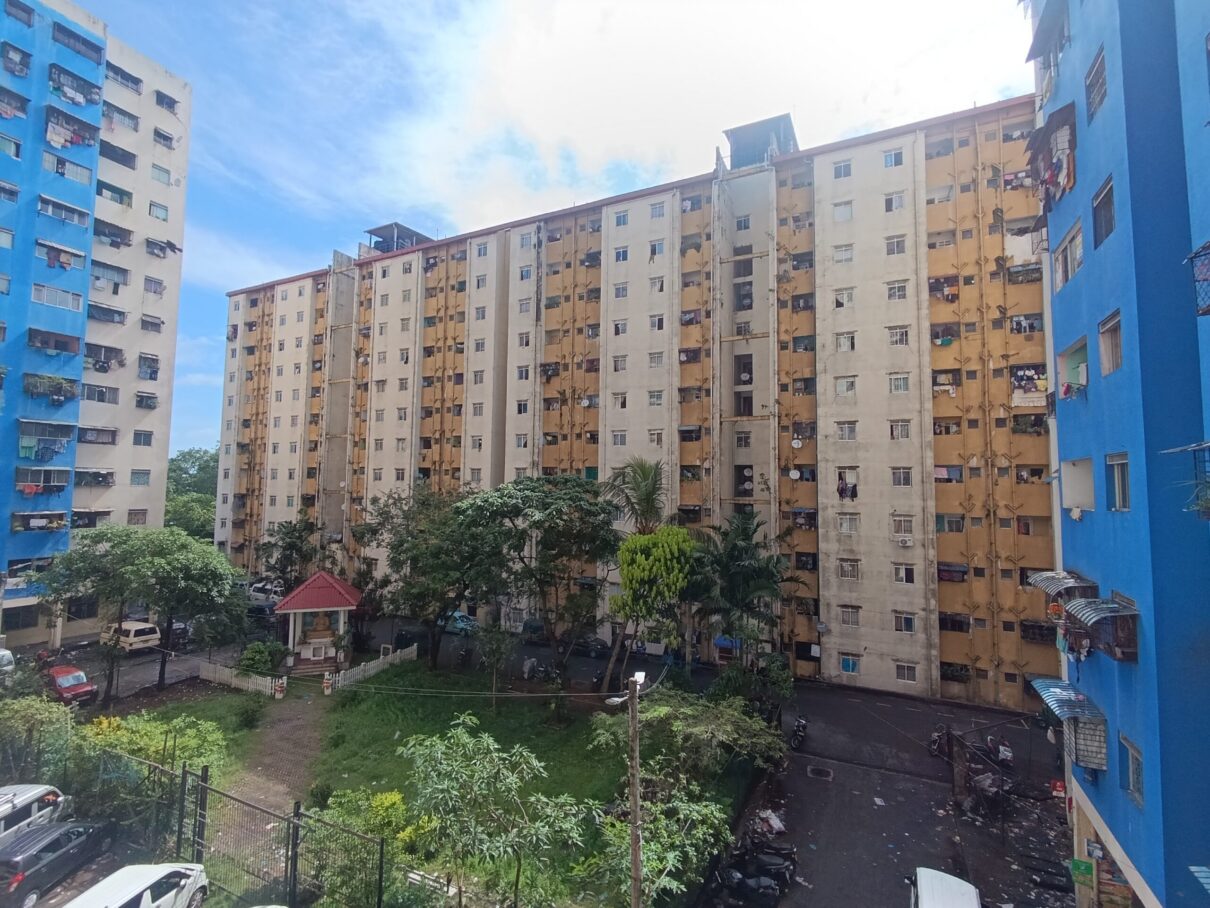
As temperatures soar, Sri Lanka’s urban dwellers are becoming more dependent on mechanical or active-cooling methods such as fans and air conditioners.The urban residential sector consumes nearly a third of Sri Lanka’s total energy demand to heat and cool buildings, and run lights, devices, and appliances.Passive cooling is an approach that uses natural energy flows such as wind to lower indoor temperatures, engineers say.Proponents say natural ventilation is one of the most effective passive-cooling strategies and especially suitable for humid climates such as Sri Lanka’s. COLOMBO — Fathima Rinoza lives on the fourth floor of a 14-story apartment block in Dematagoda, a suburb of Sri Lanka’s commercial capital, Colombo. She rarely keeps the two windows in her house open for long. The heat becomes unbearable by midday, she says, and the surrounding buildings obstruct wind flowing in the direction of her home. In addition, the stench from littered surroundings discourages residents like Rinoza from keeping their windows open. “Fresh air is a luxury for us because we can’t keep windows open for too long. By noon the heat becomes unbearable. If I keep the windows open till evening, there’ll be a lot of dust inside the house,” she tells Mongabay. Rinoza keeps the two fans in her house working almost the entire day to cool the house. The heat and poor ventilation make people like Rinoza who live in cramped urban settings heavily dependent on mechanical or active-cooling methods such as fans and air conditioners. According to the International Energy Agency (IEA), the urban residential sector accounts for nearly a third of Sri Lanka’s total energy consumption: to heat and cool buildings, and to run lights, devices, and appliances. As heat and energy demand rise, Sri Lanka is actively exploring the adoption of traditional and modern passive-cooling methods, primarily in the residential sector. Passive-cooling strategies In passive cooling, the building design approach uses natural energy flows like wind and shade to lower indoor temperatures. Research by Sri Lankan engineers in 2021 on natural ventilation for sustainable building design highlighted natural ventilation as one of the most effective passive-cooling strategies. A courtyard-style house in Colombo has a cool and welcoming look. Image courtesy of Indu Dharmasena. Rahula Attalage, one of the researchers and a professor of mechanical engineering at the Sri Lanka Institute of Information Technology (SLIIT) identifies three considerations for passive cooling: Energy efficiency, indoor environmental quality (IEQ), and thermal comfort. Indoor conditions are heavily dependent on what occupants do inside the built environment, the building structure, and outdoor conditions, he says. “The best condition within a building is what is outside under shady conditions,” Attalage tells Mongabay. “For a humid climate like ours, natural ventilation is the most important passive-cooling method. Cross ventilation is one of the techniques that doesn’t require too much energy when compared to conventional air-conditioning.” Natural ventilation in architecture Architects say that architectural design and natural elements such as the wind and shade are important when incorporating passive-cooling methods. Indoor thermal comfort, or the feeling of comfort experienced, is an important aspect in building design as it impacts on the satisfaction and productivity of occupants. Sumudu Athukorala is a chartered architect who adopts natural ventilation methods in his architectural designs. He emphasizes the importance of orientation when designing a house or building: the direction that a building faces directly affects its exposure to sunlight and wind. “For example, when there is no big façade facing the eastern and western directions, less heat enters the house. It varies depending on the land where it is being built,” Athukorala tells Mongabay. To add more ventilation, he includes features such as large windows or even a courtyard to increase cross ventilation. Lack of space in urban Sri Lanka means limited options for housing designs that incorporate natural ventilation. Image by Kamanthi Wickramasinghe for Mongabay. “People like to have a roof terrace, but it is better to complete the house with a roof. A concrete slab would absorb heat during the day and transfer the heat downward at night. When a roof is at an angle, the heat doesn’t get transferred directly into the house,” he says. Use of alternative materials Materials play a decisive role too, according to Attalage. In tropical countries like Sri Lanka, it’s important to prevent outdoor heat from entering a building. “We need to look at the best combination of concrete, bricks, wood and insulation,” he says. “Different materials have different capacities to store heat, for thermal conductivity and so on. Material properties should support least transmission of heat.” According to Athukorala, concrete blocks, a popular choice, trap heat during the day and transfer that heat into the house at night. “Clay bricks have heat-resistant properties,” he says. “I try to build houses using the exposed brick method. A brick wall is among the best passive-cooling methods.” Roofing materials such as interlocking clay tiles are able to retain the cooling effect better than traditional roofing tiles or materials such as asbestos, Athukorala says. The landscape, too, is important. Shady trees can be planted near large openings to prevent sunlight reaching the house directly, he adds. Unlike passive methods, active methods such as fans and air conditioners have the advantage of using energy and providing relief from heat without the need for the aforementioned design decisions, Attalage says. “Passive methods depend on orientation, wind velocity [that are] beyond the designer’s control,” he adds. Fathima Rinoza shows a window she had to close permanently after a thief broke into her home. Image by Kamanthi Wickramasinghe for Mongabay. The question of indoor cooling has gained urgency amid rising temperatures. A 2024 study projects that the minimum temperature across Sri Lanka from 2020-2040 will increase by 0.7-1.2° Celsius (1.3-2.2° Fahrenheit). According to Attalage, for natural ventilation to be effective, the acceptable level of air movement should be around 0.4-0.6 meters per second (1.3-2 feet per second). “The heat is another issue. Someone may be used to working at 24°C [75°F] but with natural ventilation, you will be working at 30°C [86°F],” he adds. This architectural design inspired by clay bricks has a tranquil air. Image courtesy of Kasun Wickramage. Poverty prevents solutions For many urban dwellers, the issues of design and materials ultimately boil down to affordability and accessibility. Socioeconomic factors heavily influence such choices and are out of reach for urban dwellers like Rinoza. She’s had to permanently close a window facing a neighboring building after her home was broken into; theft is common in low-income urban settlements. She’s also had to install bars across the two remaining bedroom windows, effectively blocking out natural ventilation. Sanath Kithsiri is the industrial and service sectors director at the Sri Lanka Sustainable Energy Authority (SLSEA). He predicts passive-cooling methods will be the next solution in the residential sector, even as conventional air conditioners continue to enjoy significant use at the household level. “It’s time to transition to inverter-type air conditioners due to energy-saving mechanisms. But Sri Lankans are reluctant to invest in them as repairs are costly,” he tells Mongabay. The SLSEA has developed guidelines for energy-sustainable homes incorporating various passive-design strategies to enable ventilation, choice of materials for insulation, color codes for surfaces, and shading features. It also offers ideas on the placement of windows and doors to allow wind to pass through and features to permit the required level of sunlight. A building in Pettah, a bustling town within Sri Lanka’s commercial hub of Colombo, is covered by air conditioners, which increases the outdoor temperature of urban areas. Image by Kamanthi Wickramasinghe for Mongabay. A national cooling policy Sri Lanka’s National Cooling Policy was drafted in 2021 to increase the energy efficiency of the cooling sector. However, Deputy Environment Minister Anton Jayakody tells Mongabay that the policy is still in its draft stage and needs review. With more air conditioners being used, there’s a lot of heat being generated outdoors across Colombo, he says. “The plan is to reduce this heat by cutting down on hydro-generated electricity consumption and opt for alternative methods. A committee will be set up to review the existing draft policy this year, but I cannot confirm when it would be implemented,” Jayakody tells Mongabay. Banner Image: Residents of urban high-rises face higher daytime temperatures. Image by Kamanthi Wickramasinghe for Mongabay. Citations: Geekiyanage, D., & Ramachandra, T. (2018). A model for estimating cooling energy demand at early design stage of condominiums. Journal of Building Engineering, 17, 43-51. doi:10.1016/j.jobe.2018.01.011 Attalage, R. A., & Viraj Nimarshana, P. H. (2021). Natural ventilation for sustainable building design. SLEN, 50. Retrieved from https://iesl.lk/SLEN/50/Natural%20Ventilation%20for%20SBD.php Jayawardena, I. S. P., Darshika, D. W. T. T., Herath, H. M. R. C., & Hapuarachchi, H. A. S. U. (2024). Climatevariability, observed climate trends, and future climate projections for Sri Lanka. In The role of tropics in climate change (pp. 77-119). Elsevier. doi:10.1016/B978-0-323-99519-1.00010-7 Cite this articleKamanthi Wickramasinghe (2026). As Colombo heats up, passive cooling offers a low-energy solution — but at a cost. Mongabay Conservation news. DOI: https://doi.org/10.66709/news-332188 Credits Topics
As Colombo heats up, passive cooling offers a low-energy solution — but at a cost
Full Article
Original Source
Read the full article at News →KhanList aggregates and links to publicly available news content. We do not host full articles from third-party sources. Always verify important information with original sources.