
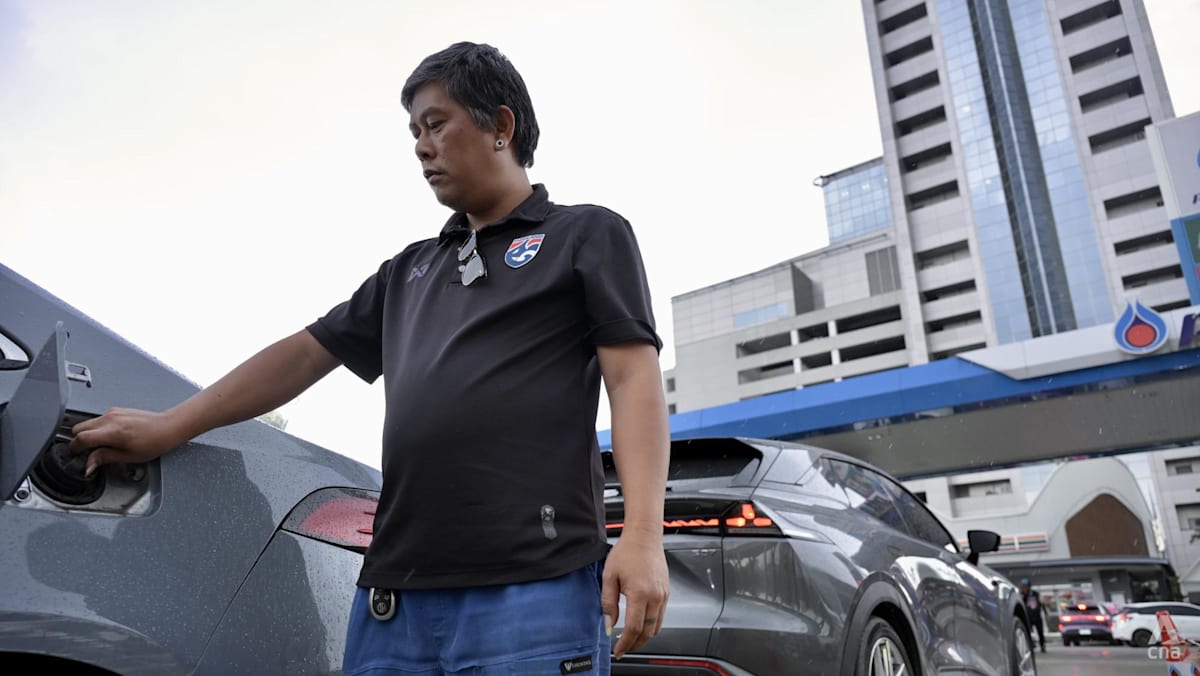
BANGKOK: During his long days driving through Bangkok's congested streets, 66-year-old ride-hailing driver Pichai Phungmai is counting every cost.The former interior decorator has been working for Grab for the past eight months. To keep costs down as fuel prices rocketed this year, he converted his Toyota Altis to run on gas rather than petrol, bringing down his daily bill down to between 200 baht and 300 baht (US$6 - US$9).Now, Pichai is considering an upgrade to an electric vehicle (EV), attracted by their performance, comfort and appearance, as well as the prospect of lower running costs.They have also become relatively affordable to buy, with many popular models priced between 500,000 baht and 900,000 baht, helped by government subsidies aimed at encouraging the adoption of cleaner vehicles. But that could soon change.Thailand is changing the rules of its electric vehicle transition and plans a steep tax rise from Jan 1, 2027 on imported EVs with the stated goal of protecting domestic manufacturing and attracting more local production.The government will increase excise taxes on fully imported EVs from 10 per cent to 35 per cent from next year, widening a price advantage enjoyed by qualifying locally manufactured vehicles, which currently only face a 2 per cent tax.An excise tax is an indirect tax charged by the government on the sale of a particular good or service.The higher tax is intended to reward companies that build domestically, protect established automotive investment and encourage Thai suppliers to shift their production further into the EV supply chain, after years of reliance on Japanese auto giants.But with a limited budget, affordability remains Pichai’s main concern. "If the price of a car increased by 100,000 baht or more, I wouldn't be able to afford it,” he said. Ride-hailing driver Pichai Phungmai wants to upgrade his vehicle to a new EV. (Photo: CNA/Jarupat Karunyaprasit) The move could also unsettle the market, narrow consumer choice and intensify competition among Chinese manufacturers for a foothold in Southeast Asia, experts said.“This is a corrective measure,” said Pavida Pananond, a professor of international business at Thammasat University.“The new tax is meant to restore a level playing field. The direction is right, but it comes late. Chinese brands already dominate Thailand’s EV market,” she said.Chinese-made EVs accounted for about three-quarters of all electric car sales in Thailand in 2025, according to the International Energy Agency, although locally manufactured EVs were gaining market share.The broader EV market in Thailand has continued to expand rapidly. Sales of battery-electric passenger vehicles nearly doubled to more than 161,000 in the first nine months of 2026, according to the Federation of Thai Industries.But imports continue to dominate. Thailand imported nearly US$2.4 billion worth of electric passenger cars in the first nine months of 2026, with China accounting for 96 per cent of the value, according to government data.Industry figures also indicate that imported vehicles accounted for around 70 per cent of EV sales during the period.That imbalance has complicated the government's ambition to turn Thailand into a regional EV manufacturing hub. Under previous incentive schemes, carmakers were allowed to import vehicles at preferential rates, but were required to offset those imports with domestic production.It has a broader ambition for zero-emission vehicles to account for at least 30 per cent of domestic vehicle production by 2030. The new tax measures are intended to shift the balance more sharply. EV cars parked at Laem Chabang Port, in Chonburi province, Thailand on Sep 11, 2026. (File Photo: REUTERS/Chalinee Thirasupa) A MARKET IN TRANSITIONThere are possible risks, experts said. The immediate consequences could be a rush to buy before January with higher prices for some models expected next year and a reshaping of competition between Chinese and Japanese carmakers.As well, the move could result in a sales slump across 2027 and the possibility that some brands drop imported models and exit the market rather than build locally, Pavida said.Krisda Utamote, an honorary adviser at the Electric Vehicle Association of Thailand (EVAT), a non-profit industry association, said he expects manufacturers to import and clear vehicles through customs before the deadline.That would allow them to sell existing inventory next year under the previous tax structure. Consequently, prices may not jump immediately in January, he said.But time is not on the side of those on the fence about shifting towards a clean, cheap ride.Nuntapat Muangprasit, 46, a noodle shop owner, is considering an EV to replace his diesel pickup truck, frustrated that he now pays almost double the fuel costs that he used to.He said he would rather pay monthly instalments on a more efficient EV. If higher taxes meant he could save money by choosing a locally manufactured car, he would not hesitate.“I would look at which locally produced models fit my budget and meet my needs. Price remains a major factor in my decision,” he said. High fuel prices have increased the viability and attractiveness of EVs for some Thai drivers. (Photo: CNA/Jarupat Karunyaprasit) Chinese manufacturers that have invested and are already producing vehicles in Thailand stand to gain from potential customers like Nuntaput, deterred from the higher taxes on imported competitors.Chinese car manufacturer BYD operates a factory in the Thai province of Rayong with an annual production capacity of 150,000 vehicles. British automotive brand MG, which is now Chinese-owned, manufactures vehicles in Chonburi, with capacity of up to 100,000 cars annually and GAC Aion, a Chinese EV manufacturer, recently opened a battery-pack assembly plant to complement its vehicle manufacturing hub.Other Chinese manufacturers like Leapmotor, XPeng and Dongfeng are now also examining local assembly options, according to local media reports.The Thai government is also proposing a three-tier system for its excise tax, with preferential rates for manufacturers using Thai-made components. Those meeting a potential 40 per cent local-content threshold would pay 10 per cent excise, while those that do not are subject to higher rates.“Take Tesla for example. Tesla doesn't have a manufacturing base in Thailand, so they have to go for 35 per cent unless Elon Musk says, okay, I'll put a plant in Thailand. Then, of course, they can talk about a preferential rate,” Krisda said.He added the previous eight-percentage-point difference in excise tax between imported and locally assembled EVs had done little to discourage imports.But the higher tax would help distinguish between manufacturers committed to investing in Thailand and those seeking to compete primarily through imports. Japanese automakers have pushed back against cheap imported electric vehicles in Thailand. (Photo: CNA/Jarupat Karunyaprasit) LONG TIES TO JAPANThe policy also reflects growing concern about Thailand's established automotive industry, developed over decades of Japanese investment.Japanese manufacturers have lost market share to Chinese EV brands, although many remain focused on hybrid vehicles and pickup trucks.Japan's ambassador to Thailand, Otaka Masato, warned last week that cheap imported vehicles threatened the country's manufacturing and export base, which employs around 800,000 people.The Thai government denied that the new tax measures were introduced to appease Japanese manufacturers, saying the objective was to protect domestic production and encourage greater investment in local supply chains.Thailand’s long-established automotive sector development has largely served Japanese companies and the thousands of components needed for a traditional vehicle powered by a petrol or diesel engine.For Thai parts suppliers, more assembly plants do not necessarily mean more business.J Phiphat Autopart Industry, a components manufacturer based in Pathum Thani, north of Bangkok has been part of the industry for more than five decades.Its representative, who only went by his Thai nickname, Ko, described increasingly unpredictable orders for conventional vehicle components as Japanese manufacturers faced stronger competition. An employee works at an assembly line in AutoAlliance Thailand, a Ford and Mazda joint venture plant, located in Rayong province, east of Bangkok on Sep 17, 2013. (Photo: REUTERS/Chaiwat Subprasom) While he saw opportunities from Chinese EV investment, established Chinese supplier networks, pricing pressures and the cost of new machinery made entering those supply chains difficult.“We would welcome measures that give Thai suppliers a fair opportunity to participate in the EV supply chain,” he said.Pavida argued that Thailand can adapt existing capabilities in bodies, seats, wiring and glass, but higher-value components such as batteries, motors and power electronics remain difficult to localise.“Chinese suppliers serve a huge home market, so Thai firms struggle to match their costs.“Chinese carmakers keep the highest-value parts, batteries and software, within their own groups or with trusted Chinese suppliers. Thailand will need time, and targeted incentives, to move into those layers,” she added.The challenge extends beyond Thailand. Chinese manufacturers are expanding across Southeast Asia, including in Malaysia and Indonesia, while Vietnam has developed a substantial domestic EV market.Thailand's higher taxes could make local production more attractive, but also complicate efforts to build integrated automotive supply chains across the Association of Southeast Asian Nations (ASEAN), now an 11-member regional bloc.While the new excise, which would apply for EVs manufactured in neighbouring countries, could undermine that ambition, Thailand needed measures to protect domestic investment, Krisda argued.“It is what it is. The government decided to put up this barrier,” he said. “Otherwise they have no other measure to protect themselves.”
As Chinese EVs reshape Thailand's car industry, higher taxes bring new uncertainty
Full Article
Original Source
Read the full article at Channelnewsasia →KhanList aggregates and links to publicly available news content. We do not host full articles from third-party sources. Always verify important information with original sources.