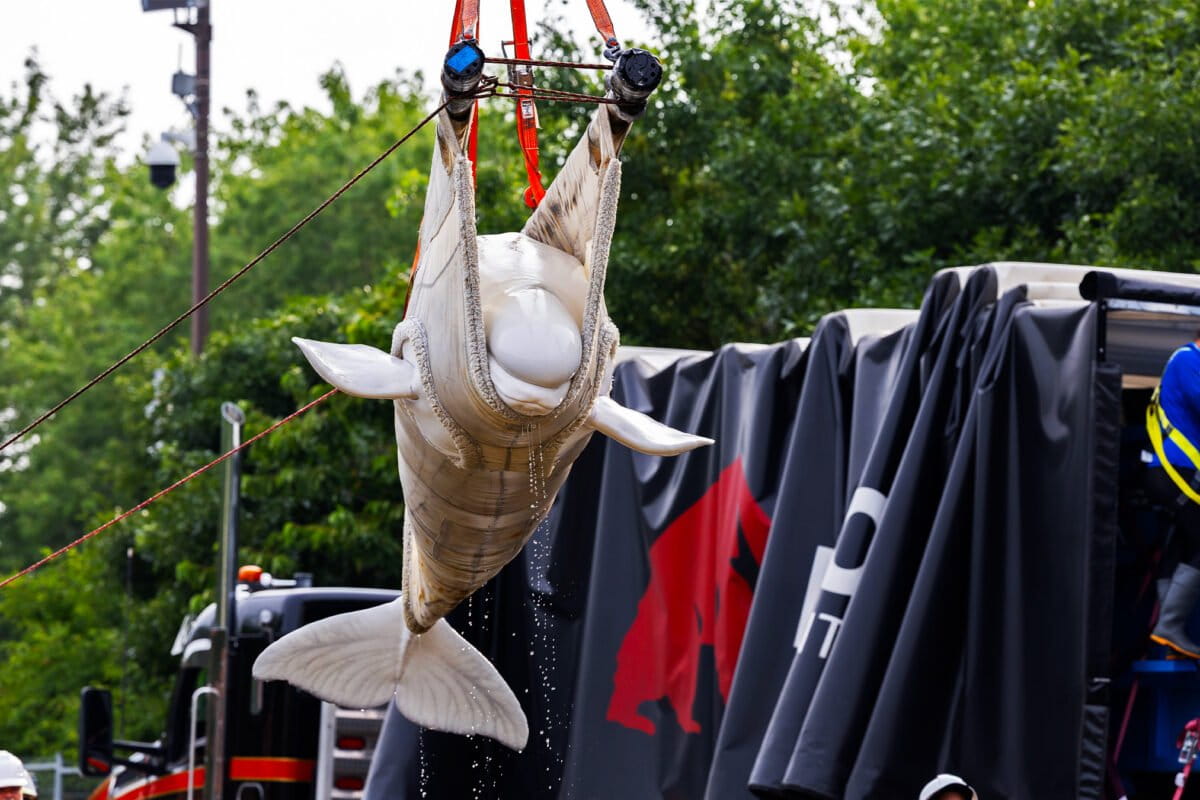
Thirteen beluga whales from a pod of about 30 languishing in the shuttered Canadian marine park Marineland arrived in the U.S., six of them on July 21, and seven on August 3, as part of an emergency rescue of these captive cetaceans.The transfers come after nearly a year of jostling between the Canadian government and Marineland about the belugas’ future, amid threats of euthanasia and disagreements over where the cetaceans should be housed.Earlier this year, several U.S. aquariums drew up an emergency rescue plan to transfer these cetaceans to four U.S. facilities.Conservationists say the U.S. move leaves questions unanswered about the cetaceans’ future, including if they would be used for entertainment or bred in captivity — both outlawed in Canada since 2019. Thirteen beluga whales, part of a pod of about 30 that were left languishing in a shuttered Canadian theme park, arrived in the U.S. The first transfer of six whales happened on July 21, and another seven were shipped out on August 3. These whales are part of the emergency transfers from Canada’s Marineland to their new homes in the U.S., marking the beginning of the end to a year-long saga of uncertainty. Shipped in specialized, cold-water containers, the belugas (Delphinapterus leucas) traveled for hours, on trucks and a plane, to two U.S. facilities: nine individuals went to SeaWorld in San Antonio, Texas, and four females to Shedd Aquarium in Chicago, Illinois, in two batches. Marine mammal veterinarians accompanied the cetaceans throughout their journeys, according to a press release from Georgia Aquarium. A spokesperson from the Atlanta-based aquarium said in an email it hopes to receive two beluga whales from Marineland in subsequent transfers. The international transfer came to fruition after several aquariums, all accredited with the U.S.-based Association of Zoos and Aquariums (AZA), drew up an emergency rescue plan earlier this year to transfer the belugas out of Marineland. These cetaceans had spent years at the theme park in Niagara Falls, Ontario. In 2019, Canada passed the landmark Ending the Captivity of Whales and Dolphins Act, which banned the keeping, breeding and trading of cetaceans — whales, dolphins and porpoises — for entertainment, affecting Marineland’s business model. By 2021, Marineland was Canada’s only entertainment park with cetaceans and was well on its way to shutting its doors forever — which it did in 2025 with 30 belugas and four dolphins still in its concrete tanks. The belugas were transferred in trucks and a plane to their new homes in San Antonio and Chicago. Image courtesy of Shedd Aquarium. After closing, Marineland said it could no longer care for the belugas and threatened to euthanize the whales after the Canadian government rejected a proposal to send them to an entertainment park in China. Marineland also declined to send its whales to a proposed seaside sanctuary off the province of Nova Scotia. After some jostling between the government and Marineland, they agreed to the emergency rescue plan by U.S. aquariums. As part of that plan, the 30 cetaceans would be split up between four U.S. facilities — 16 to SeaWorld in San Diego and San Antonio, two to Georgia Aquarium, and 10 to Shedd Aquarium — and the rest to Oceanogràfic València in Spain if the country approves the transfers. Mystic Aquarium in the state of Maine, which had previously obtained five beluga whales from Marineland in 2021, is helping with the transfers as it says it’s aware of the “significant health care challenges” of these cetaceans. The aquarium is working with the others to develop a “comprehensive animal care and transfer plan,” said Jennifer Sherman, vice president of marketing at the aquarium, in an email statement to Mongabay. In early July, the U.S. government approved the transfer of 28 whales, ending the uncertainty about what might happen to the Marineland belugas. Three weeks later, the first set of six belugas — members of a subpod that had bonded during their time at Marineland — were moved to their new homes. On Aug 3, seven more were moved to SeaWorld in San Antonio. “This moment marks the next chapter for these rescued belugas,” Dr. Karisa Tang, lead veterinarian and vice president of animal health at Shedd Aquarium, said in a press release. “Now that they are here, the full attention of our care and veterinary teams is on getting to know these whales and providing whatever supplemental support, treatment and care we can to help them acclimate to their new home.” The belugas traveled thousands of kilometers to their new homes in the U.S., but conservationists worry about their health as such moves can be stressful for these whales. Image courtesy of Shedd Aquarium. Health concerns remain The whales may have found new homes, but how they fare at them remains to be seen as these whales have a history of health conditions, experts say. The Marineland belugas have spent years confined to small, concrete tanks — a world vastly different from their natural ocean habitat — with persistent water quality issues. For the highly intelligent and social cetaceans, the isolation in the tanks often results in stereotypy — repetitive behaviors seen in many zoo animals that indicate stress — or metabolic diseases such as hemochromatosis (excess iron in the blood). Unlike other zoo animals, whales and dolphins die younger in captivity than in the wild. Many of the belugas in Marineland were also inbred, making them prone to genetic diseases. “The longer transfers to Spain and California are unnecessarily stressful for these animals, none of whom are fully well,” marine mammal biologist Naomi Rose from the U.S.-based Animal Welfare Institute, who has been following the fate of these belugas for years, told Mongabay in an email. “All of these belugas are likely suffering preexisting conditions that make the transfers more stressful than they would even be for fully healthy belugas.” There’s a precedent to Rose’s concerns. When Mystic Aquarium was in talks to import five belugas in 2021 for scientific research, the Canada-based animal welfare organization Animal Justice raised objections, warning these belugas were too ill to be transferred. But the whales were eventually shipped, and within 18 months three of them died due to ill health. A 2025 report into these deaths by the U.S. National Oceanic and Atmospheric Administration (NOAA) found that the belugas developed “adverse health conditions” due to “genetic predisposition and/or immunodeficiency, from prolonged exposure to poor environmental conditions” at Marineland. It added that “stress from the import (i.e., transport), acclimation to a new facility and social group, environmental issues (e.g., water quality), and repeated handling likely exacerbated the five imported whales’ health conditions, hindered their recovery, and/or precipitated the deaths of the three whales.” Beluga whales in their enclosure in Marineland. Image courtesy of Georgia Aquarium. Rose said she’s concerned about the health of the incoming whales because “these belugas are suffering from similar preexisting conditions.” AnneMarie Iturrizaga, vice president of public relations and communications at United Parks & Resorts, which owns SeaWorld, acknowledged the health concerns with the incoming cetaceans. “There are still many gaps in our knowledge about the health, wellbeing, and overall condition of the whales,” she said in an email statement to Mongabay. “We are preparing for the possibility that some of these whales may require specialized or even critical care upon arrival.” ‘Foolish’ to breed them An agreement was signed between NOAA and the U.S. facilities receiving the whales in June, 2026. The agreement, a copy of which Mongabay has obtained, does not impose any restrictions on breeding them. In NOAA’s 2021 permits to Mystic Aquarium for the import of five Marineland belugas, breeding the whales was prohibited. Rose said that given the history of ill health with Marineland belugas, these whales should never be bred. However, without the mandatory no-breeding clause, the future of the belugas remains unclear. “The receiving facilities refused to agree to a no-breeding provision in the agreement that they negotiated with the US agency overseeing this transfer under the Marine Mammal Protection Act (MMPA),” Rose said in her email. “This is deeply unfortunate — and foolish of all involved — as these preexisting conditions are [genetic] and allowing such animals to breed and potentially pass on these ‘bad’ genes makes no sense at all to me.” According to the Marine Mammal Protection Act in the U.S., it is illegal to allow the import of marine mammals and their offspring from a depleted stock for public display. All beluga whales in Marineland are either wild-caught in the Sea of Okhotsk in Russia, or bred in captivity from those whales. The Sakhalin Bay–Nikolaya Bay–Amur River population, from which the wild-caught Marineland whales are thought to have come, was declared a “depleted” stock under the MMPA in 2016. One of the six beluga whales from Marineland. Image courtesy of Georgia Aquarium. If the importing U.S. facilities were to breed the whales solely for public display, that “would break the law,” Rose said. While the Shedd and Georgia aquariums are nonprofit organizations, SeaWorld is a for-profit entity. Encounters with belugas, a highlight for visitors at these facilities, cost anywhere between $50 and $200. “This rescue, while immediately legitimate, is also a longer term boon to the industry, as I firmly believe they intend to breed at least some of these whales eventually,” Rose wrote. “That would be unethical and foolish.” World Animal Protection Canada, an animal welfare organization, also called for not breeding the Marineland belugas. “We urge the receiving accredited facilities to uphold the spirit of Canada’s Ending the Captivity of Whales and Dolphins Act by ensuring these whales and dolphins are not bred or used for entertainment again,” it said in a press release. When asked about their plans on breeding the Marineland cetaceans, none of the three U.S. facilities set to receive them would categorically rule it out. “Breeding is not our focus,” Georgia and Shedd aquariums told Mongabay in similarly worded statements. Representatives said the aquariums’ priority right now is to help the whales settle into their new environments. “When breeding is ever considered for animals at Shedd, it is done responsibly, guided by animal welfare and backed by science,” said Kayley Galassini, director of public relations at Shedd Aquarium, in an email statement to Mongabay. Iturrizaga from SeaWorld expressed similar sentiments. “As with all animals under professional care, responsible population management decisions are guided by the needs of the individual animals, the latest scientific knowledge, and established standards of care, including those set by the Association of Zoos and Aquariums (AZA),” Iturrizaga told Mongabay. The transfers of the belugas, while the only option, could be very stressful for these animals, marine mammal biologist Naomi Rose said. Image courtesy of Georgia Aquarium. Changes needed to avoid creating another Marineland, experts say Around the world, more than 3,700 cetaceans are kept in theme parks and aquariums, and public backlash against confining them to concrete tanks is rising. In response, some countries are passing laws that ban keeping these intelligent animals in aquariums or using them for entertainment, just like Canada did. But transferring them from one facility to another isn’t the solution, some argue. “These transfers are not evidence that the system worked. They are evidence that governments and the industry waited until there were virtually no good options left,” the Whale Sanctuary Project said in a press release. The transfer, it said, “should prompt governments to ask whether moving whales from one entertainment facility to another represents meaningful progress or merely prolongs captivity under a more favorable public-relations banner.” After Marineland closed, the Whale Sanctuary Project proposed to take some of the belugas into its seaside sanctuary currently being built off the coast of Nova Scotia, where the whales could spend the rest of their lives outside of a concrete tank. But Marineland declined that proposal. “Ending captivity is only half of the conversation,” Charles Vinick, chief executive officer of the Whale Sanctuary Project, said in the press release. “Governments also need compassionate, long-term solutions for whales who are already living in captivity. Without credible retirement pathways, they will continue to face impossible choices whenever another marine park fails.” A beluga whale at SeaWorld in San Diego, California, in 2009. The species is native to the Arctic and sub-Arctic regions of the world. More than 100 belugas, most of them caught in the wild, are in captivity across 30 facilities worldwide. Image by Steve Snodgrass via Wikimedia Commons (CC BY 2.0). World Animal Protection also called for changes to laws in Ontario, where Marineland is located. The Canadian province faces accusations of lax oversight of roadside zoos and aquariums. “Ontario must finally introduce province-wide licensing and oversight legislation to ensure another Marineland can never happen again,” WAP said in a press release. “Capitalism is not kind to nature,” said Rose, who is also a founding board member of the Whale Sanctuary Project. “The transition to a world where we respect nature rather than seek to confine it or make it serve our entertainment needs will be messy, but we absolutely must make that transition.” Banner image: One of the six belugas being transferred from Marineland in Canada to Shedd Aquarium in Chicago. Image courtesy of Shedd Aquarium. Spoorthy Raman is a staff writer at Mongabay, covering all things wild with a special focus on lesser-known wildlife, the wildlife trade, and environmental crime. Belugas facing euthanasia at shuttered Canada theme park may find new homes in US Citation: Marino, L., Doyle, C., Rally, H., O’Brien, L., Tennison, M., & Jacobs, B. (2025). An update on captive cetacean welfare. PeerJ, 13, e19878. doi:10.7717/peerj.19878 FEEDBACK: Use this form to send a message to the author of this post. If you want to post a public comment, you can do that at the bottom of the page. Credits Topics
As Canada’s captive belugas arrive in the US, questions linger about their future
Full Article
Original Source
Read the full article at News →KhanList aggregates and links to publicly available news content. We do not host full articles from third-party sources. Always verify important information with original sources.