
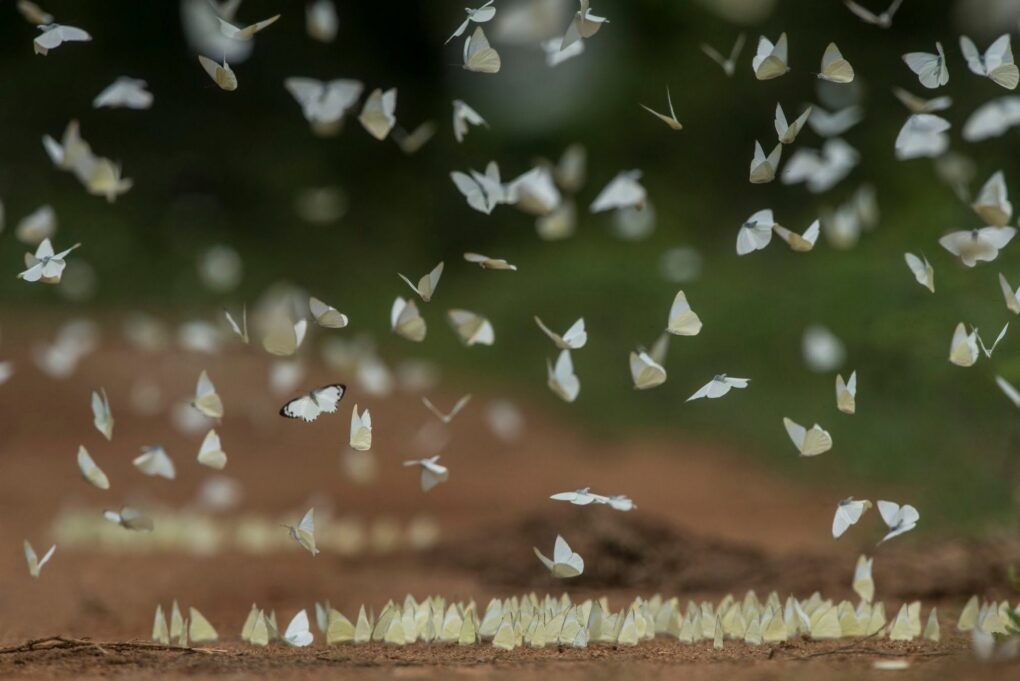
Thousands of yellow and white butterflies have swept across Sri Lanka, with 2026’s mass movement appearing unusually large and widespread.Researchers say monsoon rains and the resulting growth of host plants may be driving the seasonal butterfly boom, although their routes and destinations remain uncertain.Meanwhile, a global study records how climate change and extreme weather are associated with 79% of documented butterfly range shifts, raising concerns about a species struggling to find suitable habitats.Sri Lanka’s highland butterflies, in particular, could face mounting pressure as rising temperatures push species upslope, potentially leaving those found in the mountainous range with nowhere to go. COLOMBO – For generations of Sri Lankans, the sudden appearance of thousands of yellow and white wings fluttering across the island carries a deep sense of nostalgic magic. Folklore has long framed the spectacle as a sacred pilgrimage of butterflies flying in unison toward Adam’s Peak, a conical mountain located in the island’s Central Highlands, venerated by followers of multiple faiths. In the first week of November, this familiar natural kaleidoscope returned to the country’s commercial capital Colombo, with clouds of yellow and white butterflies weaving through traffic. The phenomenon has been reported not only in Colombo but several other parts of Sri Lanka, says Lakshman Kumara, secretary of the Butterfly Conservation and Research Group of Sri Lanka (BCRG). Butterfly numbers typically peak during two main periods, October to November and February to March. While these seasonal movements occur annually, 2026’s influx has been particularly pronounced, Kumara told Mongabay. Drawing on observations from members and butterfly enthusiasts, BCRG has tracked these mass movements for several years. Kumara said the direction of the butterfly movements observed this year differ from those recorded previously, with the insects appearing to avoid the hill country, possibly because of prevailing weather conditions. A butterfly kaleidoscope. Image courtesy of Michael van Der Pooten. A 2024 study based on BCRG data documented the movement of Sri Lankan lesser albatross (Appias galene) and common albatross (Appias albina swinhoei) across Sri Lanka during March–April 2023. Based on observations from 60 locations, researchers identified three major movement directions, with an overall pattern suggesting a northwestward movement. Butterfly researcher Kapila Dissanayake, a professor at Sabaragamuwa University and lead author of the study, told Mongabay that the current movement appears to be dominated by the yellowish lemon emigrant (Catopsilia pomona), accompanied by smaller numbers of common albatross and Sri Lankan lesser albatross. In some locations, lemon emigrants account for almost the entire movement, while other areas have a mixture of species, he noted. Long distance flutters An earlier study conducted by the BCRG team in Kumana National Park suggests that Sri Lanka’s south could be a breeding region or a starting point for these movements, while Wilpattu National Park was considered a possible destination owing to the availability of larval host plants there. Researchers estimated that butterflies could cover the approximately 280-kilometer (174-mile) distance between Kumana and Wilpattu in around three days under ideal conditions. However, the proposed route and destination still remain a hypothesis. Butterfly mass movements have been documented for more than a century. The map on the left, drawn by Emerson in 1904, is among the earliest known attempts to illustrate these movements in Sri Lanka. The map on the right shows the movement patterns of Albatross butterflies, mapped using observations collected by the Butterfly Conservation and Research Group of Sri Lanka (BCRG) during 2022 – 2023. Graph by Malaka Rodrigo. According to butterfly researcher Himesh Dilruwan Jayasinghe of Sri Lanka’s National Institute of Fundamental Studies (NISF), the main driver of the seasonal butterfly boom is the northeast monsoon, a seasonal monsoon that affects parts of South and Southeast Asia from October to March and ends dry conditions, particularly in the dry zone – a geographic and climatic region characterized by lower annual precipitation, seasonal rainfall patterns, and extended dry spells – triggering rapid growth of butterfly host plants. This provides abundant food for caterpillars, allowing butterfly populations to increase rapidly, potentially outpacing predator numbers. Inter-monsoonal rains in October may also have contributed to 2026’s unusually large numbers, he said. Jayasinghe said the butterfly population boom in March is dominated by albatross butterflies, while the November surge was mainly comprised of species from the emigrant family. Even the relatively brief inter-monsoon rains in October and November could trigger fresh growth in host plants such as cassia and senna species, providing suitable conditions for emigrant butterflies to breed. These flowering host plants include golden shower (Cassia fistula), sickle senna Cassia tora) and Tanner’s cassia (Senna auriculata). In contrast, the primary larval host plants of albatross butterflies, including the Sri Lankan lesser albatross and common albatross, are weera trees (Drypetes sepiaria and Drypetes gardneri) belonging to the family Putranjivaceae. These trees require heavier rainfall to produce fresh growth. In Sri Lanka’s dry zone, they receive most rains during the northeast monsoon, which extends from December to February. This seasonal difference explains why albatross butterflies typically dominate the first major butterfly boom of the year, Jayasinghe told Mongabay. A flutter of butterflies. Image courtesy of Sahana Vajirasena. BCRG’s Kumara added that unexpected rainfall in Sri Lanka’s dry zone could also have contributed to the extraordinary numbers recorded this year. “As climatic conditions like El Niño change rainfall patterns, these kinds of phenomena can get more affected,” he said. “We describe this as a ‘mass movement’ rather than a formal migration,” butterfly researcher Dissanayake said, emphasizing the need for scientific caution. Although large numbers of butterflies are visibly moving across the island, their overall direction, continuity and geographical extent requires verification as a coordinated seasonal migration. Mass movements in India While Sri Lanka is witnessing an unusually spectacular butterfly movement in 2026, southern India has its own well-documented seasonal butterfly migration, involving millions of butterflies traveling between the Western Ghats and the eastern plains. A 2025 Mongabay report explains how these butterflies typically move toward the eastern plains around April-May, following the pre-monsoon rains, and return westwards between September and December, closer to the onset of the northeast monsoon. The round trip can cover approximately 300–500 km (186-311 mi). Lemon emigrant (Catopsilia pomona) is the most prominent butterfly species associated with the widespread butterfly movement. Image courtesy of Michael van der Poorten. Of the 10 Danainae sub family species or Danaids recorded in south India, four are known to migrate, including the blue tiger (Tirumala limniace), dark blue tiger (Tirumala septentrionis), common crow (Euploea core) and double-branded crow (Euploaea sylverster). The movements are closely linked to the peninsula’s distinctive topography and dual monsoon system, which influence rainfall, temperature, host-plant availability and conditions suitable for breeding and survival, said Appavu Pavendhan, founder of the Nature and Butterfly Society (TNBS) in Coimbatore, Tamil Nadu, on the edge of the Western Ghats. Tamil Nadu witnessed a series of migratory butterfly movement involving the Danainae subfamily in mid-September, traveling from northeast to southwest. This was followed by another large-scale movement of the same group in October, near northeast monsoon’s onset. Butterfly range shifts While local scientists work to understand the dynamics of South Asia’s seasonal butterfly movements, a 2026 global assessment highlighted a broader concern: how a warming climate is reshaping butterfly distributions worldwide. A global study covering 1,758 butterfly species across 105 countries states that 80% has expanded their ranges, 27% experienced contractions while 22% has shifted to different elevations concluding that climate change and extreme weather were associated with 79% of documented range shifts. Image courtesy of Shawan Chowdhury. The study analyzed more than 6,000 records of range shifts covering 1,758 butterfly species across 105 countries and territories. It found that 80% of surveyed species had expanded their ranges, said lead author Shawan Chowdhury, a biologist at Australia’s Monash University. The study also showed that 27% contracted their ranges and 22% shifted along elevational gradients. Researchers also found that 79% of documented range shifts were associated with climate change or extreme weather events, said Chowdhury. He noted how warming temperatures are enabling some butterfly species to expand their ranges northwards in Europe in search of suitable climatic conditions. Finland, for instance, is witnessing the arrival of several butterfly species not previously recorded there. However, such expansion may have limits: If warming continues and suitable habitats become unavailable further north, these butterflies could eventually have nowhere to go, he said. The study also examined the range expansion of the tawny coster (Acraea terpsicore), a butterfly originally associated with the Indian subcontinent that has spread across Southeast Asia and reached Australia in 2012. Species commonly found among the recent butterfly swarms: Lemon emigrant (Catopsilia pomona), orange migrant (Catopsilia scylla), Sri Lankan lesser albatross (Appias galene), mottled emigrant (Catopsilia pyranthe pyranthe) and common albatross (Appias albina swinhoei) in the center. Images courtesy of Sahana Vajirasena. According to 2020 research, the tawny coster expanded its Australian range at an average rate of approximately 135 km (84 mi) per year. Although such rapid distributional changes raise questions about the role of global warming in allowing species to colonize new areas, researchers found little evidence that the butterfly had substantially shifted its climatic niche. This suggests it was largely occupying climatic conditions similar to those in its original range. While the tawny coster’s expansion illustrates how species can spread rapidly through a combination of environmental suitability, habitat change and ecological adaptability, further research is needed before such movements can be directly attributed to global warming, Chowdhury, lead author of the 2026 study, told Mongabay. Meanwhile, Tharindu Ranasinghe, a researcher with the Wild Island Foundation who contributed to the global study, said climate change could particularly threaten those Sri Lankan endemic butterflies restricted to cool, high-elevation habitats, including the Sri Lanka treebrown (Lethe daretis), Sri Lankan hedge blue (Udara lanka) and Sri Lankan tiger (Parantica taprobana). In India, butterflies such as the blue tiger (Tirumala limniace), dark blue tiger (Tirumala septentrionis), plain tiger (Danaus chrysippus) dominate the movements that are closely linked to the peninsula’s distinctive topography and dual monsoon system. Image by Navi on Unsplash. As temperatures rise, these species may shift toward higher elevations in search of suitable conditions but those already inhabiting mountain summits could eventually run out of suitable habitats, Ranasinghe said. Changing monsoon patterns, droughts and extreme temperatures could also disrupt breeding cycles and affect the availability of host plants and nectar sources, potentially influencing the distribution of butterflies such as the lemon emigrant and albatross butterflies. More research and long-term monitoring are required to establish whether climate change is already altering butterfly populations and their distribution within Sri Lanka, Ranasinghe told Mongabay. Banner Image: The mass movement of butterflies is believed to have originated in Sri Lanka’s dry zone where populations boom as plants produce tender leaves in the aftermath of seasonal rains. This image, taken in Yala, famous for Yala National Park, Sri Lanka’s most visited wildlife reserve, which boasts one of the highest densities of Sri Lankan leopards in the world shows a large gathering of butterflies mud-puddling to extract essential minerals from the soil. Image courtesy of Dhananjaya Dassanayake. Citations: Chowdhury, S., Aich, U., Antão, L. H., Pinkert, S., Akite, P., Almeida, G. S. S., … Lenoir, J. (2026). Extensive climate-induced range shifts in butterflies across the globe. Nature Ecology & Evolution, 10, 1900–1913. doi:10.1038/s41559-026-03117-y Chowdhury, S., Braby, M. F., Fuller, R. A., Zalucki, M. P. (2021). Coasting along to a wider range: niche conservatism in the recent range expansion of the Tawny Coster, Acraea terpsicore (Lepidoptera: Nymphalidae). Diversity and Distributions, 27(3), 402–415. doi:10.1111/ddi.13200 Credits Topics
As butterflies sweep Sri Lanka, global study finds expanding ranges linked to climate change
Full Article
Original Source
Read the full article at News →KhanList aggregates and links to publicly available news content. We do not host full articles from third-party sources. Always verify important information with original sources.