
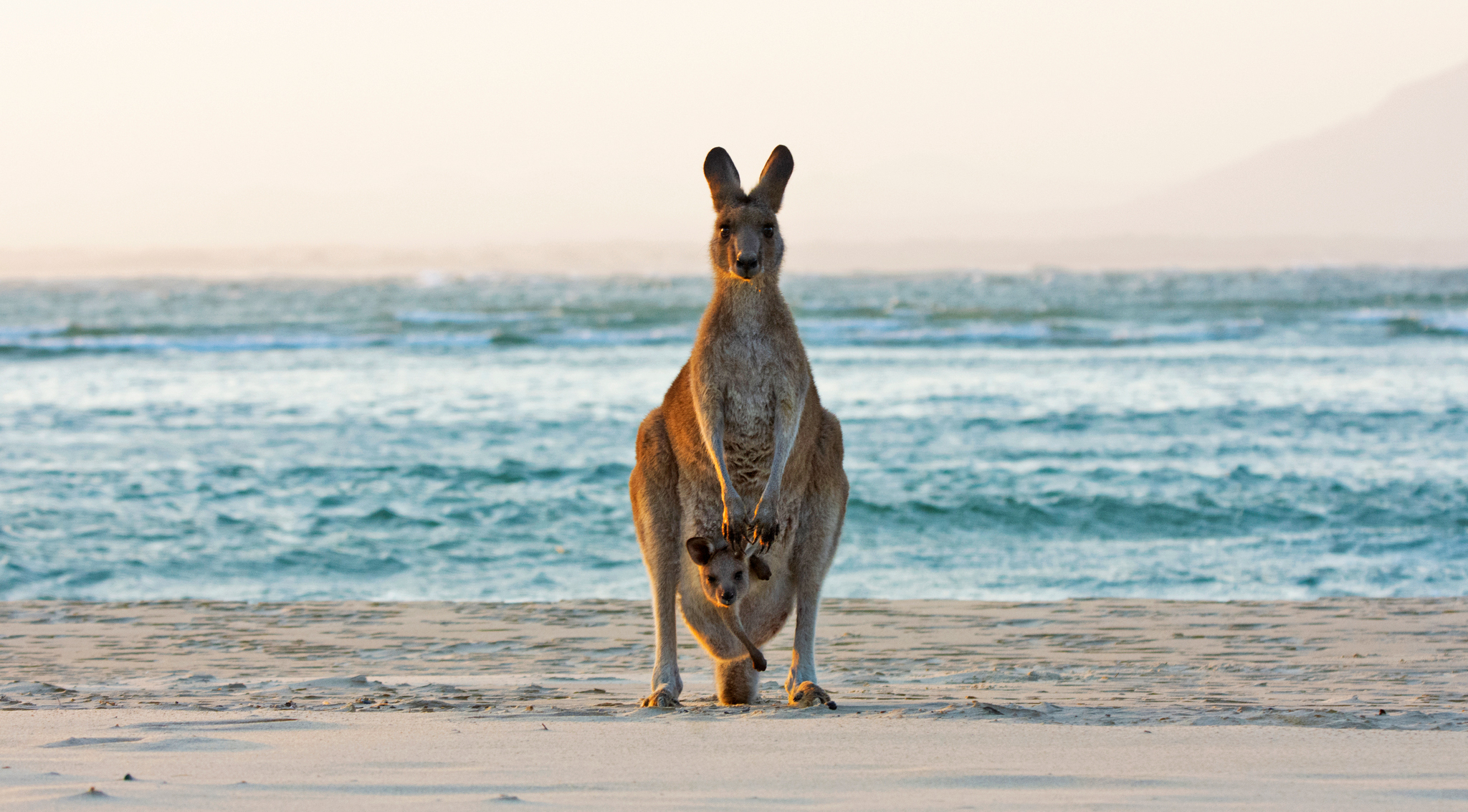
Kangaroo populations are surging across Australia, driven partly by large-scale deforestation and few natural predators.This year, a controversial government cull program in the Australian Capital Territory logged one of its highest numbers of kills.Scientists and conservationists say there’s no easy way to control the species’ growing numbers.Other possible solutions include reforestation efforts and reintroducing native predators like dingoes. CANBERRA — Australia has a problem with the very creature that is its official national symbol: The kangaroo. Endemic to Australia, they live across the country, from north to south, and from east to west. Australia has four main kangaroo species: The red kangaroo (Osphranter rufus), the largest of all species, mainly found in the outback through the Northern Territory; the western grey kangaroo (Macropus fuliginosus), in the southeastern part; the eastern grey kangaroo (Macropus giganteus), in most eastern states, including Tasmania; and antilopine kangaroo (Osphranter antilopinus), in the northern part. Population surveys by the Department of Climate Change, Energy, Environment and Water estimate there are between 30 million and 50 million kangaroos in Australia. Their number fluctuates from year to year depending on drought periods, and it even exceeds the country’s 27.8 million human population. The abundance of the macropods across the country creates a conservation dilemma. They have been blamed for overgrazing and causing environmental damage such as soil degradation and biodiversity decline. Many Australian states have resorted to kangaroo culling. A recent culling in the Australian Capital Territory (ACT), which includes the federal capital Canberra, encapsulates the controversy about the policy. The Australian Capital Territory, home to an estimated 122,000 eastern grey kangaroos, has one of the highest recorded densities in Australia. Image by Shane Lin via Flickr (CC BY-NC 2.0). Record kill At 2,358 square kilometers (910 square miles), the ACT is only slightly smaller than Luxembourg. The territory, home to an estimated 122,000 eastern grey kangaroos, has one of the highest recorded densities in Australia. In comparison, the nationwide population of eastern grey kangaroos is estimated at more than 10 million. The ACT targets this particular kangaroo species in its annual government-sponsored culling. This year’s culling, which ran from June 9 to July 31, killed more than 3,500 kangaroos across 15 natural reserves. That number was more than double the 2022 figure and one of the highest since the program began in 2009, according to public data. The practice is part of a government-managed strategy to control kangaroo population growth and their impact on biodiversity in selected reserves. Local authorities say that culling is necessary because overabundant kangaroos negatively impact pockets of Australia’s environment, including native grassland habitats in the ACT, which already face the compounding pressure of climate change and fragmentation. “The Kangaroo Management Program is conducted annually to help protect, conserve and enhance the ACT’s native grasslands, which are critically endangered,” said Bren Burkevics, the ACT conservator of flora and fauna. He added that local authorities decided to increase the quota of targeted kangaroos this year because monitored grasslands experiencing overgrazing, where many native and endangered flora species grow, have increased to 72% in 2026, up from 44% last year. Scientists say the kangaroo population boom is caused by several factors: Ongoing land clearing, which has turned thick forests and bushland into open grasslands, providing the animals with abundant food and water sources; reduced Indigenous hunting practices; and few natural predators such as dingoes (Canis familiaris). Research suggests that big kangaroo populations lead to overgrazing, which in turn degrades soil and vegetation quality, as well as reduces biodiversity, impacting grassland plants, birds, small reptile species and invertebrates. “Managing kangaroo grazing is important so these ecosystems can provide suitable habitat conditions for a wide range of native plant and animal species, including vulnerable and threatened species,” Burkevics told Mongabay. He explained that the kangaroo culling program should be seen as “one part of a suite of land management activities that also includes prescribed burning, invasive pests and animal control, invasive plant control, and restoration activities that all work together to care for the ACT’s native grassy ecosystems.” Some conservationists agree. “The ACT, and more so Canberra, has become a virtual series of [grassland] islands with often increased grazing opportunities and water” for kangaroos, said Derek Corrigan, conservation officer at the Orchid Society of Canberra. Kangaroos in fenced areas tend to eat native flora and grasses more aggressively, he said. Similar things also happen during drought years, as other food and water are more scarce. He pointed out that the Canberra spider orchid (Caladenia actensis), a critically endangered species that is endemic to the ACT, has suffered habitat loss and degradation, from urban development to animal trampling and overgrazing. However, those opposing the culls say blaming kangaroos for environmental degradation is simply overblown. Animal welfare groups argue that kangaroos are used as scapegoats, while it is actually hard-hoofed livestock like cattle and sheep that are responsible for overgrazing. The Canberra spider orchid, a critically endangered species that is endemic to the ACT, has suffered habitat loss and degradation, from urban development to animal trampling and overgrazing. Image by © John Bromilow via iNaturalist (CC BY-NC 4.0). Activists cited research by the Commonwealth Scientific and Industrial Research Organisation (CSIRO), Australia’s national science agency, which found that the ACT’s urban reserves had higher levels of vegetation diversity and healthier plants when there was at least one kangaroo per hectare. According to the report, increasing the density to two or three had no adverse effect, either. Kangaroo culls have long sparked heated community debates about the ethics and effectiveness of the practice. The government says it restricts culling of female kangaroos to between March and July each year to minimize the risk of orphaning joeys aged 8-12 months old. However, animal rights advocates are not buying it, pointing out that over 1,290 joeys were culled this year. “Behind every cull statistic is an individual animal. Behind every quota is a kangaroo family,” Animal Liberation ACT spokesperson Carolyn Drew said in an interview with local media in June, as the culling campaign began. “The ACT Government’s killing program does not only target adult kangaroos. It results in mothers being shot, pouch young being killed, and dependent joeys losing the protection and care they need to survive.” There have been calls for the government to seek other management measures, such as reforestation and reintroducing dingoes to the ACT. However, these are not easy options. The ACT has lost roughly 30% of bushland since the arrival of the settlers in the early 19th century. However, reforestation would be a big challenge in the ACT, where much historically cleared land is still owned and used by pastoralists and farmers. Reforestation could reduce the available habitat for kangaroos and help limit their numbers, yet it’s challenging to establish new forests when kangaroos are already so abundant, according to the government and conservationists. “Reforestation in many environments is hampered by kangaroo grazing,” said John Read, director of Ecological Horizons, an ecological consultancy company. “Indeed, intensive kangaroo control is often required to get many plant species re-established.” Reforestation could reduce the available habitat for kangaroos and help limit their numbers, yet it’s challenging to establish new forests when kangaroos are already so abundant. Image by Shane Walker (CC BY 4.0). Apex predator Dingoes — which first arrived in Australia 4,000 to 8,000 years ago, most likely brought from Asia with people as companion animals — were hunted to near-extinction by European settlers who viewed them as a threat to livestock, cementing their image as a pest. James Vandersteen, a Ph.D. scholar at the School of Biological, Earth & Environmental Sciences at the University of New South Wales, is investigating the role of dingoes in the Australian Alps and the effects of their lethal control on ecosystems. “Kangaroos and wallabies are primary prey for dingoes … And the broad pattern across Australia is fairly clear: There are generally more macropods in landscapes where dingoes have been removed,” he said. However, it’s not as simple as just bringing dingoes back. “Dingo absence and habitat change go hand in hand, so untangling the two isn’t straightforward,” he said. Moreover, kangaroos are likely too numerous to be controlled by dingoes alone, Vandersteen explained. Without a known population baseline pre-colonization, reintroduction is complicated. And there is another concern. “Apex predators and people don’t mix well,” the scientist said. “Reintroducing dingoes into the lowland grassy ecosystems where kangaroos are overabundant would create conflict with livestock, pets and people in adjoining rural properties and Canberra’s urban areas.” A camera trap photo shows a pair of dingoes in Namadgi National Park, in the ACT, Australia, in 2025. Dingoes are among the few natural predators of kangaroos. Image courtesy of James Vandersteen. In 2021, a group of wildlife scientists called for improved kangaroo management, citing research into their impacts on ecosystems and other species across Australia. “Where dingoes are not compatible with other land uses, regulated and accredited harvesting of overabundant macropods (as a resource) is preferable to culling (and wasting) or death by starvation,” the statement said. Apart from culling, the ACT government pursues fertility control methods, but success has been limited. Read has an idea for how the culls could be adapted. “It would be much better and sustainable if these large, overabundant macropods were harvested for human consumption,” he said. “Kangaroo meat is arguably the most organic, free-range, and ethically sourced meat available to Australians,” he added. “Increased availability and consumption, driven by demand from informed consumers, is the best way to replace dingoes and First Nations hunters to keep roo numbers in check.” Banner image:Eastern Grey Kangaroo (Macropus giganteus) with a joey in its pouch on the beach at Trial Bay in New South Wales, Australia. Image © Yi-Kai Tea via iNaturalist (CC BY-SA 4.0). Corridors, not culls, offer solution to Southern Africa’s growing elephant population As British Columbia mulls continued wolf-killing to save caribou, critics say habitat loss is the real threat Citations: Braden, J., Mills, C. H., Cornwell, W. K., Waudby, H. P., … Letnic, M. (2021). Impacts of grazing by kangaroos and rabbits on vegetation and soils in a semi-arid conservation reserve. Journal of Arid Environments, 190, 104526. doi:10.1016/j.jaridenv.2021.104526 Croft, D. B., … Witte, I. (2021). The perils of being populous: Control and conservation of abundant kangaroo species. Animals, 11(6), 1753. doi:10.3390/ani11061753 Mills, C.H., Waudby, H., Finlayson, G., Parker, D., Cameron, … M., Letnic, M. (2020). Grazing by over-abundant native herbivores jeopardizes conservation goals in semi-arid reserves. Global Ecology and Conservation, 24, e01384. doi:10.1016/j.gecco.2020.e01384 Gordon, I., Snape, M., Fletcher, D., Howland, B., Coulson, G., Festa‐Bianchet, M., … Alcock, D. (2021). Herbivore management for biodiversity conservation: a case study of kangaroos in the Australian Capital Territory (ACT). Ecological Management & Restoration, 22, 124-137. doi:10.1111/emr.12443 Read, J. L., Wilson, G. R., Coulson, G., Cooney, R., Paton, D. C., Moseby, K. E., … Edwards, M. J. (2021). Improving kangaroo management: a joint statement. Ecological Management & Restoration, 22, 186-192. doi:10.1111/emr.12467 Cite this articleCooper Williams (2026). As Australia’s kangaroo numbers rise, record cull renews calls for other control methods. Mongabay Conservation news. DOI: https://doi.org/10.66709/news-330997 Credits Topics
As Australia’s kangaroo numbers rise, record cull renews calls for other control methods
Full Article
Original Source
Read the full article at News →KhanList aggregates and links to publicly available news content. We do not host full articles from third-party sources. Always verify important information with original sources.