
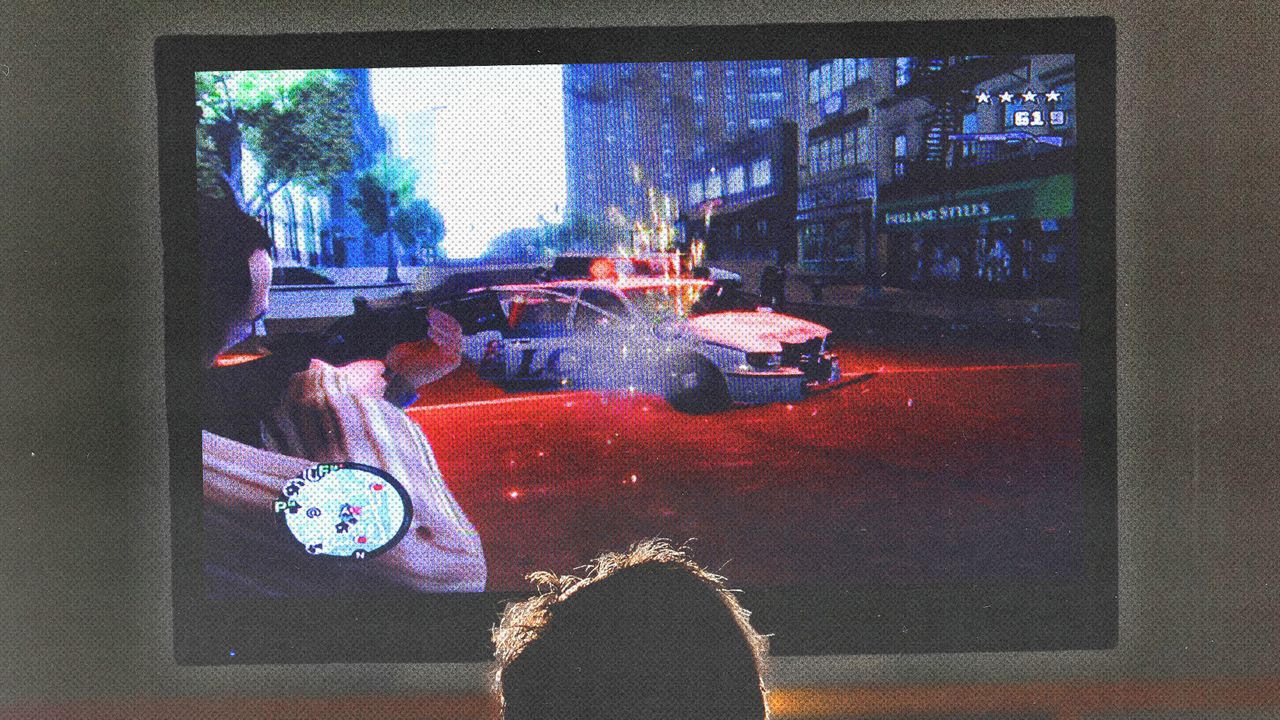
In the early aughts, GTA’s simulated depravity was funny and exciting, with graphics and gameplay so vivid I could feel like a kid again. But now, at 40? Nothing has ever made me feel so old.Kelsey Niziolek; Getty ImagesThis morning, I woke up at 7:00 AM to play Grand Theft Auto VI just hours after its release. It’s the first new installment of the franchise since 2013; the one whose first trailer was released three years ago; the one that probably cost over a billion dollars to produce; the one set in a satirical, fictionalized south Florida; the one described in this very magazine as “the peak of entertainment.” During my first four hours with the game, I made a few hundred dollars doing odd jobs, performed several repairs on my swamp-front fixer-upper, knocked out a few sets of kettlebell swings on the deck, did favors for two friendly neighbors, and ran a mile to retrieve a freshly repainted car I left behind at a fishing spot just outside of town. I’m writing in vague terms not only to avoid spoiling the game’s plot but because, so far, it hasn’t been all that exciting. The absurd and hyperrealistic mundanity of its gameplay is, simply, astonishing, and more than I ever could have wanted from a franchise I’ve been playing for nearly a quarter of a century.Grand Theft Auto, first released in 1997, and GTA 2, which followed two years later, were top-down driving games whose mechanics and visuals never intrigued me as a child. I wasn’t even aware of their existence until learning of the franchise’s third entry, and the first in 3D. I discovered GTA in a hotel room in Wichita Falls, TX, a small city just a stone’s throw from Oklahoma, because a classmate named Zach (or Zack) risked damaging his PS2 by toting it along on a school trip. We were there for the annual Texas Thespian Festival, an opportunity for dramatically inclined teenagers to perform plays and musicals in front of strange kids from strange schools and compete for prizes that, like most awards, quickly lost meaning after they were bestowed. After attending the required main stage productions, many of which were watered down to their school-friendly “Junior” adaptations—Into the Woods without the second act deaths and darkness, Guys & Dolls with considerably less gambling—we returned to the nearby hotel where students slept three to a room and were told to behave. For several nights we took turns playing this impossibly violent and vulgar game, five or six of us huddled around the television parked on a dresser no one used. We stole cars, killed non-player characters with assault rifles, and even completed an occasional story mission, most of which required, well, stealing cars and killing non-player characters with assault rifles. We were actors, and wasn’t gaming just another form of performance?Rockstar GamesI don’t remember much about that particular ThesFest, but I do remember being grateful for Zack or Zach’s generosity. Before that moment, he was simply an intimidatingly charming and friendly older boy I knew best for playing Romeo in a production that our school’s theater director chose to set during the Vietnam War for reasons he was unable to articulate. (In that, my first stage role, I was cast as Juliet’s unnamed little brother, a role that doesn’t exist in the original text.) Of course I’d played video games before that weekend—Myst, Rollercoaster Tycoon and a Titanic-themed mystery were my favorites at that point—but never before had I experienced something so immersive or graphically impressive. It was loud and exciting, a simulation of real life at its most extreme and chaotic. When I got home, I knew the console–and GTA 3–had to be mine. My life, laser-focused on math homework and our theater director’s post-apocalyptic interpretation of Antigone, could have really used a thrill.I traded in my PlayStation, a Christmas gift from years earlier on which I played mostly rented or borrowed adventure games, and used money I’d saved from mowing lawns (my family’s own, and those of a few elderly neighbors), to pay the balance. The only game I wanted was GTA III, and it’s the only one I played for months. The novelty was the thing. There was a story, of course: some nameless protagonist with a chiseled, low-polygon face committing crimes and various acts of violence to achieve a goal of… staying alive? Perhaps that’s the goal of most games, maybe even the goal of life itself. I skipped cutscenes in favor of driving from one glowing cylindrical marker to the next, shooting police officers in the head and picking up sex workers who did unseen, noisy things to my character that made the stolen cars bounce up and down like a lowrider with hydraulics. I’d largely missed the groundbreaking graphics of the N64 era—having never played Zelda or Mario Kart or GoldenEye outside the bedrooms of childhood friends with bigger houses and never-ending supplies of soda in the fridge—which meant my first truly passionate dive into console gaming was filled with manic, gratuitous violence. The original PlayStation was for catching troublemaking monkeys in nets and flying around gentle landscapes as a purple dragon. The PS2, though, was for imagining a life of crime. That my parents allowed me to play these games at all still surprises me, but I suppose to them anything was better than me getting drunk at parties I knew were happening but was never invited to.By the time Grand Theft Auto: Vice City was released the following year, I had a part time job at a local AMC, so I bought the game with money earned selling popcorn and cleaning that same popcorn off the floor. Playing it was a reward for completing an essay on Ernest Hemingway or telling multiple moviegoers that we couldn’t give refunds simply because they “didn’t like” Men In Black 2. The game’s soundtrack introduced me to songs that still activate memories sitting cross-legged on the carpet of my bedroom, turning the volume down as low as I could to prevent my father from stepping inside and saying, gravely, “Am I going to have to turn that off?” To this day, I can’t hear Laura Branagin’s “Self Control” without conjuring Tommy Vercetti, the protagonist of Grand Theft Auto: Vice City, driving a motorcycle down a sparsely populated road flanked by neon-lit palm trees. For months, I listened to more in-game radio than the local Top 40 station, unaware at the time that its curated period playlists would shape my musical appetite for the rest of my life.The third installment of that PS2 trilogy, Grand Theft Auto: San Andreas, came out two years later, when I was a freshman in college. I was 18, adjusting to life in a new city, and trying desperately to make friends. The game was less a reward for hard work than a balm when I didn’t feel like socializing, a distraction from my countless first semester anxieties. By the time I completed its main story, life away from home had become normal. I had new friends, new obligations, new problems. I used my PS2 as a DVD player almost exclusively, watching several movies a week, all borrowed from Netflix (during its original red-envelope form) and the school library. By the time GTA 4 was released, I’d lost interest in gaming altogether. We were in a recession, and I was hellbent on keeping my very first real job. In fact, I didn’t play another Grand Theft Auto game until 2013, on a PS3 Slim (the console’s discounted, late-generation entry), weeks after my now-husband and I moved into our first apartment together. In the time since my last GTA experience, I’d come out of the closet, moved across the country, started a new career, adopted my first cat, and made an entirely new group of close friends. A franchise that was once a distraction from teenage malaise was now pure, unadulterated fun. Gone were the days of playing it at a low volume–I turned it all the way up, and didn’t skip cut scenes. I was there for the story as well as the spectacle.Rockstar Games13 years later, the longest ever interval between new installments, my relationship with gaming has evolved alongside the games themselves. It’s not enough to be distracted; being distracted is now our default state. Disturbances arise, whether seeking them or not: a text message in the middle of a terrible Peacock show; a news alert regarding a global calamity about which you can do nothing but panic; the jittering beeps of FaceTime call while reading a wonderful novel, or that mindless, habitual scroll through a feed that shows videos meant to be seen but not remembered. Lately I’ve turned to gaming for total immersion, for sensations of genuine awe that might keep me from succumbing to the dopamine rush of my phone. I spent much of the summer replaying Kingdom Come Deliverance and its sequel, a pair of life simulators set in medieval Europe. In those games, every action has a consequence, and every success is hard-fought and requires patience.After several hours in its impossibly dense world, GTA 6 seems to be encouraging a similar sense of duty. My real life is fine, often even good. It’s the kind of life I thought impossible when the franchise first entered my life nearly a quarter century ago. I’m not bowled over by the game because it’s better or even more fun than the life I live outside Vice City—there are gun-toting mass murderers in both, after all—but because it’s totally different. Even when you’re comfortable in your own life, isn’t it extraordinary to enter another? The games have always been about adults, and for adults. It says so right on the box. Since 2002, their goals have fundamentally remained the same: get a job, make money, stay alive. As a teenager, its simulated depravity was funny and exciting, with graphics and gameplay so vivid I could feel like a kid again. But now, at 40? With 20-plus years of GTA under my belt and a life 16-year-old me would find more unbelievable than the functionalities of the PS5 Pro? No game has ever made me feel older. What a privilege that is.Sign up for Manual to receive useful advice on style, health, and more, six days a week.Bobby Finger is the host of the podcast Who? Weekly and the author of the novels The Old Place, Four Squares, and We Are Gathered Here Today. ... Read More
As an Awkward Teen, Grand Theft Auto Was My Escape. Now It Feels Like Real Life.
Full Article
Original Source
Read the full article at Gq →KhanList aggregates and links to publicly available news content. We do not host full articles from third-party sources. Always verify important information with original sources.