
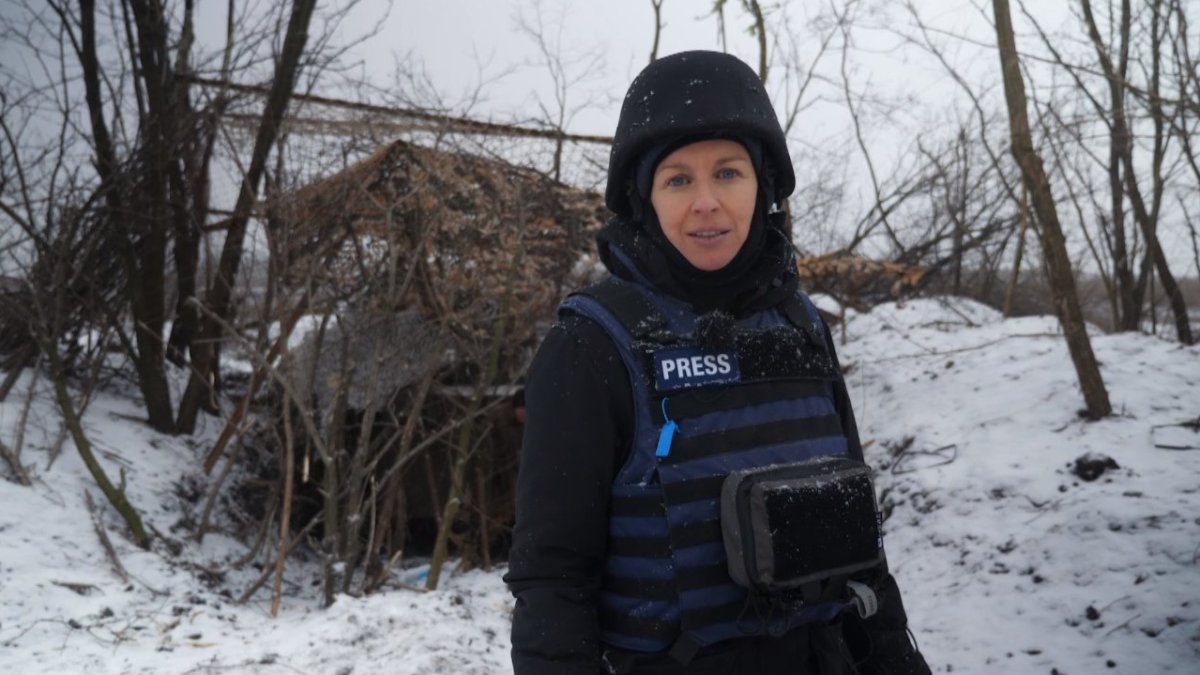
A spray of violet flowers and balloons framed the front of a coffee shop in Kyiv where groups of middle-aged women sat around tables enjoying hot drinks and catch-ups. I looked in from the street outside while reporting live for Sky News and can remember thinking how familiar the scene felt – like any boutique café back at home in the UK. The date was 23 February 2022. Less than 24 hours later, Russia would launch its full-scale invasion of Ukraine and the lives of those women, their families and the rest of the country would permanently change. Shorts Witnessing the reality of high-intensity, state-on-state warfare in the 21st century and its impact on the whole of a society drove home to me the peril that every nation – including Britain – faces when deterrence fails. Such a danger was well understood during the Cold War. The Cabinet Office used to keep a war book that set out in intricate detail the steps that everyone – from government departments and the emergency services to schools, hospitals and even museums – would need to take during the transition from peace to conflict. But this collective knowledge faded when the Soviet Union collapsed. Back then, successive British governments took a so-called peace dividend, switching funding away from defence and into other priorities such as health and welfare. The return in recent years of war to Europe has so far failed to trigger the same kind of decisive shift back in the opposite direction to more of a wartime footing. Instead, different prime ministers have responded incrementally, ramping up the rhetoric but stopping short of the painful decisions that would be needed to fix the capability gaps. The Wargame’s Blue Team includes a fictional UK cabinet led by Michael Gove as PM (Photo: Justin Downing/Sky UK) This is perhaps not surprising, because many of today’s politicians are a product of the post-Cold War era. They are far more likely to have a deep appreciation of health service pressures than the importance of ensuring warships have sufficient spare parts and engineers to go to sea. It is perhaps why, even after the then-prime minister Sir Keir Starmer warned in June that the UK’s intelligence assessment was that Russia could attack a Nato country as soon as 2030, Britain is still dragging its feet when it comes to accelerating plans to rearm at the speed of the threat. But how can there be an informed debate on where to prioritise government resources without a better understanding of defence and national resilience? A desire to help solve this conundrum was why, back in the summer of 2024, I first pitched the idea of creating a wargame as a podcast series for Sky News. I thought it would be a good way to bring to life the reality of the risk posed by Russia, and the limitations of our ability to defend ourselves, especially if the whole of Nato, in particular the United States, does not immediately rally to assist us if attacked. To ensure the deliberations were well informed, I invited former senior ministers and military chiefs to play the part of a fictional British government pitched against an imaginary Kremlin. The podcast, called The Wargame, was released in June 2025. It was deliberately designed to test what might happen if Russia attacked the UK, exposing the impact of the choice by different governments of varying colours over the years to disinvest in Britain’s air defences and shelve national plans for the defence of the nation. The scenario – devised with the Oxford academic Dr Rob Johnson – also explored the limitations of Nato’s collective defence pact under which an attack on one member state is an attack on all. It only works if all 32 member states agree to invoke Article 5 of the Nato treaty. The Wargame dramatises Russian missile and drone attacks on Britain (Photo: Justin Downing/Sky UK) But what if the US did not immediately want to rally to the UK’s assistance and instead adopted more of a neutral stance between London and Moscow? Finally, the game touched on the uncomfortable reality that an isolated UK – armed with nuclear weapons but with only limited conventional capacity – has very few options when under attack other than escalate to nuclear war or surrender. A little over a year after the podcast was released, Sky has broadcast on Sky One and NOW an even more ambitious TV version of the same name. The filming was carried out across four days inside a building in central London, with the material then edited into four, hour-long programmes. Michael Gove, the former senior Conservative cabinet member, plays the part of the prime minister, with Nicola Sturgeon, the former first minister of Scotland, as his deputy. Top Labour politicians are also involved along with General Sir Richard Barrons, a former military commander, who is cast as the head of the UK’s armed forces. Sitting in a Cobra crisis briefing, they too face an escalating attack from Russia that begins with “grey zone” hostilities – deliberately deniable and under the threshold of conventional war – before exploding into full-blown war, even the threat of a nuclear strike. The series uses AI-generated footage to portray missile and drone attacks against the UK. The British team does not know what is coming and their reactions are not scripted – they must respond to the changing dilemmas and challenges as they occur, with each one designed to expose different vulnerabilities and stress-points. Tempers fray and nerves are tested as the Cabinet tries to rally Nato, while working up options to retaliate with their own strikes against Russia. A fundamental rule in the series is that nothing we reveal is classified. That means on occasion it was not possible to explore all the options that the genuine British government would have at their disposal to inflict pain on an enemy. Rightly, there is a range of top-secret capabilities that should remain in the shadows. The television version of The Wargame captures the essence of the podcast. But it also takes the concept to a whole new level by incorporating video clips that imagine how ordinary people might respond to their country spiralling into war with Russia. A general once told me that the only time the UK would wake up to the reality of the threat would be when an attack happens – and by then it would be too late. My hope is that this TV series and the podcast have the same jolting effect without the real-world carnage, so Britain chooses more urgently to rebuild its defences to deter the worst from happening – or at least to be better prepared if it does. Deborah Haynes is security and defence editor at Sky News. Access Sky News’ Defence Insider app for defence and national security updates
As a defence editor, this Russia wargame showed me how unprepared we are
Full Article
Original Source
Read the full article at Inews →KhanList aggregates and links to publicly available news content. We do not host full articles from third-party sources. Always verify important information with original sources.