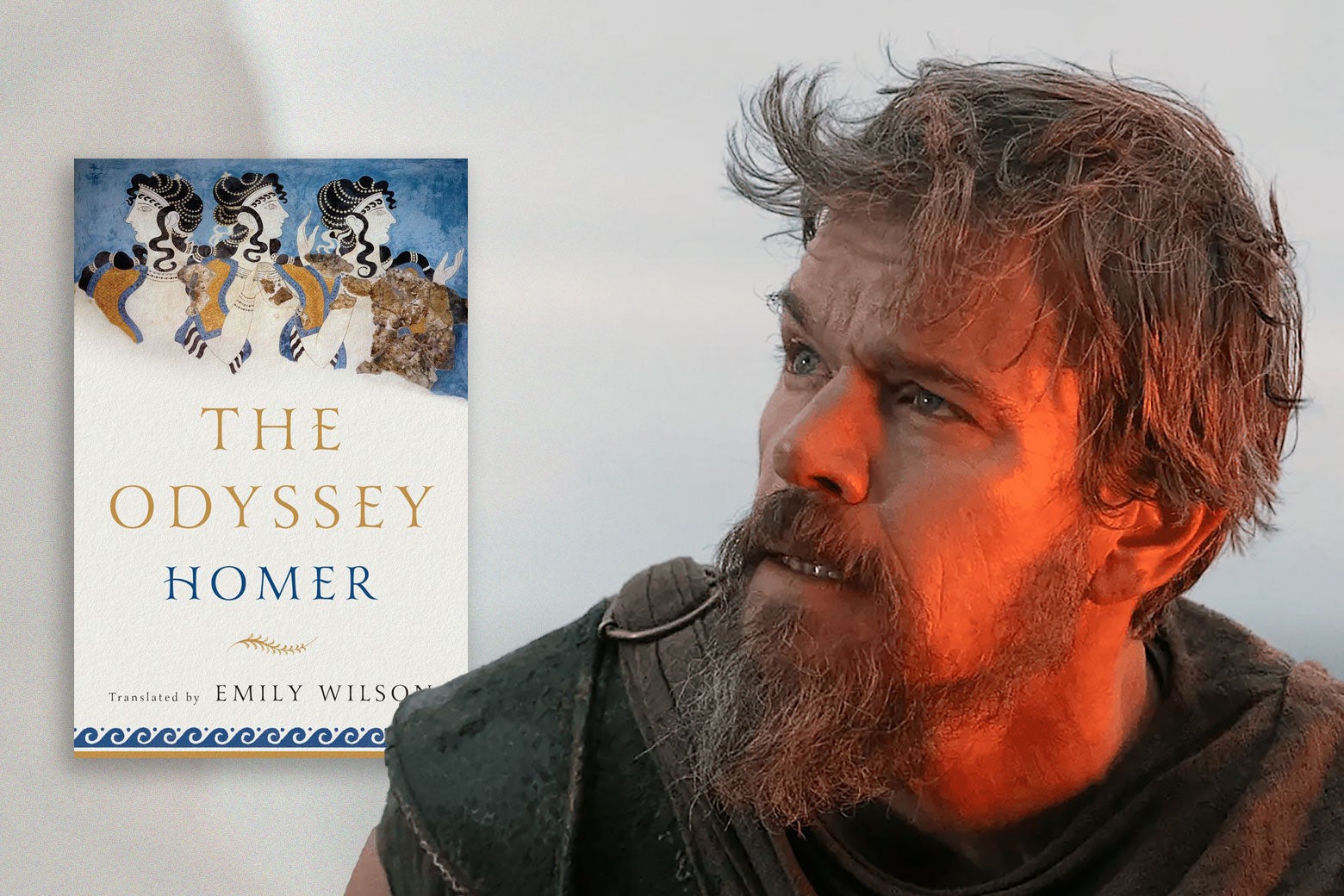
Wide Angle I’m a Classicist. Were Emily Wilson and I Watching the Same Odyssey Movie? The celebrated translator used baffling arguments to flay Christopher Nolan’s adaptation of Homer’s poem. Photo illustration by Slate. Images via Universal Pictures and W.W. Norton & Company. Sign up for the Slatest to get the most insightful analysis, criticism, and advice out there, delivered to your inbox daily. Emily Wilson, like Odysseus, is terribly clever. In comments about Christopher Nolan’s adaptation of The Odyssey, and in a provocative new essay for the London Review of Books, she does not come out and tell you that she did not like the film. She says watching it is a good way to hide from the heat; that her teenagers liked it; that the source material is so good that it cannot be messed up entirely. The best way to damn, after all, is with faint praise. Wilson’s fame is closely tied to Homer’s Odyssey, a poem that the Oxford-and-Yale-educated classicist translated in 2017. Her version, celebrated as the first translation by a woman into English verse, has sold over 1 million copies and is widely assigned in classrooms. Like any other translation, it is an interpretation. Especially in a poem, how something is said is just as important as what is said. Wilson’s decision to translate into verse, and to keep the same number of lines as the original, preserves the rapidity and poetry of the original. But it also forces her to be very concise, and her unadorned language occasionally feels a bit blunt. Some of her choices have attracted the derision of a subset of online right-wing reactionaries, but in truth they are mostly just angry that a woman has dared to interpret Homer. Their unhinged politics and violent rhetoric have made it generally difficult to engage in any sort of meaningful criticism of Wilson’s Odyssey or more recent Iliad. On X, I have probably spent too much time defending Wilson’s work against ideological attacks from those who feel that Homer should support their regressive worldviews. These people do not, as a rule, know the first word of Greek but opine with a confidence as savage as it is unearned. Contrary to what naysayers may believe, Wilson’s Odyssey has replaced neither the original nor any of the earlier translations that many continue to prefer. As a classicist, I appreciate it for making Homer accessible to a new audience. It is perfectly fitting that Wilson, whose Odyssey translation—specifically the “Tell me about a complicated man” opening line—has been cited by Nolan, was asked her thoughts on the new film and, indeed, given vast real estate to express them. The resulting piece, a 4,000-word barn burner that briefly crashed the London Review of Books’ website, is unequivocally negative, regardless of the backhanded praise with which Wilson opens. Although “humbled” that Nolan has read her translation, she is blunt in her assessment of his creation: “I would be ashamed to have written any part of this script.” Wilson’s rhetorical climax has been widely circulated: “It lacks psychological, emotional, political and ethical depth. Its narrative structure is gimmicky. The writing is abysmal. None of the characters has convincing motivation for their actions or words. There are no sex scenes, and all the food looks horrible.” That Wilson did not like the film is perfectly fair. But in the second paragraph of her review, a reference to exploding vehicles makes one start to wonder if she watched the same movie as the rest of us. There is the Trojan Horse, of course, and some dramatic shipwrecks—but even if we call these vessels vehicles, they are not exactly exploding. The impression that something has gone a bit awry continues throughout the review, culminating in several truly head-scratching moments for the reader. Wilson is naturally at her best when discussing the poem itself: This is a work to which she has dedicated years of her life, and she knows it intimately. But too often she simply criticizes Nolan for deviating from it, as if the filmmaker’s choices were not also an act of interpretation. The close attention to the text that informs Wilson’s translation is lacking in her reading of the movie, and the idea that Nolan might have something new to say about the Odyssey is denied. At times, her critical eye is so insensitive that she appears to willfully be misunderstanding basic elements of the film’s plot, characters, and themes. This is the case especially when discussing the role of the gods. In Homer, they take the form of men or women and are subject to the same pettiness and jealousies as mortals. As Wilson notes, this is hard to portray seriously on the screen. But Nolan’s decision to depict the gods primarily as elemental forces—warning rumbles of thunder or violent storms at sea—is not evidence that he has decided to “leave them out,” as Wilson puts it. Her interpretation is both overliteral and superficial: “There are no gods, and yet shipwrecks and death are presented as the inevitable consequence of blinding the son of Poseidon and devouring the Cattle of the Sun.” This is all quite impossible to explain in the absence of gods: They are invisible, with the exception of Athena, but no less real for that. The theology is not quite Homeric; some have complained that it is too Christian. But it is very familiar to anyone who has read Sophocles’ tragedies, in which the gods act indirectly to ruin those who break their laws. Wilson’s reading of human characters is similarly opaque. Anne Hathaway’s Penelope, she complains, has “nothing to do except yearn for Matt Damon, for reasons unknown.” The reasons, of course, are perfectly clear: He is her husband and the father of her son. Because a three-hour movie has less time to explore its characters than does a 12,000-line poem, Wilson discards this Penelope as “barely more interesting” than the totem Odysseus carries to remember her by. And yet Hathaway’s is one of the strongest, and most celebrated, performances in the film. Her Penelope is a prisoner in her own home, able to express her frustrated rage only in private to her son, Tom Holland’s Telemachus, in a scene that will surely be her Oscar reel. Agamemnon, too, is reduced to “the one in the weird Darth Vader outfit.” This is a strange return to criticisms from before the release of the film, when Agamemnon’s oversized and anachronistic helmet was lazily taken as proof that Nolan was being careless with his source material, although he made no strict promises to ideas of historical accuracy. And yet, in a film that does not lack for memorable images, it is the silhouette of Agamemnon walking through the gates of Troy that may be the most striking. That the man inside (played by Benny Safdie) does not live up to the armor, and dies naked and vulnerable, is precisely the point. A film is not a poem: Costume design contributes to imagery, symbolism, and meaning and may draw inspiration from sources other than archaeology. What Wilson most misunderstands, though, is the crux of Nolan’s film: that the Trojan Horse was a breach of xenia, Zeus’ law of hospitality, and as a result, all of civilization would collapse in punishment. For Wilson, Elliot Page’s Sinon, a young Ithacan who is killed presenting the vessel to the Trojans, is part of a “muddled subplot.” Why, she asks, does “the sinless Sinon [want] in on the scheme, if the sack of Troy was as bad as the movie wants to suggest”? But the entire point of the sack is that its horrors are realized only after they are already in motion—not, incidentally, unlike the bomb in Nolan’s Oppenheimer. And, significantly, as is made clear in the movie, Sinon did not know that he was part of a trick. It was his job to tell the Trojans that the horse was a gift, and to do that, as Damon’s Odysseus attempts to justify, Sinon had to be deceived too. A gift—that is the key idea. Wilson objects that “in Nolan’s Odyssey, slaughtering people with the help of trickery, technology and weapons is presented as bad when the Greeks are killing the Trojans, who have violated xenia, but good when Odysseus is killing the suitors, who have violated xenia.” Now, there is a Greek tradition that Paris’ abduction of Helen, an act that started the Trojan War, was considered a breach of xenia, and the war was therefore justified by Zeus. This is stated most explicitly in Aeschylus. But it is a matter of interpretation. Ancient Greek texts were free to emphasize, ignore, or downplay whatever elements of the tradition they wished. Modern films, of course, have the same privilege. Nolan does not linger on the circumstances of Helen’s departure, is ambivalent as to her willingness, and does not connect the episode with Zeus’ law. Just because an idea is familiar from Greek literature does not mean that it can, or should, be read into another text. And, indeed, Wilson’s reading fundamentally misses the point that in Nolan’s film, it is the Greeks who offend Zeus by hiding inside the horse, “violat[ing] all that’s ever sacred between people.” Wilson notes that, for all the importance given to hospitality, “there is no Zeus.” But Nolan does not play so loosely with cause and effect. Odysseus’ journey, the emergent threat of the “People From the Sea”—everything follows from what happened at Troy. Even the arrival of the suitors in Penelope’s hall and their outrage against their hosts are not accidents but direct results of the breakdown of the divine order precipitated by the Sack of Troy, enabled by Odysseus. On second viewing, it is clear that this is operative throughout his wanderings: In the village of the Cicones, in Polyphemus’ cave, and in Circe’s hut, the relationship between guest and host has broken down completely. These are ideas from the poem, and it is surprising that Wilson so blithely claims that “strangers in foreign lands are usually monstrous, to be blinded, robbed and slaughtered.” When Odysseus finally makes it home, the killing of the suitors is something less than a heroic rescue: The mess he cleans up is his own. This is the story that Nolan chose to tell. It is possible to dislike it, and every viewer will have their own criticisms, however precisely or clumsily articulated. (Wilson, for her part, posted Wednesday on Bluesky that she regrets reducing the movie’s nonwhite characters to “versions of the Black best friend,” despite not all of the actors being Black, and none of the characters being a best friend.) But the film, like Wilson’s translation before it, has drawn more than its share of screeching ideological criticism from those whose hearts and minds were already closed to the possibilities of this interpretation of the story. If, as classicists, we wish to enter the discussion, it should be not from the distant shelter of Homer’s poem but on the film’s own terms. Read more in Slate about The Odyssey. Get the best of culture Get the best of movies, TV, books, music, and more. Books Greece Movies The Odyssey
As a Classicist, I’ve Defended Emily Wilson’s Odyssey Translation. I Can’t Defend Her Review of Nolan’s Movie.
Full Article
Original Source
Read the full article at Slate →KhanList aggregates and links to publicly available news content. We do not host full articles from third-party sources. Always verify important information with original sources.