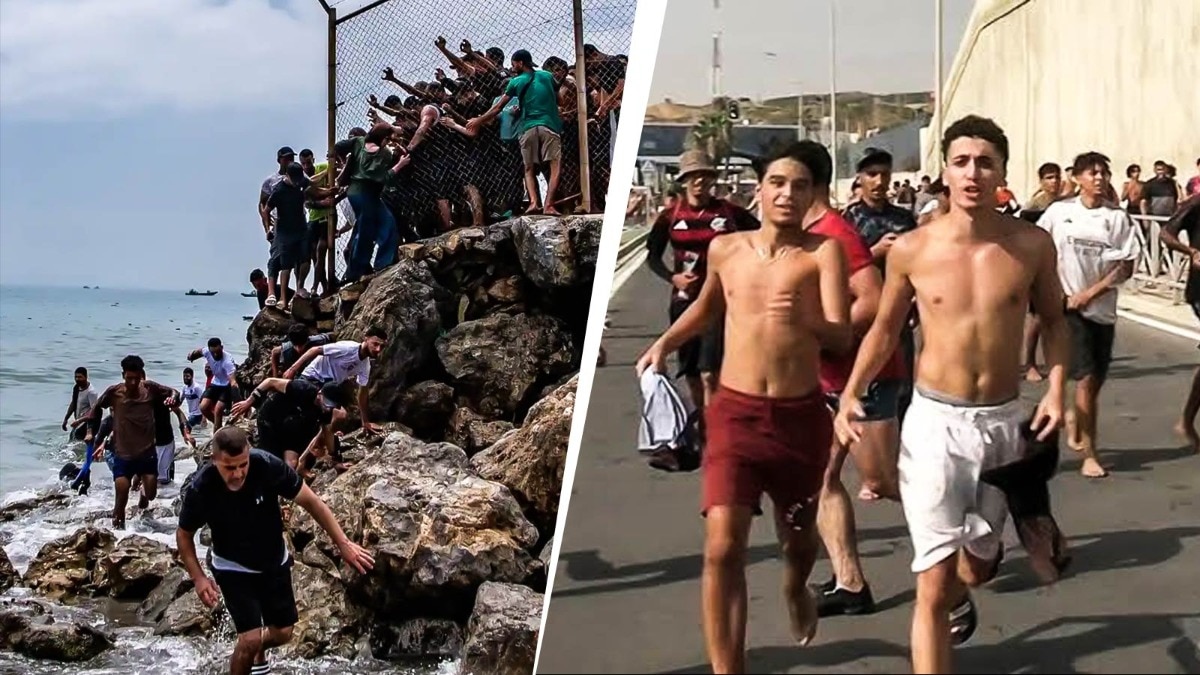
Around 50,000 migrants from Morocco stormed into the tiny Spanish enclave of Ceuta on Thursday, bringing back memories of the 2015 migration crisis. While Spain has rushed its military, Italy has called for suspension of the Schengen open-border arrangement.Thousands of migrants from Morocco stormed the Spanish territory on Thursday'Viva Espana' (Long live Spain) rang in the air in the tiny Spanish enclave of Ceuta as thousands of migrants from Morocco stormed the territory on Thursday. Several swam into Tarajal beach, broke border fences and entered Ceuta. Over 18 migrants drowned trying. The dramatic visuals have raised concerns over Europe's open borders, bringing back memories of the 2015 migration crisis.As the mayhem unfolded, Spain rushed in its military, deployed air and naval support, and sent diving teams to patrol the waters. It also triggered a call from Italy demanding Spain be suspended from the European Union's free-travel zone.According to the BBC, around 49,000 people are believed to have crossed into Ceuta, which lies in North Africa but is controlled by Spain. While most were young men, there were also families with women and children. Clashes were also reported as migrant shelters got overwhelmed in no time. Visuals showed hundreds sleeping on the streets."The border has totally collapsed... The situation is absolute chaos," Rachid Sbihi, who heads Spain's border guards, told AP. But what led to such a massive influx of migrants?WHAT'S BEHIND THE MIGRANT RUSH IN CEUTA?Before we delve into the possible reasons, we first need to understand Ceuta's geography. Ceuta and Melilla, another autonomous Spanish city, are located in Africa. Ceuta, on Morocco's northern coast, is separated from mainland Spain by the Gibraltar Strait. In fact, Ceuta is Europe's only land border with Africa. This makes it an attractive entry point for migrants dreaming of reaching Europe. The migration issue has long been a bone of contention between Morocco and Spain.Ceuta, an enclave with a population of hardly 80,000, has been under Spanish rule since 1580. However, Morocco considers Ceuta and Melilla as Spain-occupied territories.This is not the first time that Spain has faced such a crisis. Its decades-long policy of embracing immigrants, especially Latin Americans, has come back to haunt it several times over the past few years.The migration crisis reached its peak in 2021, when over 10,000 people reached Ceuta's border within two days. In 2022, 23 people died in a stampede as migrants attempted to cross into Melilla. Over the years, countless have died at sea while trying to swim from the Moroccan towns of Fnideq or Belyounech - around 5-6 km away.So, what's the pull? The allure of better job opportunities and living conditions forces these migrants to take the arduous and dangerous journey from Africa and other countries. For many, it offers an escape from violence and poverty in their home countries.On Thursday, as the dramatic scenes of thousands of migrants barging into Ceuta, tossing their flip-flops, and kneeling to kiss the Spanish soil went viral, the Spanish government came under fire.Critics and the opposition have repeatedly attacked the Left-wing government of Prime Minister Pedro Sanchez for lax border controls and its laid-back immigration policy. According to the BBC, around 49,000 people are believed to have crossed into Ceuta (Reuters) A recent order by Spain's Supreme Court has only added to the tensions.Earlier this month, the court ruled that migrants stopped at sea while trying to reach Ceuta or Melilla cannot be promptly returned to Morocco. Spain has accused human trafficking networks of exploiting the order to encourage migrants to try to enter Europe via Ceuta.Interestingly, Spain has stopped short of explicitly blaming Morocco for Thursday's chaos. Morocco is responsible for controlling migration flows across the border.Analysts have suggested that Morocco has been upset about Spain's recent effort to deepen ties with Algeria and might have deliberately enabled the stream of migrants, the NYT reported.WHAT IT MEANS FOR EUROPE?The incident has rung alarm bells in Europe - a magnet for migrants and asylum seekers seeking a better life. Europe has come a long way from 2015, when over a million refugees entered Europe, overwhelming border and asylum systems, and triggering political divisions within the bloc.Since then, several European countries have seen the rise of far-right parties that have imposed strict controls on migration.After 2015, there has been a dramatic drop in migrant arrivals. The average number of people entering Europe has been around 2,00,000 per year, according to UNHCR. In 2025, around 1,54,000 migrants entered Europe.Following the migrant influx in Ceuta, Italian Prime Minister Giorgia Meloni, who faces elections this year, said it was time for "extraordinary measures". Over 10,000 people had reached Ceuta's border within two days in 2021 In a hard-hitting post, Meloni said she might suspend the Schengen open-border arrangement with Spain. Schengen allows people to travel across most European countries without routine passport checks at their shared borders.Meloni asserted that the images from Spain's Ceuta showed that "uncontrolled illegal immigration" posed a threat to the security of Europe’s borders."Italy will not stand by and watch... On illegal immigration, we will not yield an inch," she further said.The images from Spain's Ceuta - thousands risking their lives for a chance at a better future - are more than just another migration incident. It serves as a warning that Europe's migration challenge is far from over.- EndsPublished By: Abhishek DePublished On: Jul 31, 2026 14:12 IST
As 50,000 migrants 'take over' Spain's Ceuta, a big warning for Europe
Full Article
Original Source
Read the full article at Indiatoday →KhanList aggregates and links to publicly available news content. We do not host full articles from third-party sources. Always verify important information with original sources.