
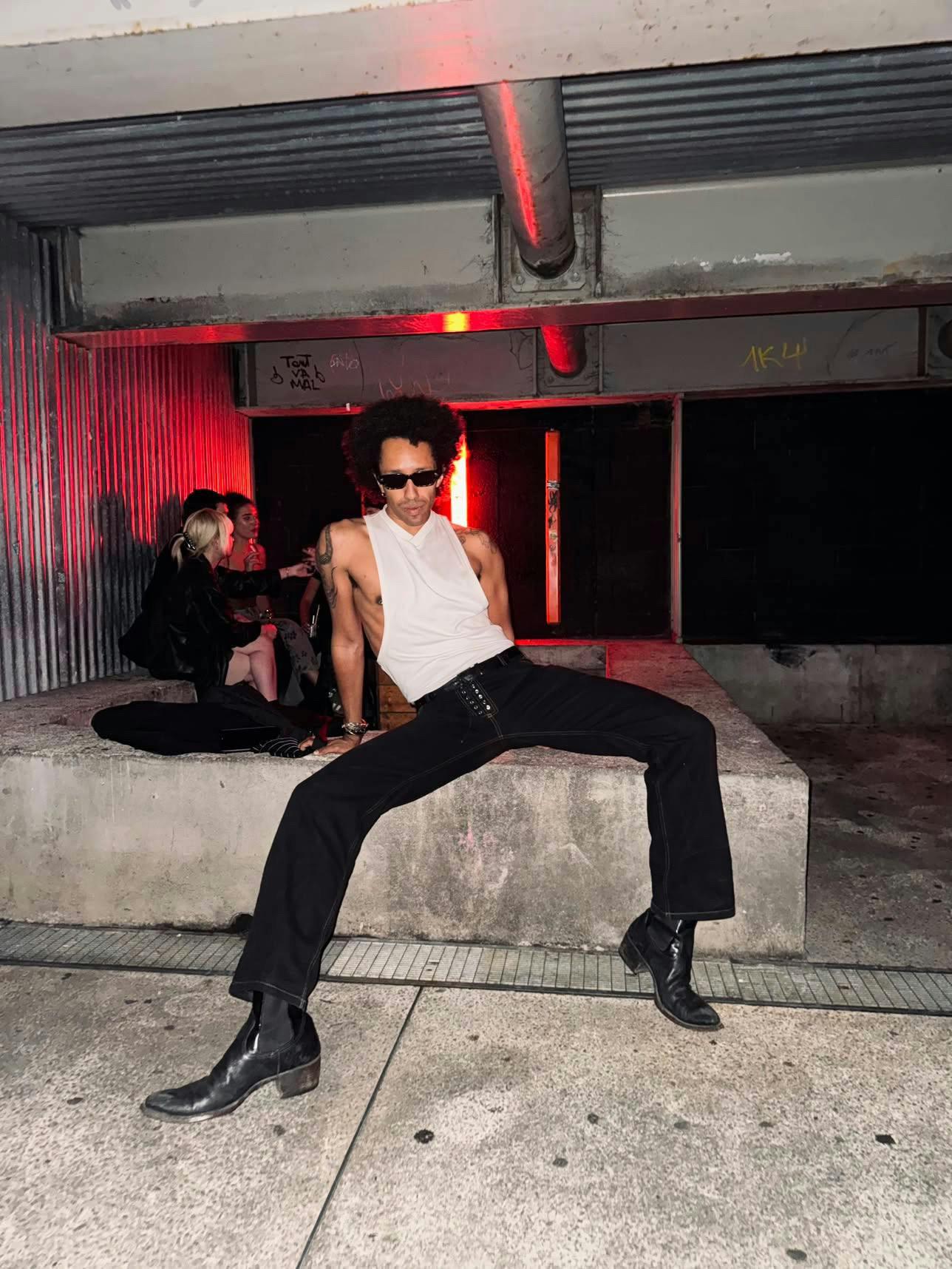
In Artist Uniform, a column for Highsnobiety, Chris Erik Thomas traces how personal style shapes an artist's identity.In a dark, cavernous space in Manhattan’s former 86th Street Cinema on October 29, more than 44 people walked ceaselessly on treadmills for six hours. This phalanx of bodies assembled as part of WAR, a durational artwork organized by Miles Greenberg and presented by Performa. Each person was shirtless, wearing matching black pants, with Greenberg at the center like the eye of a hurricane. The costuming was intentionally chosen to strip away individuality and create a kind of silent army, inspired by the terracotta soldiers from China’s ancient Qin dynasty — a physical embodiment of imminent collision. “In a performance like this one, the garment should disappear,” Greenberg told Highsnobiety by email, after WAR’s premiere. “That’s the difference between a uniform and a costume; my performances have always relied mostly on uniforms.” Offstage, his wardrobe follows a similar logic: a handful of pieces worn so often they’ve become their own kind of armor. Your Highsnobiety privacy settings have blocked this Instagram post.For the Canadian artist and sculptor, bodies have become a go-to tool for exploration, sometimes to grotesque effect. His Fountain I and Fountain II performances in 2022 and 2023 saw Greenberg stand atop a pedestal like a statue, slowly rotating for over six hours as artificial blood poured from tubes tied to his arms into a 25-foot-wide pool. The fascination with statues dates back to when he was a kid in Canada watching his mom perform in an absurdist Russian theater troupe. “Theatre wasn’t really my thing, but I was very attracted to sculpture,” he said in a 2024 interview. “The body was the only thing I understood or knew how to use or manipulate.” Seeing Marina Abramović’s “The Artist is Present” at age 12 sparked his interest in art, but the lessons he learned clubbing in Montreal as a teen (with future performance-art duo Matières Fécales) were what taught him about clothing's transformative power. “We were the freaks at the club,” he recalls. “My neighbor was a costume designer, and I’d raid her stuff all the time before going out. I had this one piece: a mid-length dress made of grey wigs that might’ve been a rejected tour look from Arcade Fire or something.”Miles Greenberg, Miles GreenbergSince launching his career at just 17 with a week-long exhibition in a rented Montreal storefront, he’s enclosed himself in boxes filled with insects and walked on a conveyor belt for 24 hours, earning praise from critics and fellow artists alike. (He’s been a protégé of Abramović since participating in her durational performance workshop in Greece when he was 20.) Even without seeing his work up close, it’s easy to see why people are paying attention. Greenberg is fearless, testing his mental and physical limits through art, but it’s his total command of self-presentation that becomes the flint, sparking a flame that surges through whatever he does. At the core is the kind of duality that defines any good artist. While productions often see him carrying on the spirit of his early experimental era, donning blinding white contact lenses or covered in oils and paints, his life offstage is more muted. As Greenberg recovered from WAR, we talked about this duality — covering his favorite clothes, his go-to designer, and “being someone else’s doll, for a change.” This interview has been condensed and edited. How do you dress when you’re not performing?I used to describe my personal off-duty style as somewhere at the intersection of Dennis Rodman and Kim Possible. Utilitarian, a little studious, with a touch of sleaze. I often think about the way Miles Davis dressed, or David Hammons, or Anjelica Huston in that one Leibovitz photograph of her smoking a cigarette in a white tank top. Miles GreenbergMy default is a pair of Martin Margiela trousers from ’01 that I’ve owned for about a decade, a belt, a pair of beat-up loafers, an old leather jacket, and a white Hanes rib knit tank top from the pharmacy. I also love a relaxed suit.You once described fashion as a fun space for you with no stakes. Is that still true? How do clothes inform your work, if at all?It’s not no stakes, but it’s definitely not my profession. I think of myself as a fan and an admirer. It’s not that clothes inform my work per se, but they definitely do something similar to my work in that they are a means of transforming and influencing the shape and composition of the body; fashion designers are very subtly like choreographers who seduce you into fulfilling a persona in their universe, superimposed on everyday life in a way that’s almost imperceptible.I recently got to know Louise Trotter of Bottega Veneta. I really like her; I think her universe is one that is so sensitive and smart and really takes into account all those super intimate details that are kind of just between you and yourself; when I’m wearing her clothes, I feel like I get to know these microscopic details about the way I move that remind me of my own performance practice. That’s where our Venn diagram meets.Miles GreenbergAre there any other designers or brands you return to, or feel a kinship with artistically? Lately, it's Bottega Veneta, Maison Martin Margiela (and his Hermès years), and Dario Vitale’s Versace.How has being dressed up by fashion magazines changed how you see your own body?I don’t get to inhabit other people’s visions all that often, so when I do, it’s always refreshing and fun and sexy to me. I’ll always enjoy spending an afternoon being someone else’s doll, for a change.Highsnobiety has affiliate marketing partnerships, which means we may receive a commission from your purchase. Want to shop the products our editors actually love? Visit our SHOPPER page and subscribe to the newsletter for recs on all things fashion, footwear, and beauty.
Artist Uniform: Miles Greenberg’s Style Is Dennis Rodman Meets Kim Possible
Full Article
Original Source
Read the full article at Highsnobiety →KhanList aggregates and links to publicly available news content. We do not host full articles from third-party sources. Always verify important information with original sources.