
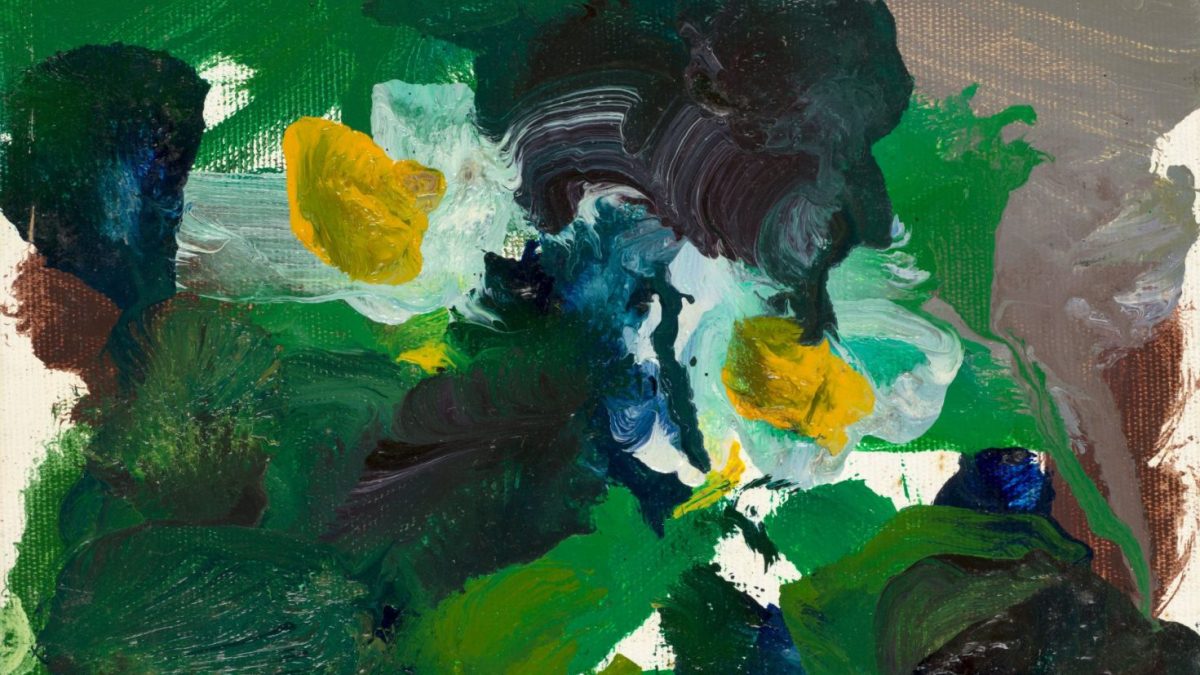
“There must be a great many more artists whom we have never heard of”, wrote Audrey Amiss in one of the scrapbooks recovered from her south London flat after her death in 2013. Had she been less assiduous in her record-keeping, and her family less respectful of the life represented by the teetering piles of sketchbooks, scrapbooks, diaries and photo albums she left behind, Audrey Amiss the artist would surely have disappeared without trace. Despite the unorthodox nature of her archive, Amiss’s career began in the way of many celebrated artists when she won a scholarship to the Royal Academy Schools in 1954, and moved to London from Sunderland. She was forced to abandon her studies when she suffered her first breakdown, and she trained as a shorthand typist, taking a job in the Civil Service where she worked for the next 30 years. This unexpected turn of events effectively severed her links with the art establishment, and the networks that might otherwise have secured her reputation as an artist. Amiss’s family were loving and supportive, and though they certainly thought of her as an artist, it was only after her death, when her niece and nephew came to clear out her flat, that the extent of her activities began to emerge. Amiss had catalogued almost every aspect of her life. It was discovered that in addition to taking part in group exhibitions, including the Royal Academy’s Summer Exhibition, she staged at least six solo shows, which have been reconstructed as far as possible in Audrey Amiss: The Surviving Exhibitions.The title’s dual meaning emphasises description of herself as a mental health survivor, for whom art was central to her being, while indicating too the difficulties of locating and reuniting her work. Amiss never achieved top prices or acclaim: though her paintings and drawings were widely distributed, she was not represented by a prestigious Mayfair gallery. Instead, she sold her art at her exhibitions, or through charity shops; others, specifically related to her experiences on a locked ward, she handed in at a police station, and sent to various publishers, hoping to raise public awareness of the conditions endured by psychiatric patients. Orchestra, 1950, by Audrey Amiss (Image: Wellcome Collection) The earliest work in the show is a print, titled “Orchestra”, which was shown at the 1957 Summer Exhibition. Economically produced using black, two colours and the white of the page, it is evidently the work of a trained artist, and the skills she learned at art school were the foundation for her practice all through her life. Observation from life was her touchstone, and she filled sketchbooks with rapidly drawn impressions of concerts and operas, the zoo, parks and people, her style shifting from naturalism to abstraction, gestures in paint matched with sparse line drawings, her chosen media ranging from watercolours and photography, to the photocopied drawings that she produced apparently as more affordable alternatives to the originals. On her passport, Amiss listed her occupation as “Typist Artist Pirate King” – a gift of a title for film-maker Carol Morley’s 2022 biopic, starring Monica Dolan – vividly evoking a free-spirited, offbeat character, for whom 11 forced detentions in psychiatric institutions caused an accumulation of painful wounds. Amiss’s experiences of mental illness, and her determination to raise public awareness of the treatment of psychiatric patients, was inseparable from her art. Her placards were not just for marches: they were framed for what she described as “protest exhibitions”, including her 1989 show FIREWORKS at St James’s Church, Piccadilly, in central London – “The Wren”, as she called it, presumably after its architect Sir Christopher Wren. “I intend to cause more trouble with my protest exhibition ‘FIREWORKS’, which I’m due to hang next Sunday, if I last that long. It will include graffiti (which are framed written statements) such as ‘Psychiatrists are mad’, ‘Doctors are Quacks’, etc, etc.,” she wrote. Framing was no guarantee of their survival, though – all the FIREWORKS placards are missing, and of the 49 works originally shown, 26 have been reunited here with the help of price lists and other documentation. The missing slogan, “Psychiatrists are mad”, apparently the show’s first exhibit, is recreated here as a projection of Amiss’s handwriting. ‘Daffodils’, 1986, by Audrey Amiss (Image: Wellcome Collection) The exhibition poster, featuring Amiss’s unmistakable calligraphy, outlines the array of material on show: FIREWORKS was not solely a protest against the suffering of people undergoing psychiatric treatment. Photographs of Vietnamese Boat People, taken during a trip to Hong Kong with her mother in 1987, and photos highlighting “Malaga Poverty” in 1959, as fishing communities struggled to survive mass tourism on the Costa del Sol, show both the range of her concerns and her adventurous spirit. The material accumulated in Amiss’s flat in Clapham, and now in the care of the Wellcome Collection, includes 854 sketchbooks, record books, account books, photo albums and scrapbooks, filled with the minutiae of her daily life. There’s the time she woke up that morning, the price of a packet of crisps, her musings on a particular word or name that has caught her attention. She logged everything she ate, filling scrapbooks with food packaging and household items, including a Cornetto wrapper, the sticky, and certainly smelly, wrapper from a kipper, and a loo roll. Next to a crisp packet, she has noted: “Salty.” Though the archive is now publicly accessible, much of the material is deeply private, and curator Madeline Kennedy emphasises that in confining The Surviving Exhibitions to work that the artist had herself submitted to public view, Amiss is afforded agency that was so glaringly denied her during her lifetime. A scrapbook image of Audrey Amiss (Photo: The Wellcome Collection) Amiss’s 1989 show Drawings and Watercolours from the 1960s, staged at Dance Attic Studios in London, is the most comprehensively reconstructed exhibition here, featuring 24 of the original 30 works. The title doesn’t quite capture the speed or urgency of her approach – a good proportion of the works were made in a single sketchbook, which page after page she filled with crayon and watercolour sketches of the inside of her flat, or the view from the window, before turning the book round and working back, covering both sides of each page. Often, the marks are made with enough force to tear the paper, or at least to leave deep indentations that are visible on both sides of the sheet. When it came to exhibiting them, Amiss seems to have framed them so that both sides were visible, the work hung from a cord so that visitors could look at both sides, an innovation that the Wellcome exhibition echoes in its own display. Inevitably, one wonders to what extent these energetically, sometimes violently made pictures reflect Amiss’s mental state, but there is no evidence to suggest that she was ever interested in exploring her mood, or feelings. To coin a phrase, she dealt with “systems not symptoms” anchoring her work in the tangible. The tangible world slips entirely beyond our grasp in 2002 exhibition Drawings from a Locked Ward (The Snakepit). Only the exhibition poster survives from the show at Gallery Forty Seven, opposite the British Museum, its double windows evoked in the exhibition design. Forty-four sketches, made during Amiss’s detention on a locked ward in 2001 are represented here by descriptions gleaned from the price list, ghosts of drawings that in a single title represent limitless despair: Nurse. Distinguished Old Man. Dusk, Houses of Parliament, River. Thames with Static Shipping. Plant. Plant. Poster for ‘Fireworks’, a protest exhibition (Image: Wellcome Collection) The drawing on the poster is little more than a ghost itself, an arrangement of lines that suggest a slumped, seated female figure. According to Kennedy, Amiss was sometimes so severely medicated while in detention that she could barely hold a pencil, let alone make a mark. Confronted with such appalling information, you long for the colour and vigour of her London scenes of trees, flowers and Christmas lights. And yet though only half here, preserved only as titles, the Locked Ward drawings represent Amiss at her most irrepressible, determined not just to make her pictures, but to show the world that the “madhouses” and “Snakepits” of the 19th century were still operating well into our own, and urging the change that today’s campaigners continue to fight for. ‘Audrey Amiss: The Surviving Exhibitions‘ is at the Wellcome Collection, London, until 7 February
Artist Audrey Amiss died in obscurity – then her family cleared out her flat
Full Article
Original Source
Read the full article at Inews →KhanList aggregates and links to publicly available news content. We do not host full articles from third-party sources. Always verify important information with original sources.