
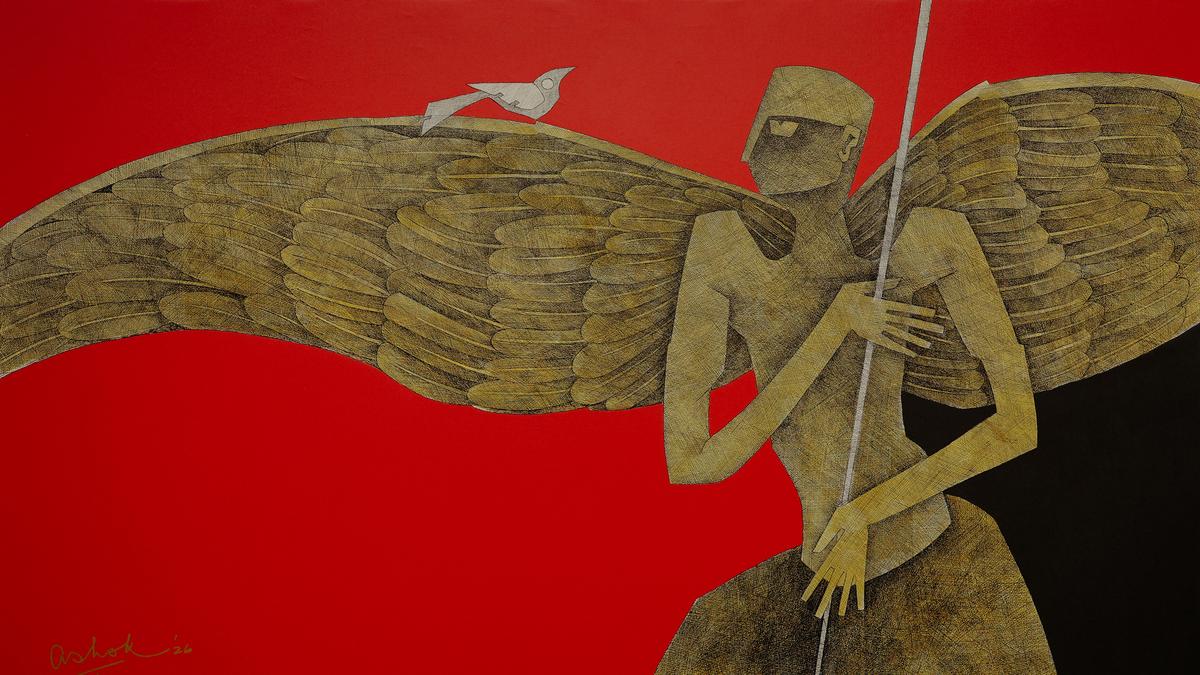
“I have been on this path for close to 60 years, so it would be easy to bluff about my work,” says Ashok Bhowmick with candour. “But painting has nothing to do with words.”“When you use words to talk about your painting, you unknowingly convert it into a physical language. If I use English to explain my work, a man who doesn’t understand the language will not understand my art,” says Ashok Bhowmick.The Delhi-based artist was talking about his solo show, Intersections, currently underway in the city.“I do not paint to influence the viewer, but to engage their participation. Even if I am not present, my thoughts are communicated, and then, it is more of a feeling than an understanding.”Intersections comprises pieces from the artist’s journey spanning five decades, with works created from the late 70s and 80s till early this year. For Ashok, who had his first solo show in 1974, this is his 26th, and he says, “When you paint or are involved in any creative process, you realise there is a compelling force which causes you to do certain things or veer away from your original plan of action. In today’s world where everything is commercialised, it is that force which keeps you from following trends.”Unintended pathAll through his work, whether depicting people or places, birds or animals, one can see the criss-crossing of fine lines creating a sense of depth and shade. Technically termed cross-hatching, this method “creates shadow and light, giving volume to the form on the canvas. It marks the departure from drawing to painting,” says the 73-year-old. An untitled work by Ashok Bhowmick | Photo Credit: Special Arrangement He continues, “Lines are used for drawings, but when managed and executed properly, you create a painting.”Hailing from a small village in Uttar Pradesh, Ashok says there was barely any exposure to art and the only materials at hand were pen and ink. “Only after working with these for a while did I understand that I was creating light, shade and volume without realising it. And I started thinking about how to convert drawings into paintings.”Going off on a philosophical tangent, he says, “It is only much later that one can one look at certain incidents and see their place in the chronological order of life, but while they are unfolding in real time, it may seem like random incidents following each other.”Though most of his works are figurative and rooted in nature, Ashok says literature, cinema and theatre have had a great influence on him. “The ‘70s were an intense period in India’s history and I believed it was my duty to my fellow man to save society through my art. I realised later that while creativity has its place, to make an actual difference, one has to actively participate in the struggles of the common man.” Amina and her Bird by Ashok Bhowmick | Photo Credit: Special Arrangement “Today’s times are different, but when I was growing up, we read the works of Badal Sarkar, Vijay Tendulkar, Girish Karnad and others. We never thought of them as being from Karnataka or Maharashtra; they told us the plight of Indians.”He says the parallel cinema of the times and local influences as well as works by Camus and Kafka, were part of the social fabric of their times. “Artists should be free to choose what to paint and how to paint. It is this freedom, whether you are a poet or a theatre person or painter, that unites us.”“Unlike other art forms, painting as a medium holds a frozen moment and that is seen as a limitation by some. Sadly, many intellectuals believe painting is just another version of poetry or a literary creation. But, unless artists develop this idea that painting has a strength in what others call a limitation, art will never change.”“Ultimately, artists should seek their verdict from the common man,” he says.Intersections, a solo show by Ashok Bhowmick, is on at Artisera till November 5.
Artist Ashok Bhowmick on the intersections of life and art
Full Article
Original Source
Read the full article at Thehindu →KhanList aggregates and links to publicly available news content. We do not host full articles from third-party sources. Always verify important information with original sources.