
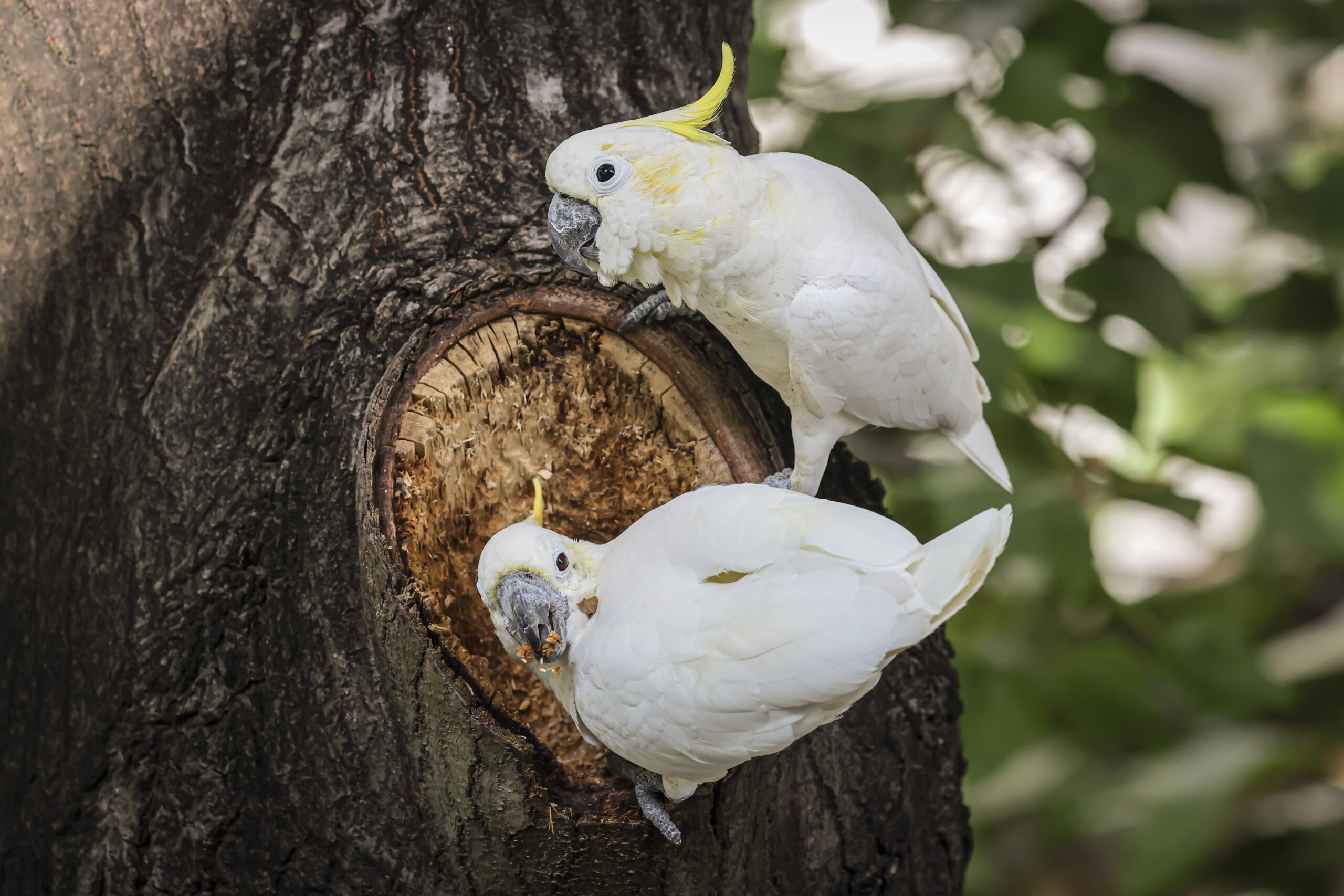
In the urban landscape of Hong Kong, artificial nest boxes are providing shelter and research opportunities for one of the world’s most threatened parrot species. The yellow-crested cockatoo (Cacatua sulphurea) is critically endangered, with fewer than 2,000 individuals remaining across its native range in eastern Indonesia and Timor-Leste. However, Hong Kong hosts roughly 200 wild cockatoos, a tenth of that number, believed to be descendants of escaped or released pets, reports Mongabay’s Yenni Kwok. Although the city’s cockatoo population remains stable due to strict legal protection and a lack of natural predators, severe storm damage and tree pruning have eliminated more than 60% of natural tree hollows where the footlong birds make their nests. “In the city, they do not have that luxurious choice available,” said Astrid Andersson, a biologist and postdoctoral researcher at the University of Hong Kong, who described the tree hollow shortage as “a housing crisis for these birds.” To tackle the issue, Andersson teamed up with arborist and conservationist Harry Wong to launch HK Cockatoo Watch. Adapting Australian prototypes for Hong Kong’s humid climate, the pair build artificial nest boxes fitted with internal cameras to monitor breeding behavior remotely. “What I am doing is to find a way: How can we coexist with them?” said Wong, who previously spent six to seven years in bee conservation. Since March 2025, the team has installed 15 nest boxes across public parks and school campuses, including St. Louis School and ISF Academy. The project has actively engaged local students in urban wildlife observation. Students now draw the birds for orientation booklets and photograph them during recess. At St. Louis School, visual arts teacher Winster Wong reached out to the conservationists after noticing a pair of cockatoos attempting to excavate a nesting hole on campus. “I believe they wanted to make a home for themselves,” Wong said. Four out of the 15 boxes are currently occupied by cockatoo pairs. In May, one of them became the home of a chick that was found inside an apartment air-conditioning vent. The chick was placed in an artificial nest nearby where the parents reunited with it. “The parents were able to feed him and bring him from a tiny little baby to a fully fledged bird,” Andersson said. Harry Wong is now working to modify the PVC boxes to reduce internal temperatures and improve nesting conditions. Because recent genetic testing shows Hong Kong’s cockatoos retain high genetic diversity, researchers emphasize that protecting these urban birds could serve as a vital genetic lifeline for restoring wild populations back in Southeast Asia. Read the full story by Yenni Kwok here. Banner image: A pair of cockatoos try to make a hole in a tree at St. Louis School on Oct. 10, 2025. Image courtesy of Winster Wong/St. Louis School. Credits Topics
Artificial nests help Hong Kong’s rare cockatoos cope with a ‘housing crisis’
Full Article
Original Source
Read the full article at News →KhanList aggregates and links to publicly available news content. We do not host full articles from third-party sources. Always verify important information with original sources.