
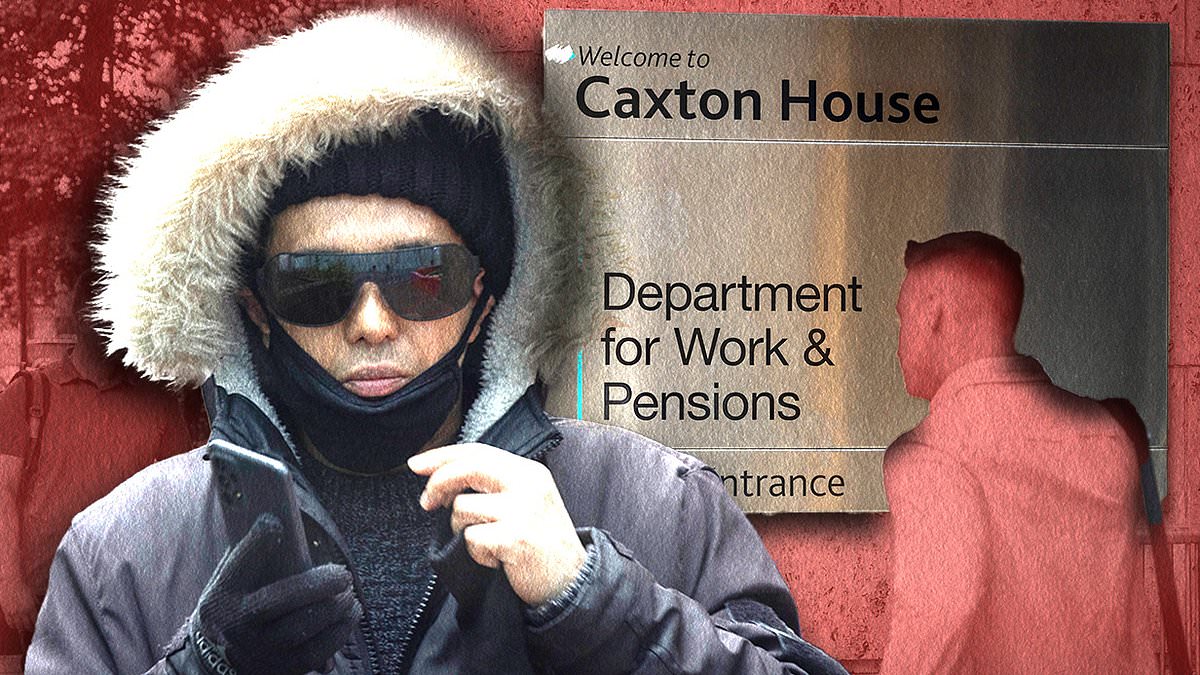
Right at the beginning of this discussion about indolence, shirking and buck-passing in the civil service, I just want to say, ‘Is everyone all right? The most important thing here is your wellbeing.’No Whitehall meeting can get under way without first establishing the mental health of all participants, in an earnest display of empty empathy. It’s toe-curling. It is also a shocking waste of time.But time-wasting is what the civil service has raised to the status of an art form. I spent six years in the corridors of officialdom – three years in the Department for Trade, three at Health and mostly as a government speechwriter. And I am still staggered by the shameless devotion to ways of doing nothing that many of my former colleagues have perfected.No one did it better than Kashim Chowdhury, 56, who this week appeared at Southwark Crown Court on nine charges of fraud. He now faces prison after being convicted of an extraordinary scam that exposes the quite incredible laxness and ineptitude of government departments.For more than three-and-a-half years, Chowdhury juggled multiple jobs across the civil service – as many as five at a time. He was employed by the Departments for Environment, Food and Rural Affairs (Defra), Health, Business and Trade, the Food Standards Agency, as well as the Home Office.At one point he was contracted to work 183 hours a week, the equivalent of more than 26 hours a day, seven days a week. This fraud was astonishingly lucrative: at his most dishonest, he was drawing salaries amounting to almost £350,000. Kashim Chowdhury, 56, appeared at Southwark Crown Court on nine charges of fraud. He now faces prison after being convicted of an extraordinary scam that exposes the quite incredible laxness and ineptitude of government departmentsNaturally, it was possible for him to do this only because the civil service tolerates utter inefficiency from its staff. Clearly, he was doing next to nothing in any of his well-paid posts. And since he provided his genuine national insurance number for every job he took, it was only the inefficiency of multiple departments that meant his scheme went unnoticed for years.Inefficiency on this scale does not occur by accident. It is facilitated by inadequate management and engineered by employees who have honed endless techniques for getting away with doing nothing.Working from home (WFH) helps, of course. There are all sorts of tricks to make it seem as though staff are at their laptops – such as signing in to Zoom meetings with both camera and microphone switched off. It’s clear that some staff are merely pretending to attend, but few are ever challenged.When attendance in person is unavoidable, the simplest method is simply to turn up late. A time-and-motion study by the Centre for Government Reform revealed this month that at the Department for Work and Pensions’ main London offices, fewer than one in seven employees were at their desks by midday on a Friday.These are the civil servants whose role is to get Britain working. But three-quarters of the 2,245 staff stayed at home, and just 26 had arrived at the office by 8am. A mere 114 were in work by 9am – once acknowledged as the latest acceptable time to begin the working day.Delays are built into the system at all turns. Every document has to be approved and countersigned, often in triplicate. With so many people working flexible hours or on sick leave, decisions that ought to be signed off within minutes can often linger in in-boxes for weeks, even months.The shallow emphasis on wellbeing is another cause of hold-ups. Since the advent of Covid, which coincided with the Black Lives Matter movement, a culture has developed which places staff’s feelings above all other priorities. Productivity is practically irrelevant compared to everyone’s emotional condition.In any team meeting, all the way up to the Secretary of State’s office, the first question is never ‘What progress have we made?’ but ‘How are we all feeling?’I always felt the unspoken implication was that we were expected to be feeling fraught, stressed, rundown and despondent. This was never overtly stated, but it was evident that brownie points were not being awarded for stoicism and stiff upper lips.In my experience as a civil servant, not only was anxiety always considered a legitimate reason for taking time off, but the demands of the job were also an unarguable source of anxiety. In other words, it was assumed that the mere fact of being required to perform a job was sufficient excuse to be unable to perform it.This is the civil service’s 21st century version of Catch-22: if you’re employed to work here, it stands to reason you’ll probably be too stressed to get any work done.Among the prime causes of anxiety cited by those I worked with were the demands placed on us by government ministers.Many of my colleagues objected when the politicians they served asked anything that might add to their workload. Their objections were varied – the tasks were arduous, or they seemed pointless, or they were designed for political ends of which individual staff might not approve. Which, in Whitehall’s view, was a good reason not to do it.But if the minister persisted, and asked a second time, and wanted to know why the work isn’t being done, this went far beyond stress. It was now in the realms of bullying. Arthur Reynolds spent six years in the civil service – three years in the Department for Trade, three at Health and mostly as a government speechwriterSome ministers do shout and bang the desk, of course. A few hurl insults and even objects. But the likelihood is that, when we read of a politician accused of ‘bullying’ civil servants, the only crime is that someone was insisting on jobs being done by people who were intent on ignoring the requests.Senior MPs who expect compliance without argument swiftly get a bad reputation.When I arrived in one department, my manager sat me down and delivered a warning: ‘Be aware – your minister is a very tough person. Nothing you do will merit praise. This leaves a void. As a team, we have to look after each other’s mental health and give ourselves the support we deserve.’An unspoken narrative was there between the lines. Before I’d even met my new boss, my opinion was being dictated to me.As it happened, this minister and I liked each other and got along well from the start. But I could never quite shake the feeling that my colleagues disapproved.My face didn’t fit in other ways. At one appraisal, I was warned that I couldn’t be given the top score or ‘box mark’, because I hadn’t signed up for diversity networks and other internal events. I was not, in the Whitehall jargon, making a ‘corporate contribution’.According to the government’s website, these networks are designed to make the civil service ‘a positive and inclusive place to work’ by raising ‘awareness of some of the barriers faced by our underrepresented groups’.They include the ‘A gender network’ for ‘the support network for trans and intersex staff’, which covers ‘gender reassignment’ and ‘gender expression’.There’s the ‘dyslexia and dyspraxia network’, the ‘neurodiversity network’, the ‘stammering network’, the ‘vegan network’, the ‘autism network’ and the ‘senior disability network’.I had not signed up for any of them, chiefly because I was doing my job as a speechwriter instead. This decision not to do so precluded me from promotion. I had literally failed to tick the box.The civil service interview panels that ultimately decide who merits promotion are prevented from applying to team managers for references. They have to make up their minds based on ‘success profiles’ – a sort of credit-scoring system, which the worst candidates can often manipulate in order to come out top.These panels ask set questions such as: ‘Tell us about a time when you successfully managed competing priorities’. They then hear the same pre-written spiel endlessly repeated, the same anecdotes churned out by one candidate after another – and instead of challenging an obvious lie, they tick the box and move on to the next.Honesty is not the best policy. Saying what the panel wants to hear is rewarded. The result is that those who play the game most cynically get promoted fastest. It’s performative. It’s insincere. But it’s effective.Perhaps some younger staff do truly believe in the value of rainbow lanyards, but for the older, more experienced people, it’s largely lip service. They do it because they cannot afford to ignore it. Another shortcut to promotion is to switch between departments. This suits the staff whose colleagues are only too glad to see the back of them.Many jobs within the civil service will only be advertised internally. Common sense suggests that any manager taking on a team member will ask around to find out if this new face will fit. But that is not permitted. Inefficiency on this scale does not occur by accident. It is facilitated by inadequate management and engineered by employees who have honed endless techniques for getting away with doing nothing, writes Arthur ReynoldsInevitably, the people who get promoted are the ones who know how to play the game. It’s in their interest to continue that system so, the longer this goes on, the more self-serving and inefficient the system will become.There’s no way to avoid it. On occasion, when managing a team, I was grateful for it. One of my junior staff once came in stoned: red-eyed and slurring, reeking of cannabis, she could barely sit at her desk, and had to be sent home... with a mild reprimand.She also appeared to be stoned on a Teams video call, though, of course, that’s impossible to prove when working from home. She was notorious for not turning up to work, going AWOL for large parts of the day while WFH, and generally being useless.But we couldn’t sack her. The sheer amount of paperwork would have been overwhelming, and I would have been inviting a claim for unfair dismissal on grounds that, however spurious, might easily have proved successful.The best recourse, from my point of view if not the taxpayer’s, was to wait until she moved to a different department of her own accord. Then she’d be someone else’s problem.Such an attitude could not exist in the private sector because any company as inefficient as the civil service would go bust. But Whitehall is protected against reality. However much its staff complain that their pay is too low and they don’t have the budgets to do their jobs, they will never run out of money – taxpayers’ money.But perhaps the greatest failing of Woke Whitehall is not its inefficiency. The civil service exists to be the engine room of democracy, and as such it should be politically impartial. Today, it doesn’t even pretend to be apolitical.My personal views are Right- leaning, but to voice them in any of the government departments would have been unimaginable. The only acceptable standpoint was to be pro-Labour, and the more Left-wing the better.When Labour came back to power in 2024, the mood among my colleagues was one of elation. One senior manager, a former private secretary to Tony Blair, announced that she was looking forward to working with ‘ministers who care about public service’ again.I was at the Department of Health when Wes Streeting was announced as our new secretary of state. On the day he was due to meet us, we were warned not to applaud too enthusiastically as it might look bad for the cameras.Nearly everyone at Health openly approved of the junior doctors’ strike – which wasn’t surprising, since a fair proportion of them seemed to be dating doctors themselves.The sad irony is that, despite its Left-wing bent, the civil service is failing Labour just as much as it did the Tories. And until it puts performance above its obsession with wellbeing, diversity and box-ticking, it will continue to fail.
ARTHUR REYNOLDS: My six maddening years in the woke, workshy civil service explains why nothing works in Britain any more
Full Article
Original Source
Read the full article at Dailymail →KhanList aggregates and links to publicly available news content. We do not host full articles from third-party sources. Always verify important information with original sources.