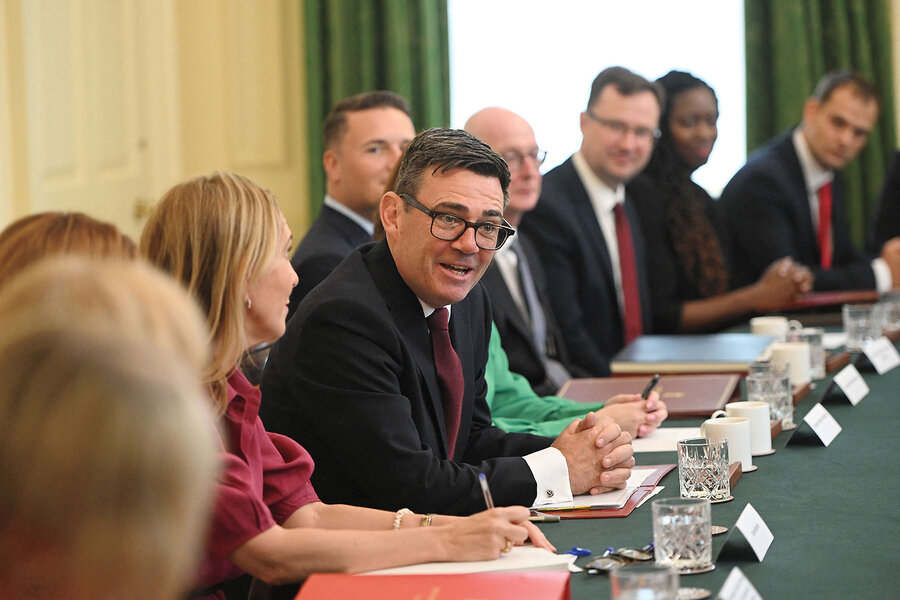
In his column on governance and diplomacy this week, my colleague Ned Temko explores “whether Europe’s parliamentary democracies are capable any longer of providing stable, effective government – of securing bedrock popular support, or at least public understanding, for the policies needed to address urgent economic, social, and security challenges.”Andy Burnham has a theory about that.Britain’s new prime minister – the seventh in 10 years – has promised “a new political model and a new economic model” grounded in the restored agency of individual citizens. Why We Wrote This The notion of governing closer to the people, expressed by Britain’s new prime minister when he took office in late July, implies two ideals that we explore in this week’s magazine: trust and equality. From Tokyo to Caracas, Venezuela, there is a growing desire – expressed in different ways in different countries – for a new contract between citizens and their elected officials. After decades of centralized political power, privatization of economic power, and deindustrialization, many “feel as though they’re still in decline and they don’t have the ability to turn things around,” Mr. Burnham said in his first comments outside 10 Downing Street in London on July 20.The solution, he argues, is to “take power out of here [London] and carry it into every postcode in the land so that they can do more.”This notion of governing closer to the people implies two ideals that we explore this week in contexts from Tokyo to Caracas, Venezuela: trust and equality. And it reflects a growing desire – expressed in different ways in different countries – for a new contract between citizens and their elected officials.The Edelman Trust Barometer annual report for 2026 found that 70% of respondents across 28 nations are hesitant or unwilling to trust someone who holds different views or supports different approaches to societal problems. That skepticism extends to public institutions. Its effect is a greater retreat into polarization and insularity. “Distrust is the default instinct,” the researchers found.For nations, that means charting new routes through a fragmenting global order. Ann Scott Tyson explores that task in Japan, where Takaichi Sanae, the country’s first female prime minister – and its fourth in five years – is redefining her country’s security resilience amid shifting signals from Washington.In a recent guest essay in the Financial Times, Ms. Takaichi wrote that amid “today’s challenging international circumstances … each country in the region [must] acquire the agency necessary to determine its own destiny” as a prerequisite to shared resilience and prosperity.The cost of distrust is more granular in societies such as Venezuela, where two recent earthquakes have exposed the state’s inability to meet the needs of its citizens in a moment of crisis.“There’s a real sense of a broken pact: that if we support you, you support us,” Alejandro Velasco, a Venezuelan historian, tells our contributor Tibisay Zea. “And here what we’re seeing is the rupture of that reciprocal promise.”Countering insularity, Edelman found, requires brokering trust through common interests. That might be why, in a country where a 0.1% economic growth rate in May marked a rebound, rather than focusing on engines like innovation or manufacturing, Mr. Burnham made addressing homelessness his first order of business.“I will put the care of people at the heart of everything I do,” he said. Building “a new national sense of unity, of common purpose and positivity” is how “Britain starts to believe again.”
Around the world, looking for a new model of trust
Full Article
Original Source
Read the full article at Csmonitor →KhanList aggregates and links to publicly available news content. We do not host full articles from third-party sources. Always verify important information with original sources.