
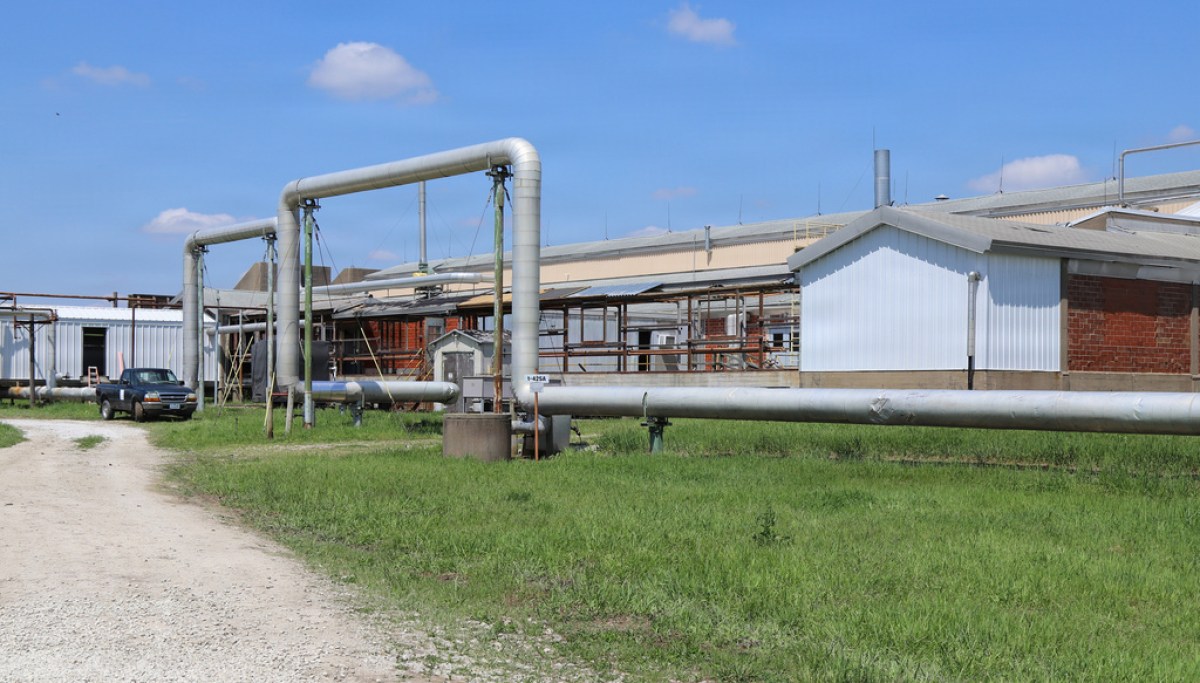
For about 20 years, 68 drums of lead azide, an explosive used to make detonators, sat in bunkers at the Iowa Army Ammunition Plant in Middletown, a small town near the Mississippi River in southeastern Iowa. This year, the material began to crystallize, leaving it so unstable that the Army says it can’t be moved, neutralized, or safely left in place.The Army’s answer is to blow it up where it sits. The Iowa lead azide detonation was set for noon Friday, Nov. 20: two controlled blasts that would destroy nearly five tons of the explosive. Its own models show the blasts could send a plume of lead dust across eastern Iowa and into western Illinois.Late Thursday, after days of backlash from residents, farmers, environmental groups, and elected officials in both parties, acting Army Secretary Adam Telle pushed the detonation to Monday, Nov. 23. “Public safety is the Army’s top priority,” Telle posted on X in a statement. The new date is as late as the Army says it can go. Telle said Monday is the last possible day before a forecasted cold snap that could make the already unstable lead azide even more volatile.It would also be a first: An Army Sustainment Command spokesperson said the Army has never detonated lead azide at this quantity. That same deadline now hangs over the blast’s opponents. Environmental groups have asked a federal appeals court to block the detonation altogether, but the court had not ruled as of Thursday night.The plan was made public five days before the original date and set off alarm across the region. Illinois Department of Public Health Director Dr. Sameer Vohra warned that no level of lead in the body is safe, and lead is especially harmful to young children’s development. School districts on both sides of the Mississippi canceled classes or kept students indoors.The reaction runs deeper in the Hawkeye State, where environmental health was already a defining political issue. Lead’s main danger is developmental rather than cancer, but it landed in a state where Iowa Cancer Registry data show the second-highest age-adjusted rate of new cancer diagnoses in the country, one of only two states where that rate is rising. Five of the six House, Senate, and gubernatorial candidates who appeared at this year’s Iowa State Fair discussed the state’s cancer rates, making the disease a bipartisan campaign issue. The plant itself has been on the EPA’s Superfund list since 1990 for contamination of groundwater, surface water, private wells, and on-site soils. On Friday around noon, the Army is blowing up 68 barrels of an old explosive called lead azide at the Iowa Army Ammunition Plant near Burlington. It has dried out and gotten too unstable to move, so they're setting it off at the plant.The blast will throw up a cloud of dust… pic.twitter.com/N3LeZuYzQF— Ryan Hall, Y’all (@ryanhallyall) November 18, 2026 Editor’s note: Model by Ryan Hall, posted before the Army moved the detonation to Monday. Farmland raises the stakes further. Experts advise that farmers in the heavily agricultural state should take steps to protect its food supply. Iowa State University Extension officials reported an influx of calls from farmers worried about their crops and animals. Mike Thie, a farmer in Sperry, Iowa, with more than 70 cows, told KWQC he plans to put them in a pole barn and cover the openings with tarps, but can’t seal them off from outside air.The pressure crossed party and state lines. A bipartisan group of Illinois and Iowa lawmakers, including Illinois Republicans Darin LaHood and Mary Miller, asked Telle and EPA Administrator Lee Zeldin to consider delaying the detonation until safer alternatives could be explored. Illinois Gov. JB Pritzker (D-IL) echoed the call. In Iowa, Gov.-elect Rob Sand (D-IA) and Sen.-elect Josh Turek (D-IA) called for a pause.The postponement buys three days, not answers, leaving the questions that forced the delay unresolved as the clock runs toward Monday. Here is why the Army says it can’t wait, what critics want, and what residents should expect.This photo provided by the U.S. Army shows the Iowa Army Ammunition Plant in Middletown, Iowa, on May 14, 2024. (Shawn Eldridge/U.S. Army via AP) Why the Army says it can’t wait The plant, about eight miles west of Burlington, Iowa, closed from March 12 to 30 for what the Army Joint Munitions Command called “a proactive safety review.” The lead azide had been stored in an ethanol and water solution, and temperature swings caused it to crystallize, making it more sensitive to shock and friction. The Army wants the job done before winter because the material becomes more unstable in the cold.The Army’s 41-page environmental assessment weighed the alternatives. It rejected doing nothing as an “unacceptable, persistent, and escalating risk.” It ruled out transport because of the material’s sensitivity, and chemical neutralization because it would require handling the highly explosive crystals.The EPA agreed. In its emergency permit, the agency concluded that the explosion risk from the degraded lead azide presented an imminent and substantial threat to human health and the environment.The communication gap between the Army and the public In this image provided by the U.S. Army Corps of Engineers, Assistant Secretary of the Army for Civil Works Adam Telle speaks April 13, 2026, to announce action to complete the Everglades Agricultural Area (EAA) Reservoir Project, in South Bay, Fla. (Brigida I. Sanchez/U.S. Army Corps of Engineers via AP) The Army’s account of how it warned the public clashes with what state officials say they were told. The Army says it found the degrading lead azide in March, and Telle said it “immediately began communicating” with stakeholders and the public. EPA staff attended an Army briefing on the barrels in April.The Army first presented the plan at an Oct. 15 community meeting for residents of Middletown and communities within a 50-mile radius. An October fact sheet told residents that “now that advanced explosive and scientific modeling is complete, we are sharing these detailed plans with the community.” It addressed whether the blast would contaminate air, water, or soil, saying that when lead azide is detonated properly, “the intense heat incinerates the explosive material,” and that the Army would work with the EPA to monitor the air. It made no mention of a lead plume.The wider region didn’t learn of the plume risk until Sunday, Nov. 15. Gov. Kim Reynolds (R-IA) said her office learned of the plan Monday, after the Army issued a public advisory, and Illinois says the regional federal EPA office never notified the state. The EPA permit itself wasn’t made public until Wednesday night.The Army has not publicly said what it did with the material between April and October. Army spokeswoman Justine Barati said the region could have been notified earlier, but the five-day notice was what the EPA required.How politicians lined up The split doesn’t run strictly along party lines. Several Iowa Republicans deferred to the Army, while the Democrats taking over the governor’s office and Ernst’s Senate seat in January called for a pause. Illinois Republicans, meanwhile, joined Democrats in seeking a delay.Beyond the delay, the letter asked for an examination of the contractor’s handling of hazardous materials, citing concerns about Army and EPA oversight of the contractor-operated facility. Besides Pritzker and Turek, its signers were Sens. Dick Durbin (D-IL) and Tammy Duckworth (D-IL), Reps. Darin LaHood (R-IL), Mary Miller (R-IL), and Eric Sorensen (D-IL), and Sen.-elect Julianna Stratton (D-IL).Turek, who will fill the seat left open by Sen. Joni Ernst (R-IA), was born with spina bifida due to his father’s exposure to Agent Orange. “Until those questions are answered, the detonation should not proceed,” he said.Sand cited “an unacceptable lack of communication and clarity” and said that if this is the safest option, the public should be told why other options weren’t chosen.On the other side, Rep. Mariannette Miller-Meeks (R-IA), who represents the district that includes the plant and lost her seat this month, wrote on X that because the material cannot be moved and could detonate unpredictably, “a controlled detonation is the safest and best option.” Reynolds did not take a position, noting that “All planning and permitting for this event have been managed at the federal level by the Army.”Among other Iowa Republicans, Sen. Chuck Grassley (R-IA) said the Army is “responding to the questions and concerns I’ve shared from Iowans,” and Rep. Ashley Hinson (R-IA) said surrounding communities “were not given adequate notice.” State Sen. Scott Webster (R-IA) called for an independent review by the Iowa Department of Natural Resources.Two incoming Democratic House members also weighed in. Rep.-elect Christina Bohannan (D-IA), who defeated Miller-Meeks on Nov. 3, said she relayed Iowans’ “grave concerns” to the Army and to members of the House Committee on Armed Services and asked for a delay if one could be done safely. Rep.-elect Lindsay James (D-IA) said the blast shouldn’t go forward if basic safety requirements aren’t met. Ernst has not taken a public position.The lawsuit Earthjustice, a nonprofit environmental law organization, sued in the 8th U.S. Circuit Court of Appeals on behalf of the Iowa Environmental Council and the Sierra Club Iowa Chapter. The suit argues that the EPA did not require the Army to consider safer treatment alternatives, that the permit conditions do not adequately protect human health, and that the Army gave inadequate public notice.“Instead of keeping people safe, the Army is knowingly blanketing communities with lead,” Earthjustice attorney Thien Chau said in a press release.The groups’ emergency motion asked the court to rule by 10 a.m. Nov. 20, two hours before the original blast time. The filing notes that the Army operated under successive temporary storage permits before opting for open-air detonation, and that federal rules for emergency permits typically require a 45-day public comment period. The groups want an environmental and health impact statement and an investigation into safer alternatives.Wally Taylor, legal chair of the Sierra Club Iowa Chapter, said the Army is “proceeding recklessly.” Michael Schmidt, general counsel for the Iowa Environmental Council, said: “The EPA itself admits that there is no safe level of lead exposure for humans.”With the blast pushed to Monday, it was unclear whether the court would act before then.Where the lead could go The Army and EPA describe the same plume maps differently. The EPA-required maps assume all lead in the 68 barrels is released. The Army says the actual release will be lower because of containment: wetting the soil, spraying water over a buried cement bunker, and a sand barrier. The EPA says it cannot quantify the Army’s reduction efforts, so it chose the most conservative modeling.Earlier modeling projected elevated airborne lead in an area up to 20 miles wide stretching from Burlington to well north of the Quad Cities. Illinois officials say current Army modeling identifies Mercer County, Illinois, as potentially affected.Iowa lead surface dispersion map provided in Nov. 17 public advisory by the U.S. Army. What residents should know Under the original schedule, residents near Middletown City Park and Butterfly Park were asked to voluntarily leave from 8 a.m. to 2 p.m. Central time due to possible window damage, with a shelter available at the Armed Forces Reserve Center. The Army had not yet set a time for Monday’s detonation or said whether those plans would carry over.School districts that canceled Friday classes — including Burlington, West Burlington, Mediapolis, New London, Danville, and Columbus — may need to reconsider following updated guidance.The Army advises people in the plume path to stay indoors with windows and doors closed and HVAC set to recirculate, and to keep children, pregnant people, and older adults from outdoor activity. Afterward, it advises wet-cleaning play equipment, windowsills, and patios, as well as washing cars. Illinois goes further: Vohra advised residents there to stay indoors for 24 to 48 hours.For farmers, Iowa State University Extension is distributing soil test kits and advising moving livestock out of the plume’s path. Across the river, Illinois EPA Director James Jennings has called for “comprehensive post-detonation environmental sampling” of air, soil, and surface dust in Illinois, with the results made public, and said his agency will run its own air monitoring.The road to Monday and beyond Updated plume models are due the morning of the detonation, and the weather that day will decide where the dust goes. The Army has said it will update the maps six hours before the blast and every hour after that until it goes off.University of Iowa environmental health professor Patrick O’Shaughnessy said that a still day would allow heavier particles to settle, while some wind can dilute airborne contamination.MAN CHARGED IN PEORIA, ILLINOIS ETHANOL PLANT BOMB THREAT THAT FORCED MASS EVACUATIONAfter the blast, the EPA permit requires the Army to sample, clean up, and report on what the detonation left behind, and to issue a final estimate of the affected area. Under existing agreements, the Army also pays for long-term soil and water testing at the plant, overseen by the EPA and the Iowa Department of Natural Resources.For Middletown, the wait now stretches through another weekend. Families near the blast site still don’t know whether they will be asked to leave their homes again Monday, and communities across two states will be watching the wind.
Army postpones plan to detonate nearly five tons of explosive lead azide after provoking bipartisan outrage
Full Article
Original Source
Read the full article at Washingtonexaminer →KhanList aggregates and links to publicly available news content. We do not host full articles from third-party sources. Always verify important information with original sources.