
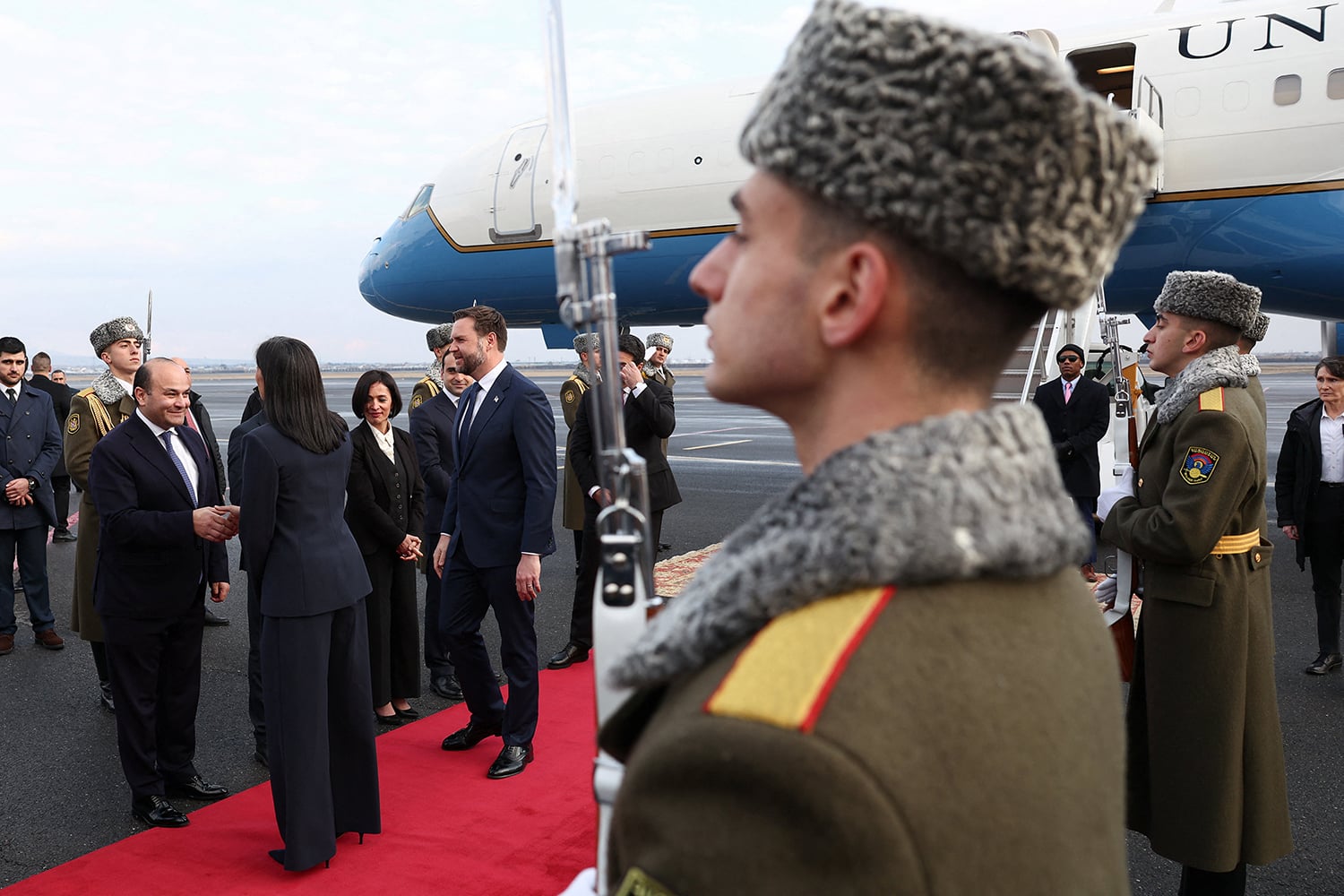
The photographs lining the walls of the stairs of the Armenian Embassy in Washington are impossible to miss. There are multiple portraits of Armenian Prime Minister Nikol Pashinyan with U.S. President Donald Trump in the White House last year; pictures of Pashinyan and U.S. Vice President J.D. Vance in Yerevan from February of that same year, when Vance became the senior-most sitting U.S. official to visit Armenia; and photos of U.S. Secretary of State Marco Rubio during his visit to Yerevan last May. There are also multiple pictures of the Oval Office prayer meeting organized by the embassy in September, where Trump met with leaders from the Armenian Christian community in the United States. I asked if they change the photographs with each administration, and the embassy’s spokesperson informed me that this is the first time any photographs have been put up—to mark the momentous nature of the Trump administration’s relationship with Armenia. The photographs lining the walls of the stairs of the Armenian Embassy in Washington are impossible to miss. There are multiple portraits of Armenian Prime Minister Nikol Pashinyan with U.S. President Donald Trump in the White House last year; pictures of Pashinyan and U.S. Vice President J.D. Vance in Yerevan from February of that same year, when Vance became the senior-most sitting U.S. official to visit Armenia; and photos of U.S. Secretary of State Marco Rubio during his visit to Yerevan last May. There are also multiple pictures of the Oval Office prayer meeting organized by the embassy in September, where Trump met with leaders from the Armenian Christian community in the United States. I asked if they change the photographs with each administration, and the embassy’s spokesperson informed me that this is the first time any photographs have been put up—to mark the momentous nature of the Trump administration’s relationship with Armenia. Trump brokered the signing of a joint declaration in August 2025 between Pashinyan and Azerbaijani President Ilham Aliyev, which committed Armenia and Azerbaijan to resolving their decadeslong violent conflict over disputed territories. It’s one of several wars that Trump claimed to have solved during his second term as he lobbied for the Nobel Peace Prize, though the two countries have yet to sign a formal peace agreement more than a year later. “The final peace deal is not there, but we have peace on the ground,” Armenian Ambassador Narek Mkrtchyan said. “We have trade relations with Azerbaijan right now—we are buying some stuff from them, they are buying from us—and this is very important for the peace. Of course, there are still some issues that need to be addressed, but in general, peace is in the region.” Monday marked movement on two of the biggest outstanding issues. Armenia put forward a draft proposal of its new constitution that removes language calling for reunification with the Nagorno-Karabakh region, a disputed territory within Azerbaijan that was controlled by ethnic Armenians until an Azerbaijani military offensive deposed them in 2023. Pashinyan has supported the new constitution—which Azerbaijan has demanded as a condition to reach a permanent peace deal—and has said that he will resign if a referendum to adopt it fails. The second development was the official launch of the Trump Route for International Peace and Prosperity (TRIPP), a roughly 27-mile transit corridor between Azerbaijan and its exclave of Nakhchivan that was agreed (and rebranded from the “Zangezur corridor”) during the joint declaration in Washington last August. The TRIPP corridor passes through Armenian territory and will be controlled by the Armenian government, though it only retains a 26 percent stake in the corridor’s development—the remaining 74 percent will be held by the U.S. government. Mkrtchyan, who previously served as the Pashinyan government’s minister for labor and social affairs, was appointed to be the country’s ambassador to Washington in late August 2025, just weeks after the Trump-brokered accord with Azerbaijan was signed. “The current agenda that we have with the United States of America, we never had before,” he said. Armenia has high hopes from Trump and TRIPP. “It actually has the potential to change the concept of the South Caucasus. Previously, this region has always been associated with conflict, with instability,” Mkrtchyan said. “This region has the potential to turn into a territory of dialogue, of connectivity, of prosperity, and cooperation, and the TRIPP project is an organic component of this.” Mkrtchyan also corrected me when I referred to TRIPP as a “corridor,” describing it instead as an “infrastructure project route” with “roads, railroads, fiber optics, transmission lines, possibly pipelines.” TRIPP is now “becoming more than a bilateral project” for peace and connectivity between Armenia and Azerbaijan, he said, and will eventually turn into a key trade passage between Central Asia and Europe—entirely under Armenian jurisdiction. “It’s going to be a new global supply chain,” Mkrtchyan said. Those ambitions could run headlong into Armenia’s geopolitical reality. The landlocked country also shares a 193-mile land border with Turkey that has remained closed since 1993, when Armenia’s conflict with Azerbaijan first began. “Right now, 80 percent of Armenia’s borders are closed,” Mkrtchyan said, adding that talks to reopen the Turkish border continue in parallel with the Azerbaijan negotiations, “and there is a lot of hope and a lot of potential.” Then there is Armenia’s 27-mile border with Iran that the TRIPP route runs uncomfortably close to. Iran has bristled at the prospect of having a U.S.-led initiative so close to its territory while Tehran and Washington remain at war, and a senior advisor to Iran’s supreme leader warned this week that “if Trump and his allies want to cross this Iranian red line, we will break their legs.” Armenia’s entire railway system is also still controlled by Russia—a legacy of the erstwhile Soviet Union that both countries were a part of—and the once-tight relationship between Yerevan and Moscow has steadily deteriorated thanks to Russia’s war with Ukraine and a perceived lack of Russian support over Nagorno-Karabakh. But those conflicts have only spurred Armenia to diversify from its neighbors and traditional partners by aligning more closely with Washington, according to Mkrtchyan. “This is a new reality, and we live in this new reality, but this is our strategic choice,” he said. “But we were very transparent and open to our colleagues in the region—we told them that this is not against you. It’s not against Iran, it’s not against Russia. It’s first of all for Armenia’s national interests, for Armenia’s security, and for regional cooperation,” he added. “. This is a unique opportunity to transform the region.” Armenia is also hoping to parlay its newfound U.S. links into becoming a technology powerhouse. Earlier this year, a San Francisco company called Firebird established a new data center in Armenia in partnership with fellow U.S. firms Nvidia and Dell, in a deal that will be powered by 70,000 of Nvidia’s advanced semiconductor chips by the end of 2027. “We want to become a key partner of the U.S. in providing sustainable supply chains for future AI systems,” Mkrtchyan said. That ambition is further bolstered by nuclear cooperation and critical minerals agreements signed by Vance and Rubio during their respective visits this year. “Especially after the peace deal, it gave a strong signal to the American companies that right now is the moment to consider Armenia as a platform for cooperation and investment,” Mkrtchyan said. Given that our conversation took place just days after a resounding defeat for Trump’s Republican Party in the U.S. midterm election, officially consigning the U.S. president to lame-duck status for the remaining two years of his term, I asked Mkrtchyan how Armenia is thinking about its relationship with Washington heading into a post-Trump world. “It’s very natural that at some point, President Trump and the Trump administration will not be in power. It is also natural that in the coming 50 years, only Republicans or President Trump will not be ruling the government, because our agreement with the United States of America—the TRIPP agreement—is for 50 years,” he said, adding that historically Armenia has had “bipartisan friends” in Washington. “Of course, President Trump will always be remembered as someone who brokered this peace deal and the Armenian nation is very thankful to him,” Mkrtchyan added. “But we are building our relationships with the United States of America institutionally.”
Armenia’s Pivot to Washington
Full Article
Original Source
Read the full article at Foreignpolicy →KhanList aggregates and links to publicly available news content. We do not host full articles from third-party sources. Always verify important information with original sources.